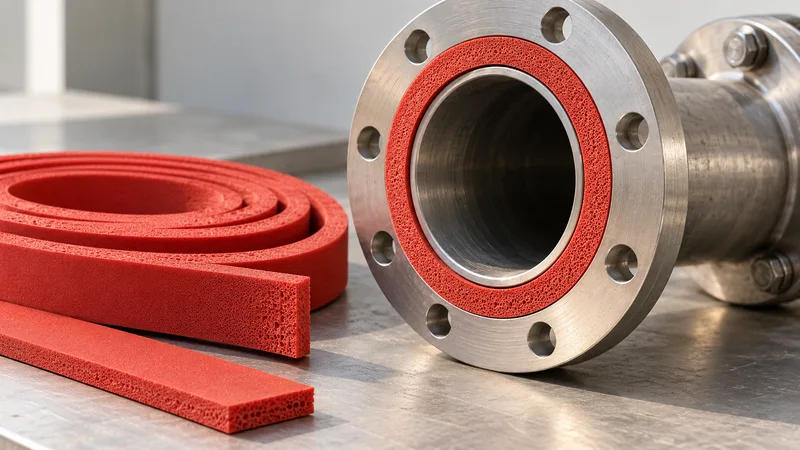
Choosing Silicone Foam for high-temperature sealing requires an interface and an exposure brief, not just a temperature adjective. Identify where the part sits in the piping or equipment assembly, what it contacts and which requirement the project must verify. The material discussion becomes useful when these conditions are explicit and tied to an approval owner.
The Silicone Foam material route follows the supplied Silicone Foam material information: high-temperature piping and electronic-equipment insulation/sealing. The material information directs selection by temperature and medium, without pre-guaranteeing a grade. It does not supply a universal numerical temperature range, flame class or complete-system rating. Treat those outcomes as project evidence questions.
Locate the foam within the actual assembly
Provide a section or drawing that shows the mating parts and the foam position. State whether the task is sealing, insulation-related separation or another defined interface function. These jobs can need different acceptance observations. Do not assume that one successful contact check answers every thermal or sealing question in the equipment.
Name the piping or equipment location instead of only writing industrial use. A pipe-adjacent interface and a part inside electronic equipment can have different access and exposure. The project owner should describe the actual surfaces and assembly constraints. The material family cannot infer them from an application label.
Mark the places where the foam must contact and the places that must remain clear. Show fasteners, service access and local changes in the interface where they affect the design. If a dimension is provisional, keep it marked. A supplier recommendation should not silently become an unreviewed redesign of the surrounding assembly.
- Piping or equipment interface drawing.
- Mating surfaces and contact/clearance zones.
- Installation and service-access sequence.
- Temperature and medium conditions.
- Acceptance requirement and responsible engineer.
Turn temperature language into controlled project inputs
State where the temperature requirement applies and how the project defines it. A broad label such as high temperature may explain the material shortlist, but it does not identify a grade or sample condition. Ask the engineer to describe the relevant location and evidence requirement without inventing a numerical limit from the family name.
Record whether the stated condition represents operation, assembly, cleaning or another project event. Those contexts should not be merged automatically. A component may experience different conditions at different steps. The record should identify the events that need evidence and who owns the decision to accept them.
Keep the grade discussion separate from the system requirement. The supplier can explain what record applies to a proposed material. The equipment or piping owner decides whether that evidence addresses the assembly. A material reference alone cannot prove the outcome of every interface, joining method or surrounding component.
If the current record lacks the relevant temperature evidence, leave the item open. Do not replace it with a common-looking range, a competitor statement or a general silicone claim. An honest evidence request is a stronger basis for selection than a numerical promise that the project cannot trace to the proposed grade.
| Selection input | State in the brief | Evidence boundary |
|---|---|---|
| Interface | Piping or equipment location, surfaces and geometry | Family name does not establish assembled sealing |
| Temperature | Condition, location and required evidence | No numerical range or universal class is confirmed |
| Medium | Actual substance and contact conditions | Compatibility must relate to the proposed grade |
| Format | Shape, thickness, joints and installation | Supply/conversion scope needs confirmation |
Name the medium and how it contacts the part
Record the actual substance or contamination source relevant to the interface. State whether contact occurs during operation, processing, cleaning or maintenance. Include the condition the project needs evaluated. A family description cannot establish compatibility with every medium, and a vague chemical-resistant label leaves the supplier unable to identify the right evidence question.
Ask whether the proposed grade record addresses that medium and condition. If not, identify the evaluation required and its owner. A sample might answer geometry while a compatibility question remains open. Keep these scopes separate instead of using a successful fit to close a medium requirement.
Where the assembly has more than one medium condition, list them individually. The record should not hide a cleaning exposure inside a general operating-environment line. The engineer can then decide which requirements are mandatory and which are exploratory. This structure avoids turning one material statement into a universal compatibility promise.
The resulting medium brief should follow the same drawing and configuration as the temperature brief. A different backing, joint or mating material can change the evidence question. Ask the supplier to identify those assumptions in any route proposal. Keep the complete interface visible through grade and format selection.
Choose a form that can be installed and inspected
Show the shape, thickness envelope, edges and local features required by the interface. Ask whether a sheet-cut, strip or custom-gasket route should be reviewed. These are format concepts, not confirmed stocked products. The current material information does not establish every dimension, backing or conversion method for every Silicone Foam grade.
Explain how the part is placed and how its position is checked. A continuous strip, joined form or cut outline can introduce different installation questions. Corners, starts, ends and service access belong on the drawing or assembly note. Do not rely on a product photograph to define the route.
The Silicone Foam format guide examines these details. Use it after the exposure conditions are described, because form and construction must remain connected to the grade evidence. A route that fits the drawing may still need a separate temperature or medium review.
Ask for proposed backing or joining details as explicit scope questions. Do not assume adhesive availability from the word gasket. If another material forms part of the construction, record its location and the requirement it must address. The assembly owner needs to understand the whole interface, not only the foam surface.
Read density and hardness without treating them as exposure ratings
The material information records density 150–350 kg/m³ and Shore C 10–40 as [需确认]. These are provisional material fields, not a validated grade table. They do not establish temperature capability, medium compatibility or assembled sealing. Request the proposed grade, method, specimen and tolerance rather than deriving a performance class from the range.
Density and hardness also answer different questions. The Silicone Foam density and hardness guide explains how to retain their method context. Do not convert a Shore scale informally or infer an installed contact result from one number. Geometry and assembly conditions need their own review.
The ASTM International catalogue provides method references, and the NIST measurement resources help discuss measurement context. These public sources do not certify a Green Foams grade or prove the interface. The project needs its own applicable record.
- Identify the interface and required outcome.
- Define temperature and medium conditions.
- Request the applicable grade and method records.
- Review form and installation in a representative setup.
- Release only the observations and evidence approved.
Close the choice with bounded assembly evidence
A representative sample should identify the drawing revision, mating parts and installation method. Decide what can be observed directly and what needs another evaluation. A contact or fit check can be valuable without proving a universal sealing life or temperature class. State its scope before using it to release the component.
The Silicone Foam industrial/electronics brief guide organizes this handoff. Preserve the exposure questions, proposed grade and form, acceptance owner and unresolved actions. Expected volume belongs in the inquiry, but unsupported production capacity, MOQ and delivery promises do not.
Review alternatives against the same interface. If a proposal changes the thickness, geometry, backing or installation order, record those changes next to the material choice. A result cannot be assigned to the family alone when the configuration changes at the same time. Ask the engineer which observations need repeating.
Finally, maintain the distinction between requirement and evidence. The project can ask for a temperature, medium or flame outcome without claiming it already exists. Keep unsupported items open until the applicable record is approved. That produces a useful Silicone Foam selection decision around a specific piping or equipment interface rather than a general promise about the material name.
Record why a proposal remains on the shortlist
A shortlist should connect each proposal to an identified interface question. One grade may need a temperature record, another construction may need a medium evaluation and another form may need a revised corner. These gaps lead to different next actions. Keep the reason beside the proposal so the next reviewer does not mistake an open route for an approved component.
If a supplier recommends another form or added material, ask which part of the original requirement it addresses. A simpler installation may be useful without resolving the exposure evidence. A new technical record may clarify a grade without approving the cut shape. Distinguishing these outcomes makes the selection discussion more precise than a single overall preference.
At receiving or assembly handoff, preserve the orientation and installation notes that made the sample reviewable. An operator should be able to identify the approved part and the surfaces it was reviewed against. If the actual assembly differs, record that difference and return it to the acceptance owner. The earlier evidence remains useful for its stated configuration, while the changed interface gets the review it needs.