Read the provisional ranges accurately
Rigid PU Foam density and compressive strength are separate fields in the client knowledge base. It records 30–200 kg/m³ and compressive strength 0.2–5 MPa, both [需确认]. These values frame a request for technical evidence; they do not establish a complete stocked-grade table or guaranteed purchasing limits.
Density describes the mass-to-volume relationship of an identified specimen. Ask for the method, measured specimen state and grade reference. Keep part mass separate from material density, especially when a shaped core includes pockets, facings or other components. An external envelope and a shipping weight cannot replace the specimen record.
- Record the controlled component and counterpart revisions.
- Identify thickness, orientation and critical interfaces.
- Keep unverified material and process fields [需确认].
- Assign the next evidence question to its owner.
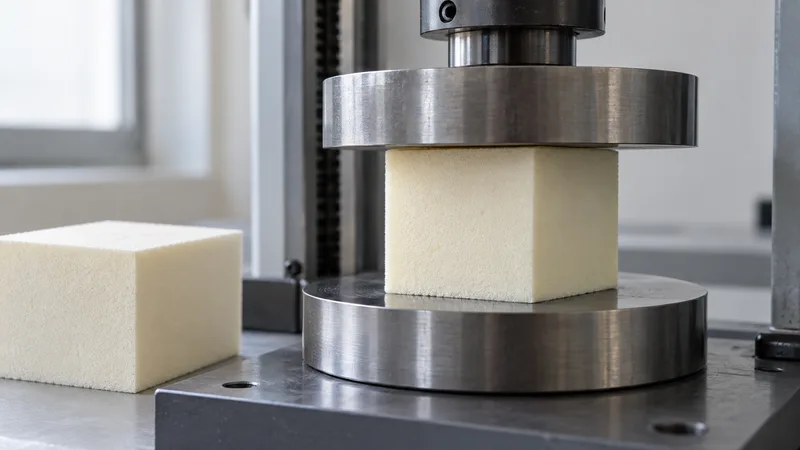
Compressive strength is reported as stress under a defined compression procedure and criterion. MPa is a stress unit, not a Shore scale or an indentation-force label. The proposed report must identify how the compression result was obtained and what endpoint or criterion the method uses.
Begin with the Rigid PU Foam product hub to identify the proposed grade and sample. Do not construct an invented density-to-strength table from the two source ranges. Their endpoints are not mapped to each other by the current record.
Ask what the compression result represents
A compression value needs its method and reported criterion. Ask the technical owner whether the report identifies a specified deformation, a maximum stress or another endpoint defined by the applicable method. Do not select a meaning from the number alone or assume every report uses the same criterion.
Retain specimen dimensions, loading direction, preparation and conditioning with the value. A direction identified in a report should be traceable to the material and the proposed component orientation. If that direction is missing, mark it unresolved rather than implying the result applies equally to every assembly load path.
Keep force and stress distinct. A force applied during testing and a stress reported for a specimen are related by the test setup, but a stress value is not an allowable load for a finished panel. The current article does not calculate panel capacity from provisional material data.
Ask for the specimen state associated with the record. A machined test piece, a formed sample and a component between facings can represent different configurations. The material evidence should describe what was tested; the engineering owner should decide whether it supports the current project question.
| Decision field | Input or record | Review purpose |
|---|---|---|
| Density | Mass relative to specimen volume | 30–200 kg/m³ [需确认] |
| Compression | Stress under stated criterion | 0.2–5 MPa [需确认] |
| Method | Procedure and reported endpoint | Do not rename an indentation scale |
| Specimen | Dimensions, state and direction | Compare compatible records |
| Assembly | Facings, geometry and load path | Separate panel approval |
When the report contains a curve or several result columns, retain the column heading used for the quoted stress and ask the report owner to explain its criterion. Do not replace that heading with the generic word strength in the purchasing record. A result associated with one deformation or endpoint should remain identified that way. The reviewer also needs to know whether the proposed acceptance field refers to an individual observation, a summary result or a requirement agreed for future supply.
Compare reports with consistent inputs
Create a comparison table with grade, density method, compression method, loading direction, specimen dimensions, conditioning and reported criterion. Two values in MPa may still be based on different inputs. Keeping these differences visible is more useful than ranking the records by the largest number.
Consult ASTM International and the ISO standards catalogue with the test owner to identify terminology and candidate methods. These public directories do not demonstrate that a Green Foams grade has a report or that a panel is certified.
If a report omits relevant conditions, request clarification. Identify the missing field and the decision it affects. An incomplete record can remain part of the inquiry, but it should not be converted into a guaranteed specification through an assumed loading direction, specimen thickness or acceptance threshold.
Preserve the original units and notation in the evidence record. If procurement needs a shortened description, make it point to the complete technical sheet. A shortened grade label should not erase the method or criterion that distinguishes one report from another.
Keep panel capacity and thermal performance separate
An installed core interacts with facings, bonding, supports and local attachments. Distributed compression through a facing and concentrated loading near an attachment are different engineering situations. Material compressive strength alone cannot establish the load capacity, safety factor or failure behavior of every panel geometry.
Thickness, unsupported regions, local recesses and interface details belong in the assembly drawing. The project engineer should identify which analyses or tests are needed. A core sample that fits between facings can support a geometry review while leaving structural evidence open.
Thermal performance is another evidence field. The knowledge base supplies no validated conductivity, thermal resistance or universal use-temperature limit for Rigid PU Foam. Density and compressive strength do not fill that gap. Ask for the relevant method and grade-specific record if insulation performance is required.
The core selection guide connects the material fields to those separate requirements. It helps a buyer identify the functional brief before treating a data value as a complete material decision.
Link specimens to processing and sample identity
Identify which material record applies to each sample route. A CNC-cut core, a planar layer and a molded proposal should each carry the proposed grade and relevant orientation references. A route change does not automatically preserve evidence relevance, even when the outside dimensions appear similar.
Use the format and processing guide to record datums, local features and inspection priorities. Actual stock dimensions, tolerances, equipment ownership and feature limits remain [需确认]. They cannot be derived from the density or stress range.
Record surface and counterpart conditions when they matter to the test or assembly. A bond face or local support may require another evaluation, while a trim edge can have a different inspection priority. Keep geometry checks and material tests separate so their approval scopes remain understandable.
When comparing samples, note what changed. A new grade, orientation, thickness, machining route or facing can affect the evidence question. The next action may be another defined specimen or assembly review instead of accepting a similar looking part as the same material construction.
For a specimen taken from proposed stock, request a sketch or reference identifying its location and direction relative to the finished core. Preserve any preparation described by the report, including whether a surface or local feature was removed. These records help the technical owner judge applicability when the supplied component is later machined or formed differently. They do not establish a direction-dependent property or process effect unless the relevant evidence is actually available.
Release each specification field with its evidence
Keep 30–200 kg/m³ and 0.2–5 MPa marked [需确认] until an applicable grade record is approved. Request actual measured values, method and tolerance for the proposed material rather than assigning guaranteed range limits to a purchase specification.
The cold-chain and construction brief carries these fields into procurement. It names the assembly, loading direction, facings, thermal questions and owners. This allows a material field to be approved without pretending every application requirement is complete.
If a source document and sample label disagree, preserve both identities and ask for resolution. Do not silently choose the value that suits the desired design. Update the controlled drawing, grade map and quotation assumptions together when the responsible owner confirms the correction.
A substitution request should provide the same evidence fields and identify changed variables. Have the engineer decide which specimen, dimensional and assembly checks require repetition. The practical purpose of reading density and strength is a traceable decision, not an unsupported calculation or an indentation-scale definition borrowed from a flexible material.
Avoid unsupported design calculations
A buyer may receive a stress result and ask for a quick allowable load. That calculation requires a defined geometry, load introduction, interface construction and engineering basis that the current source does not supply. Keep the material report as an input and refer the assembly question to the design owner rather than creating a universal core load rating.
The same caution applies to attempts to derive thermal performance from density. The client ranges do not contain a conductivity relationship, and a density-to-strength correlation is not supplied. An apparently convenient spreadsheet would create unsupported data if it interpolated those relationships without an applicable technical record.
If a project calculation is available, identify its owner, assumptions and the material inputs it uses. Ask whether the reported method and specimen direction match the proposed construction. A calculation can require another material record or assembled test; it should not erase the need for traceability.
Keep raw records, interpreted requirements and acceptance decisions in separate fields. This lets procurement preserve approved inputs without presenting an engineering conclusion as a supplier guarantee. The result is a specification that another reviewer can understand and revise when the grade or assembly changes.
- Define the component function and load or thermal question.
- Request the proposed grade and relevant methods.
- Review geometry, interfaces and processing scope.
- Preserve the sample identity, evidence and approval boundaries.