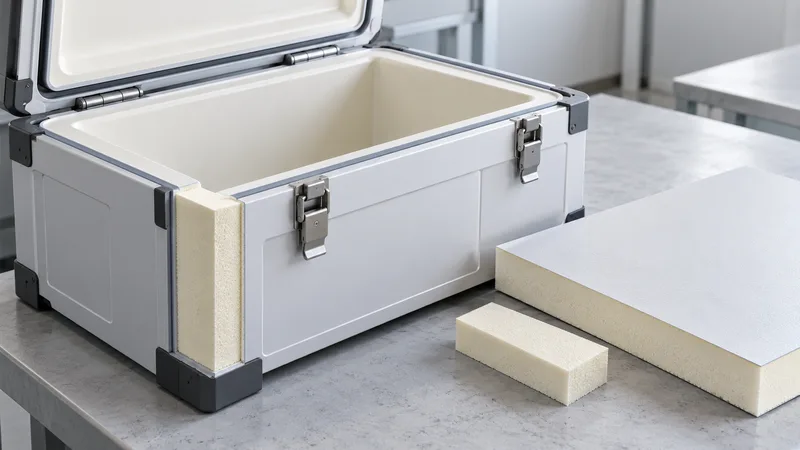
Identify the assembly and the request purpose
A Rigid PU Foam core brief for cold chain and construction should identify the component rather than begin with a catalogue range. The client knowledge base covers insulation layers, models and structural cores in building, cold-chain and industrial contexts. It does not provide a completed application case or a certified thermal or structural rating.
Record the project reference, drawing number, revision and owner. State whether the work concerns a planar insulation layer, a shaped industrial component or a core between facings. Identify which counterparts are supplied and which are still being developed. The purpose of the next sample should be understandable to engineering and procurement.
- Record the controlled component and counterpart revisions.
- Identify thickness, orientation and critical interfaces.
- Keep unverified material and process fields [需确认].
- Assign the next evidence question to its owner.
Provide a section drawing with thickness and facing references. Add local features, supports and attachments that influence the core. A top view can identify the envelope while missing the construction that controls thermal continuity, available depth or load introduction.
Use the Rigid PU Foam product hub to start the inquiry. Send the same controlled brief to every proposal reviewer. This makes commercial comparison possible without turning a generic material name into an assumed specification for the finished assembly.
Separate cold-chain and building conditions
For a cold-chain insulation request, ask the project owner to identify the actual assembly and relevant thermal conditions. Record surfaces, facing interfaces, local interruptions and how the component is used or stored. The brief should request evidence for these conditions instead of inventing a temperature range or conductivity value.
For a building component, identify its role within the proposed construction and who owns application requirements. A material family does not establish a fire classification, code approval or structural capacity. Record those requirements as questions with their applicable evidence plan rather than adding compliance language from an unrelated product.
An industrial model may prioritize dimensional fit and processing rather than a panel thermal rating. If that work shares the same inquiry, give it a separate component reference and sample purpose. Do not use the model approval as evidence for an insulation or load-bearing construction.
Reuse field headings when useful, while keeping their content specific. A cold-chain panel and a building layer can both ask about thickness and facings, but their counterpart conditions and acceptance owners differ. A traceable brief preserves that distinction during sampling and quotation.
| Decision field | Input or record | Review purpose |
|---|---|---|
| Assembly | Component function and controlled drawing | Identify what is being quoted |
| Conditions | Cold-chain or building requirement | Assign evidence owner |
| Interface | Facings, retention and local features | Confirm the actual construction |
| Grade | Density and compression stress records | Keep provisional ranges pending |
| Handoff | Sample scope and commercial exclusions | Compare equivalent proposals |
For the cold-chain record, ask the application owner which sides of the proposed insulation assembly define the thermal evaluation and where its boundaries are interrupted by attachments or neighboring parts. Mark those locations on the assembly section rather than adding an unsupported material temperature limit. Identify who provides the actual operating or storage conditions and who confirms the evaluation scope. A supplier can then distinguish a request for core material data from a request concerning the complete insulated construction and its interfaces.
Define thickness, interfaces and loading
Show nominal and local thicknesses, datums, steps, pockets and edge transitions. Name which dimensions control assembly fit, interface alignment or the functional requirement. If geometry may change after sample review, identify the exploratory fields so they are not mistaken for released production dimensions.
List facing materials, bond or retention proposals and interface preparation questions. Actual compatibility and interface strength remain [需确认] until the specific construction is evaluated. The word core does not include an automatically approved adhesive, facing or manufacturing process.
Describe the compression direction and where loads enter the assembly. Identify whether the core is supported continuously or interacts with local features. The engineer should define relevant evidence or analysis; a provisional material strength range cannot provide a universal panel load limit.
Record what can be inspected before the core is hidden. Thickness, pockets and interface features may need pre-assembly checks, while counterpart alignment can require an assembled sample. Giving these observations different owners and methods helps quality preserve the scope of each acceptance.
Attach grade and process evidence questions
Retain 30–200 kg/m³ and compressive strength 0.2–5 MPa as [需确认]. Ask for the proposed grade, density method, compression method, loading direction, specimen state and tolerance. Compressive strength is a stress result under an identified procedure and criterion, not a Shore or indentation hardness label.
The density and compressive-strength guide keeps these fields distinct. Request thermal evidence separately when needed because the source does not supply validated conductivity, thermal resistance or a universal operating range.
For manufacturing, use the sheets, blocks and CNC-cut core guide. State stock assumptions, orientation, feature access, tooling questions and inspection scope. Mold-in-foam and CNC are client planning directions whose actual capability requires confirmation.
Consult ASTM International and the ISO standards catalogue with the relevant owner for method language. Directory links do not certify the material, a processing route or the complete construction.
For a building request, include a responsibility entry for any application classification or construction approval that the project owner requires. Identify the document to be supplied and the assembly it must describe, including the facing and interface references. If the foam quotation excludes that evaluation, preserve the exclusion and the party responsible for obtaining it. The technical brief should make the remaining work visible at order review so that delivery of a shaped core cannot be interpreted as release of the whole building construction.
Plan the sample and acceptance record
Give the sample a controlled identity linked to the drawing, proposed grade and counterparts. State whether it is intended for machining review, assembly fit, interface evaluation or a defined test. A single sample can support several questions only when each setup and acceptance scope is documented.
Inspect dimensions and features before assembly. Record local thickness, datum relationships, pockets, edges and interface surfaces using the agreed method. If a dimension is still to confirm, leave it visible in the record instead of reporting the entire sample as fully approved.
Assemble the reviewed facings or supports where needed and observe fit, alignment and handling. Keep these observations separate from thermal or load evidence. A component that fits does not establish a conductivity result, interface strength, service life or regulatory approval.
Use the thermal and structural core selection guide if the trial exposes a new function or geometry question. Record which variable changed before ordering the next sample. This keeps development iterations purposeful rather than accumulating unidentified foam pieces.
Compare quotations against the same scope
Ask proposals to identify included and excluded work. Stock preparation, machining, molding, facing attachment, packing and formal tests can be different scope items. A custom-core request should not assume that all of these are automatically available or included under general OEM support.
Record expected volume and revision timing, then request actual commercial confirmation. The knowledge base does not establish universal minimum orders, production capacity, tooling costs or lead times. Keep those terms separate from the technical fields the engineering owner has already reviewed.
When a proposal changes the grade, thickness, processing route or facing interface, identify the deviation and affected evidence. A lower price may describe a different construction or approval scope. Procurement needs that difference stated before comparing the offers as equivalent.
Finish the handoff with accepted revisions, sample identity, evidence received, pending questions and the next owner. Reopen the relevant checks when the construction changes. A useful brief carries the project intent through quotation without turning provisional ranges or a fit trial into unsupported thermal, strength or supply promises.
Assign the unresolved items before handoff
Group open questions by owner rather than leaving a general note that everything is to confirm. The material owner can supply grade methods; the design owner can resolve thickness and loading; the process owner can confirm the proposed route; the application owner can identify thermal or compliance evidence. This turns uncertainty into concrete work.
For each open item, record the document or sample that would resolve it. A technical report, revised section drawing, interface proposal and dimensional inspection are different deliverables. Naming the required record helps the next reviewer avoid sending another generic material brochure when the project needs a specific answer.
Update the brief when a question is resolved and retain the revision history. A clarification that stays only in a message can conflict with an earlier quotation drawing. The controlled record should identify the accepted answer and the component or grade it covers.
At purchasing handoff, list any conditions that remain outside approval. A component may be accepted for machining geometry while thermal or application evidence is still pending. Preserving that boundary prevents an early development sample from being interpreted as a released construction with every requirement satisfied.
- Define the component function and load or thermal question.
- Request the proposed grade and relevant methods.
- Review geometry, interfaces and processing scope.
- Preserve the sample identity, evidence and approval boundaries.