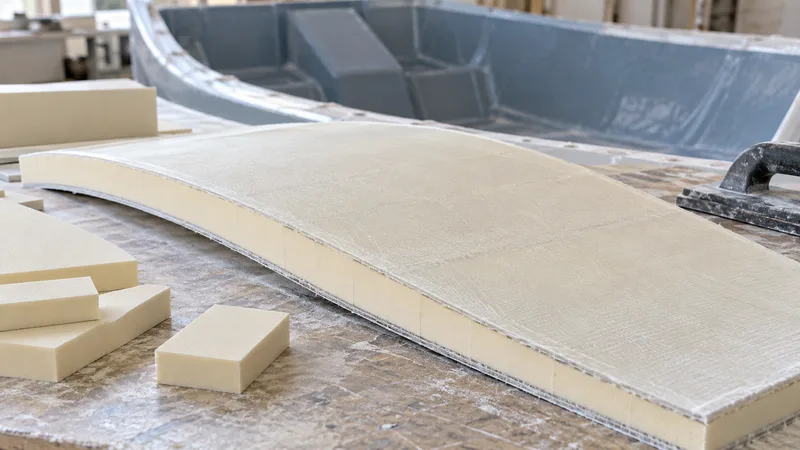
A PVC Foam core project brief should define the assembly and the next engineering decision, not merely name a material. Hulls, decks and wind panels can require different geometry and evidence. The brief needs the skins, core drawing, loading context and sample scope that make this particular request reviewable. Keep the project designer responsible for the actual structural requirements.
The PVC Foam route describes customer applications for hulls, decks and sandwich panels. Density and size customization is a discussion direction, with detailed supply scope still to confirm. This guide organizes the handoff. It does not claim a completed marine project, a wind certification or a guaranteed panel result.
Identify the assembly and controlled drawing
Name the component and its position in the wider structure. Provide the drawing revision and a section through the core and skins. The material supplier should understand whether the request concerns raw stock, a converted core or an assembled sample. Those scopes lead to different quotations and evidence questions.
Mark the drawing fields that remain provisional. A prototype can be useful before the design is complete, but the reviewer must know what it represents. If thickness, edge shape or an interface is not released, preserve that condition beside the sample identity. Do not let an early photograph become the final specification.
Identify surrounding components and any substitute parts used in the review. A sample core checked without the intended skin or adjoining piece has a limited scope. State that scope explicitly. A later assembly change should not inherit an observation made with different parts without the owner considering its relevance.
- Assembly/component name and application location.
- Drawing revision and controlled section.
- Skin and adjacent-core identities.
- Provisional dimensions and known departures.
- Requested material, conversion or panel decision.
Communicate geometry and local features
Show the external envelope, thickness changes, curvature and edges. Include openings, joints and local features where they belong to the design. A simple rectangle of dimensions cannot explain every shaped core. Let the drawing owner define critical features and mark questions that need a route recommendation.
Identify the reference surfaces used for checking the converted part. State which dimensions affect assembly and which are less critical or still provisional. Avoid assigning generic machining tolerances to fill missing fields. The supplier can identify proposed capability and inspection questions against the actual drawing.
If multiple core pieces meet, show their relationship and the intended assembly order. Mark orientation and identification needs where they help the panel manufacturer. A proposed rearrangement of pieces should return to the designer. It may change joints, handling and evidence requirements even when the material family stays unchanged.
The PVC sheet, block and machined-core guide helps compare conversion scope. Use it to distinguish raw stock from finished features. Keep the processing responsibilities visible rather than assuming that every quotation includes machining, shaping or joining.
| Brief section | Record | Decision owner |
|---|---|---|
| Assembly | Hull/deck/panel, skins and controlled section | Project designer |
| Core | Thickness, geometry, edges and interfaces | Drawing owner |
| Supply | Grade, form and conversion work boundary | Supplier and panel manufacturer |
| Evidence | Method, sample configuration and open requirements | Material/quality/assembly owner |
Describe skins, interfaces and the manufacturing boundary
Name the skins or facings proposed for the panel and the interfaces that matter to the sample. Ask the assembly owner which joining and processing conditions must be considered. The current application scope does not specify a universal skin system or bonding method. These details need the actual project configuration.
Record which operations belong to the supplier and which belong to the panel manufacturer. A core-only quotation should not silently become responsibility for the complete structure. A converted-part quotation should identify the drawing features it supplies. Procurement can then compare proposals without mixing work scopes.
Where a process condition needs material evidence, list it as a question and identify the owner. Do not invent a temperature, pressure or chemical window. Ask for the applicable grade record or evaluation plan. The designer can decide whether that evidence is suitable for the assembly being proposed.
Keep prototype departures visible during the manufacturing review. A temporary skin, simplified joint or substitute fixture can support an early question, but it may not represent the final panel. Record what the sample demonstrates and what still requires another configuration. A useful partial decision should have an explicit boundary.
Keep loads and material records in their proper scope
Identify the project load direction and local conditions that the designer wants considered. State the design requirement and its owner rather than asking the foam family to imply it. Raw material values can inform the discussion, but skins, joints and local attachments create assembly questions that need their own criteria.
The material information records density 40–250 kg/m³ and compressive strength 0.3–4 MPa as [需确认]. Keep them provisional. Ask for the proposed grade, method, specimen direction and conditioning. Do not derive a grade table or a panel capacity from these family-level ranges.
Compressive strength in MPa is a stress record, not Shore hardness or seal softness. Preserve that distinction in the brief and supplier response. The PVC density and compressive-strength guide explains how to keep method and specimen context attached to the material fields.
List other required properties or complete-panel outcomes as evidence requests. The current record does not establish universal fire, water, fatigue, life or industry approval. Name any relevant requirement and ask which evidence is supplied. An open project requirement is not an existing material result.
Prepare a sample around the intended next decision
Define whether the sample is intended to check geometry, conversion or an assembled-panel question. A converted core can be compared with its drawing. A panel sample needs the identified skins and interfaces. Do not merge these tasks into a broad approval phrase that leaves the configuration unclear.
State the observation or measurement method for critical features. A repeatable record names the feature, setup and result. It need not invent a complicated form. A photograph paired with the drawing location can support a geometry discussion, while an applicable material or panel test needs its own method and conditions.
Consult the ASTM International catalogue for method terminology and the NIST measurement resources for measurement context. These references do not prove a Green Foams result or certificate. Identify the actual evidence needed for the proposed sample.
- Name the sample and controlled configuration.
- Identify the geometry or performance question.
- Agree the relevant observation or test method.
- Record departures and unresolved requirements.
- Assign the approval owner and next action.
Make supplier alternatives visible as design choices
A supplier may propose another form, grade or piece arrangement. Ask the response to identify every departure from the brief. A simpler conversion route may be useful, but it should be reviewed by the drawing and assembly owners. Do not call it equivalent before the changed geometry and evidence requirements are understood.
Use the PVC structural-core selection guide when an alternative changes the application or design inputs. A different route can require another material record or sample setup. The existing sample approval should not be kept unchanged while the proposed configuration changes underneath it.
Record the reason for accepting, rejecting or retaining an alternative. One may need a drawing revision, another a grade record and another an assembled evaluation. These are different open actions. Clear disposition lets procurement follow the project without replacing missing evidence with a universal performance claim.
Release the bounded configuration to purchasing
Approval should name the drawing revision, proposed material/grade and observations accepted. Geometry can be accepted while another requirement remains open if that scope is stated. Keep the evidence owner visible for each unresolved item. A core shape approval does not release every structural requirement in a hull, deck or wind panel.
Include expected volume and the work scope at quotation handoff. Ask about tooling, process and delivery conditions without assuming universal capacity, MOQ or lead time. The material information does not supply those commercial promises. A request should be complete enough to discuss them without inventing default values.
Identify which changes trigger another review. A revised skin, thickness, joint, grade, process or local feature can affect the configuration. Retain the earlier sample record and state which observations need repeating. The project owner should decide the scope rather than relying on a similar visual appearance.
Finally, keep the drawing, material record, converted-part observations and panel requirements together but distinguish their roles. Another engineer should be able to identify what was proposed and what evidence supported the next step. That is a useful PVC Foam core project brief: a controlled structural-core handoff with no unsupported marine, wind or production promise.
Make the handoff understandable to the receiving and panel-assembly teams. They should be able to identify the approved core, drawing and orientation before processing begins. If a practical access or fit problem appears, record its location and configuration rather than changing the part informally. Return the proposed correction to the drawing owner.
The corrected drawing and sample record can then show which observation was repeated and which evidence remains valid. This keeps shop-floor feedback connected to the controlled structural-core decision without treating an unreviewed adjustment as a released new panel configuration.