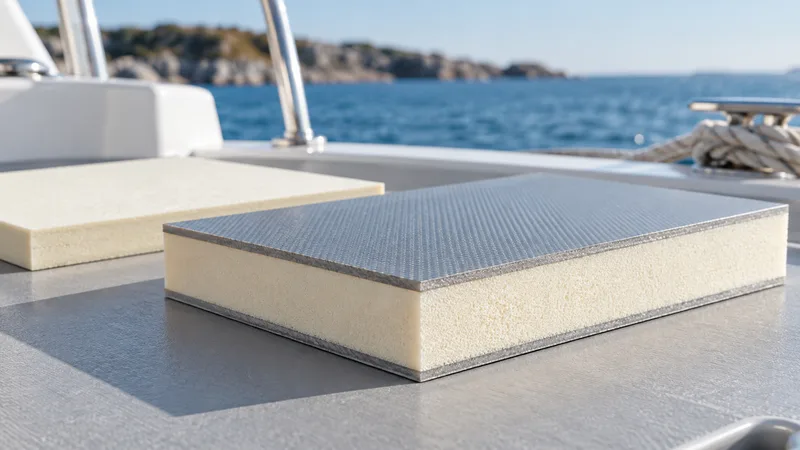
Choosing PVC Foam for marine and sandwich cores starts with the structure around the core. A hull, deck or panel includes skins, joints and local features that determine its design context. The foam family cannot select those features on its own. Define the assembly and its requirements before asking which grade or form should enter the review.
The PVC Foam material route follows the customer material information: hulls, decks and sandwich panels, with marine, wind and building applications. Its density and size customization directions remain subject to confirmation. This guide organizes an engineering request; it does not claim a completed vessel project, certified panel or universal structural result.
State the role of the core in the panel
Provide a section through the proposed assembly. Identify the skins and the core between them, together with joints, attachments and local changes in geometry. The project designer owns the structural requirements. The material request should communicate those requirements without pretending that a family-level description supplies the missing design approval.
Name the application location rather than only the industry. A deck panel, hull region and building sandwich panel may have different geometry and review conditions. Wind applications also need an identified component rather than a general wind label. Keep the application direction tied to the exact drawing and requirement being discussed.
Record what the sample needs to answer. It may be a fit check for a shaped core, a conversion trial or part of a panel evaluation. Those are different tasks. A loose core sample can support a material discussion while leaving skin bonding, local attachment and complete-panel questions for another review.
- Assembly name and drawing revision.
- Skin materials and interfaces.
- Core thickness envelope and local features.
- Load direction and project requirement owner.
- Planned material, conversion or panel sample decision.
Map the geometry before selecting a supply form
Show the core envelope and the features that affect processing. Include curvature, edges, openings and changes in thickness where they exist on the design. A simple length-and-width request cannot represent a shaped hull or deck core. Give the converter enough information to distinguish a flat stock concept from a shaped or machined part.
Identify joints and interfaces with other core pieces. State where the proposed part ends and which adjacent parts complete the panel. The designer should define any local support, relief or attachment zone that affects the core. Do not infer these features from a product photograph or invent them as a typical marine construction.
Record dimensional priorities rather than assigning unsupported tolerances. The project may care strongly about one mating edge or local thickness while another dimension remains provisional. Mark both conditions. The supplier can then propose a route and identify which features need capability confirmation instead of assuming every dimension has the same importance.
The PVC sheet, block and machined-core guide explores this geometry-to-format decision. Formats are review routes, not guaranteed stocked products. Density and size customization appears in the customer scope, but the actual machining, shaping and supply limits still need material-specific confirmation.
| Core decision | Project input | Evidence to request |
|---|---|---|
| Assembly | Hull, deck or sandwich panel and skins | Controlled section and design requirements |
| Geometry | Core thickness, curvature, edges and local features | Drawing and conversion scope |
| Loading | Direction, local attachments and project conditions | Applicable material and assembly evidence |
| Release | Representative core/panel configuration | Method, observations and approval owner |
Describe loads without converting them into a foam promise
Name the direction and location of the project loads that the designer wants considered. Identify local attachments, concentrated contacts or assembly conditions when they are part of the drawing. The material supplier needs this context, but the project designer remains responsible for deciding which material and assembly evidence is required.
Compressive strength is recorded as stress in MPa in the material information. It is not Shore hardness or a measure of how a seal feels under a cover. Do not replace structural-core questions with gasket closure language. A panel request concerns the core, skins, interfaces and design requirements, not a generic sealing contact band.
Density is another field with a different meaning. A density record does not by itself determine panel capacity, stiffness, water behaviour or service life. Ask how the proposed grade record relates to the project decision. Keep the method, specimen and conditions visible so comparisons are based on applicable evidence.
Where the design needs another structural property or a complete-panel result, state it directly as an evidence request. The current record does not provide a comprehensive property table. Do not create one from assumptions. An open engineering requirement is more useful than a fabricated number that appears to complete the material specification.
Review skins, joining and processing as assembly inputs
Identify the skins or facings and the proposed assembly route. The relationship between the core and skins is part of the panel design. Ask the project owner which joining or process conditions require evaluation. Do not assume a universal bonding system from the word sandwich or from a reference image of foam sheets.
If a proposed process affects the core geometry or material condition, include that question in the request. The supplier should confirm the applicable grade and processing scope. Keep any temperature, pressure or chemical exposure requirement as a project input unless the relevant evidence is available. Avoid assigning an unsupported manufacturing window.
Local features need the same discipline. An opening, fastener region or edge transition may require a separate drawing detail and review task. Mark it rather than leaving the material supplier to design it informally. A material recommendation should not silently become a redesign of the hull, deck or panel interface.
Record planned conversion operations and their owner. Ask which work is supplied and which belongs to the panel manufacturer. This makes the quotation scope easier to compare without promising in-house machining, capacity or delivery. The material information establishes a discussion direction, not every production detail.
Read provisional ranges as questions for the proposed grade
The PVC record lists 40–250 kg/m³ and compressive strength 0.3–4 MPa as [需确认]. These ranges are customer-provided planning records. They are not a menu of validated grades and do not prove that each density maps to a particular strength. Request the actual proposed grade and its technical record before making that comparison.
Ask for specimen orientation, dimensions, method and conditioning where applicable. A value without these details may not support the same question as another supplier's value. Preserve differences rather than treating every result in MPa as directly interchangeable. The PVC density and compressive-strength guide explains this reading framework.
Use the ASTM International catalogue for method terminology and NIST measurement resources for measurement context. These public references do not certify Green Foams material or prove a panel result. The project needs its own applicable grade and evaluation record.
- Identify the required property and design question.
- Request the proposed grade and method.
- Check specimen and condition context.
- Separate material data from complete-panel requirements.
- Keep unsupported outcomes open until evidence is approved.
Approve a representative configuration
Select a sample that answers the next project decision. A shaped core can demonstrate drawing geometry; an assembled panel sample can address an agreed assembly question. Record the configuration and the method for each observation. A successful shape check should not be summarized as proof of an entire marine or wind structure.
Keep the approval owner and open requirements visible. The current scope does not establish fire, water, fatigue, lifetime or industry certification. If the project requires those outcomes, define the applicable evidence and owner. Avoid borrowing a result from another material family or an unrelated reference application.
The hull, deck and wind-panel core brief turns the selection into a controlled handoff. Include the drawing, skins, format questions, required evidence and expected volume. Ask the supplier to identify deviations so the designer can review them before they become purchasing assumptions.
When the panel changes, check whether the previous sample still represents it. A new skin, local feature, thickness or process condition can alter the design context. Retain the original record and note which observations need repeating. Choosing PVC Foam means selecting a route for an identified core assembly, not assigning universal structural performance to a material name.
Record the design choice behind the shortlisted core
Keep a short reason beside each proposed route. The reason should connect the grade or form to a named assembly question, such as a local thickness feature, an edge interface or the need for a representative panel evaluation. A proposal can remain open because its material record is incomplete even when its shape is useful. Preserve that distinction in the shortlist.
If another core family enters the discussion, use the same drawing, skins and evidence requirements. PET and Rigid PU have different customer application scopes, so a comparison needs an explicit reason rather than a generic structural ranking. The panel designer should identify what would need to change in the configuration and which new evidence would be required.
At the next review, check that the original design question has actually been answered. A cleaner machining proposal might solve a delivery problem while leaving the panel requirement unchanged. A new material record might clarify a grade without approving the converted shape. Distinguishing these outcomes keeps the selection useful and prevents a single favourable observation from becoming a universal core performance claim.