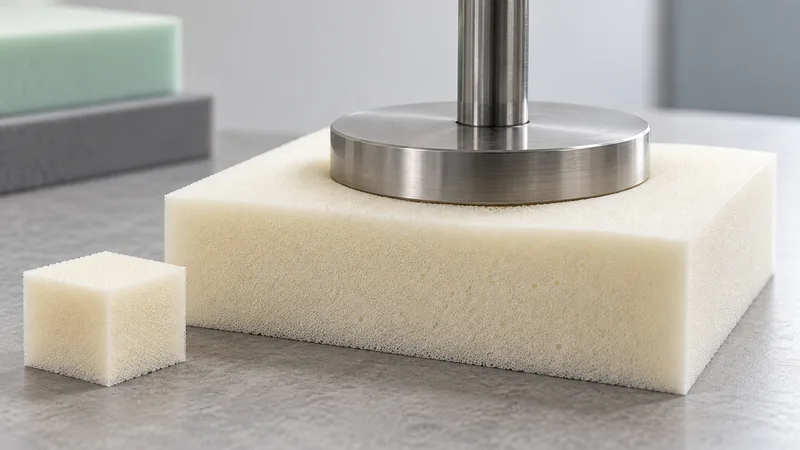
Read the density field as a mass-to-volume description
PU Foam Cushion density and ILD should appear as separate fields in a seating specification. Density relates the specimen mass to its measured volume. It does not directly state how far a covered cushion will deflect under a seated user, how its contour will feel or how long the finished seat will retain an approved response.
The knowledge base lists 25–70 kg/m³ as [需确认]. Keep that source range visible as provisional information, then ask for a proposed grade and its actual technical record. Do not divide the range into invented product grades or imply that every intermediate value is available from Green Foams.
Request the specimen description and measurement method. State whether the record refers to a loose material sample or a specimen associated with the proposed formed cushion. Ask how the volume was determined and what conditioning and tolerance accompany the value. These details help explain a result instead of leaving procurement to interpret an isolated number.
- Keep the seat, cover and base revisions identified.
- Record the proposed material and unresolved evidence separately.
- Assign an owner to the observation or specification question.
Cushion geometry also matters when interpreting mass. A deep contour, an underside pocket and a flat pad can have different volumes even at the same outside envelope. Keep total part mass separate from material density. A photograph or a shipping weight cannot establish the density of a proposed grade.
Start with the PU Foam Cushions product page to connect the material record to the project. If the seat geometry is still unresolved, use the seating selection guide before asking a density number to make the design decision.
Keep the complete 25% ILD notation
The source records 25% ILD 100–350 N/314cm² as [需确认]. ILD refers to an indentation load or force observation made under an identified method. The percentage tells the reader which indentation condition is being discussed; the force unit and loading area retain context. Removing these fields can make unlike results appear interchangeable.
Ask the test owner to identify specimen thickness, loading surface, preparation, conditioning and the point at which the force was recorded. Retain the procedure reference beside the value. The current client record does not establish that its provisional range was obtained from one method or one specimen construction.
Do not rename the field “Shore hardness.” An indentation force record and a Shore scale record are different descriptions. Do not convert the source force and area into a universal seat pressure or a user weight recommendation. The seated load path, cushion shape, cover and base have not been defined by that notation.
Two ILD records can share a number while differing in indentation percentage or sample thickness. Keep those differences visible in the comparison table. If a report omits its area or specimen conditions, mark the field as unresolved and ask for clarification before ranking candidate materials.
When a project needs a different indentation condition, request the applicable record. A designer may want to understand a different portion of the response, but the site knowledge base does not provide a supported conversion relationship. A calculated substitute would obscure the missing evidence instead of answering the specification question.
| Decision field | Project input | Review purpose |
|---|---|---|
| Density | 25–70 kg/m³ [需确认] | Grade, method, specimen volume and tolerance |
| ILD | 25% ILD 100–350 N/314cm² [需确认] | Percentage, force, area, thickness and conditioning |
| Assembly | Seat base and cover | Keep local contour and support visible |
| Approval | Sample and drawing revision | Record differences before substitutions |
Check conditioning and specimen comparability
A useful comparison starts with matching questions, not merely matching values. Record sample identity, thickness, conditioning, method and test date for each candidate. Ask which variables were held constant and which changed. This makes an engineering discussion possible even when two records cannot be treated as directly equivalent.
Conditioning belongs beside the result because the evaluation setup defines what was measured. Ask how the sample was stored and prepared before testing and which environmental conditions the procedure required. Do not publish an unverified temperature range for the foam or assume a laboratory result represents every seating environment.
Specimen thickness and support can influence an indentation observation. Retain them in the record rather than assuming a test sample duplicates a deep contoured cushion on a seat pan. A test coupon may be useful for grade identification while an assembled cushion is still needed to review the project geometry.
Use the ASTM International catalogue and ISO standards catalogue with the test owner to identify terminology and candidate methods. These catalogue references do not prove that a Green Foams grade was tested or that a result satisfies an automotive seat requirement.
Keep a report difference log. If one sample was tested at another thickness, another loading area or another conditioning state, document the difference explicitly. The next action may be to request comparable specimens rather than choosing the larger number. This protects both the engineering decision and the quotation comparison.
Relate specification values to the installed seat
An installed seat combines the cushion with the base, cover and attachments. A nominal density and ILD pair therefore identifies only part of the construction. Show the seating section, support surface, local thicknesses, cover seams and retention method when asking a reviewer to interpret the proposed grade.
Consider the front edge separately from the central sitting area. The local contour and underlying support can differ, so a hand press at the center does not describe the whole seat. A backrest or equipment cushion may involve another contact direction. Name the positions and locations that the project owner needs evaluated.
Keep geometry changes distinct from grade changes. If one sample is thicker, another has a new underside pocket and a third uses another cover, a seated comparison can still be informative, but it is a construction comparison. It cannot isolate density or ILD without additional controls.
Record the observations in plain language. A reviewer might note cover wrinkling, hardware contact, limited adjustment clearance or a difference in the reference seated position. These observations help define the next prototype. They should not be rewritten as a universal comfort score, fatigue result or ergonomic claim.
If the project needs load response, durability or safety evidence, define the evaluation method with the responsible owner. Density alone does not establish those outcomes, and an informal seated sample does not replace a formal requirement. Keep the proposed grade linked to the exact cushion and assembly used for the evidence.
Write a specification that purchasing can preserve
Create separate fields for material family, grade reference, density, ILD notation, method, thickness and tolerance. Add sample number, drawing revision and cover/base references. This record lets procurement ask a focused question when a supplier proposes a substitution instead of accepting a similar sounding material label.
Keep provisional source values marked [需确认] until approved. The range 25–70 kg/m³ and 25% ILD 100–350 N/314cm² can guide a data request, but it cannot become a guaranteed purchase limit without a grade-specific technical record. Do not add unconfirmed stock positions, manufacturing capacity or delivery promises to a specification table.
When the cushion is contoured or molded, include the local sections and measurement datums that matter. Use the shapes and molded options guide to clarify which geometry is being discussed. A specification sheet and a drawing should describe the same sample rather than separate imaginary products.
Before release, assign owners to open questions. Engineering may own the selected grade and geometry; quality may own the inspection method; the seating owner may approve the assembled response. A buyer should be able to distinguish an approved field from a question still waiting for evidence.
The seating project brief carries these fields into quotation and sample approval. Preserve the approved record when a cover, base, thickness or material changes. Repeating the necessary checks is more useful than asserting that the replacement has “the same density.”
Handle incomplete or conflicting reports
An incomplete report should produce a clarification request, not an invented value. Identify the missing field, explain the decision it affects and ask the record owner to supply the supporting method or specimen information. For example, an ILD force without its indentation percentage cannot safely be treated as the source 25% ILD field.
If a sample label and technical sheet disagree, preserve both references and mark the comparison unresolved. Ask which document identifies the proposed grade and whether the sample was made from that construction. Do not silently choose the value that looks closer to a desired seating response. The drawing, sample and report must remain traceable to each other.
Keep any translated notation alongside the original units until the technical owner confirms it. A shortened purchasing description may be convenient, but it should point back to the complete approved record. This makes a later substitution review possible without reconstructing the evidence from email fragments or loose sample labels.
A report can support one question while leaving another open. Accepting a specimen identity does not establish seated comfort, and receiving a density record does not establish an ILD tolerance. Release each field according to its evidence rather than treating the presence of a datasheet as blanket material approval.
- Confirm drawing and counterpart identities.
- Review the proposed cushion in its intended assembly.
- Record observations, open questions and approval scope.
- Recheck affected conditions when a component or grade changes.