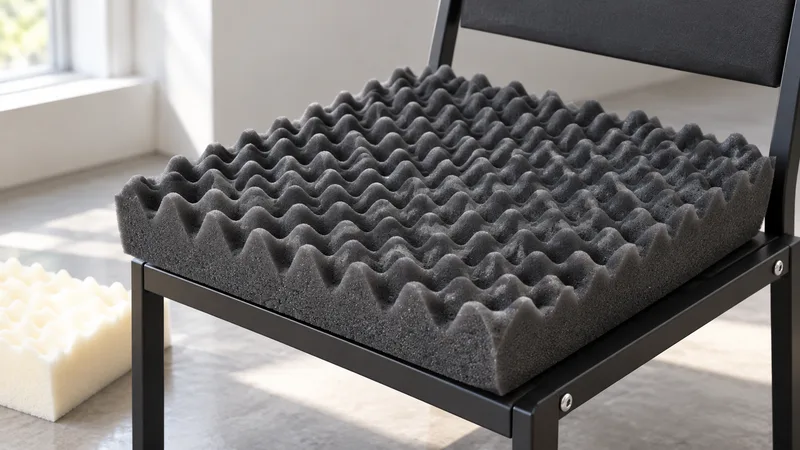
Describe the seat before choosing the foam
Choosing PU Foam Cushions for seating begins with what supports the cushion and what surrounds it. The client knowledge base identifies office chairs, automotive seats and equipment cushions as application directions. Those directions help organize a brief; they do not identify a proven grade or establish comfort, safety or fatigue performance for a particular finished seat.
Attach a plan view and a section through the sitting area. Mark the base, backrest transition, front edge, arm or frame clearances and attachment points. Indicate whether the base is continuous, contoured or interrupted by hardware. A cushion can have the same outer dimensions as a reference part while meeting a different support surface underneath.
Describe the seated position that the project wants to review. Record where contact is intended and where clearance is needed for clothing, equipment or seat mechanisms. If several positions matter, name them separately. A loose sample pressed by hand cannot communicate how the installed cushion interacts with the base and cover during those positions.
- Keep the seat, cover and base revisions identified.
- Record the proposed material and unresolved evidence separately.
- Assign an owner to the observation or specification question.
Use the PU Foam Cushions product page as the starting point for the material discussion. Send the seat reference, drawing revision and open questions together. This lets the reviewer see whether the request concerns a new seat design, a replacement cushion or an adjustment to an existing assembly.
Avoid starting with an unsupported claim such as “ergonomic foam.” Instead, describe the problem the team will observe: interference at the frame, a cover that wrinkles, an unclear support zone or a thickness that consumes adjustment space. These are reviewable inputs and can guide a useful sample without inventing a measured user benefit.
Map support zones, thickness and cover interaction
Seat support is an assembly question. Identify the sitting region, transition to the front edge, lateral contours and any back support area included in the cushion. Show the section at each important location. A nominal overall thickness can conceal local thinning, a raised edge or a base pocket that changes the available material beneath the user.
Record where a contour is intended to locate the user and where it is mainly a visual shape. Ask the seating engineer which dimensions must be held and which may be revised after evaluation. Keeping this distinction explicit prevents appearance requirements from silently controlling a support decision.
The cover belongs in the evaluation record. Note fabric or other cover construction, seam location, backing, attachment method and the assembly sequence. A tight cover may change the way a contour is presented, while a loose cover can hide the geometry. Neither condition should be assumed from an uncovered foam photograph.
Compare the cushion with the actual cover and base, then observe the intended seat positions. Record front-edge clearance, hardware access, visible folds and movement between components. Keep personal preference observations separate from dimensional findings so that the team can decide who owns each type of approval.
If a supporting layer, insert or adhesive is proposed, treat it as a separate scope item. Request construction details and relevant compatibility evidence rather than inferring them from “custom cushion.” A change to an underlying layer may require another seated sample even if the visible surface shape stays the same.
| Decision field | Project input | Review purpose |
|---|---|---|
| Seat base | Support surface and hardware | Check clearance and seating envelope |
| Cover | Construction, seams and attachment | Review with the proposed contour |
| Material | Density and ILD with method | Keep provisional records [需确认] |
| Sample | Assembly, reviewer and conditions | Separate fit from comfort and compliance |
Use density and ILD without turning them into comfort promises
The knowledge base retains 25–70 kg/m³ and 25% ILD 100–350 N/314cm² as [需确认]. These are provisional source ranges. They are not a list of confirmed stocked grades, a purchasing tolerance or a map from foam to a guaranteed seating experience. Ask which proposed grade and test record apply to the sample being discussed.
Density describes mass relative to volume. ILD describes a force measured at a specified indentation under an identified procedure. Keep the percentage, force unit, loading area, specimen thickness and conditioning with the result. The source notation 25% ILD must remain attached to its context instead of being shortened to “hardness.”
A sample comparison should hold relevant assembly variables steady. If density changes, record whether ILD, thickness or contour also changed. If ILD changes, record whether the cover or base changed. This does not make every variable identical; it makes the differences visible enough to interpret the seated observation.
The PU cushion density and ILD guide explains the specification fields in more detail. Use that vocabulary to request data, then bring the data back to the seat drawing. A material number cannot replace the evaluation of the assembled cushion.
For method terminology, consult ASTM International and the ISO standards catalogue. These references are starting points for selecting a method with the project engineer; they do not certify Green Foams foam or establish an automotive seating approval.
Choose a form that can be assembled and inspected
Flat pads, shaped cushions and molded concepts solve different geometry questions. A flat pad may allow a simple thickness comparison. A shaped cushion can communicate transitions and pockets. A molded route can be discussed when the project needs a defined three-dimensional form, but its tooling and manufacturing scope must be confirmed for that project.
Review how the cushion reaches the seat frame. State the placement direction, orientation marks, retention features and whether the cover is fitted before or after placement. A shape that looks correct on the bench may obstruct an attachment tool or require a handling step that was not included in the original brief.
Define inspection access alongside geometry. Some dimensions can be checked before covering; others require an assembled seat. Identify the base-facing surface, contour datums and important local sections. If a cover conceals a feature, decide how that feature is identified and inspected before it disappears from view.
Use the cushion shapes and molded options guide when the form is still open. Compare candidate routes using the same seat envelope, cover and inspection priorities. Actual molding, inserts, dimensions and tolerance remain [需确认] until the route is agreed.
Expected volume and revision timing help frame a manufacturing discussion. They do not establish a minimum order, stock position, lead time or production capacity. Keep commercial confirmation visible in the request so that an engineering preference does not accidentally become an unsupported supply promise.
Plan the seated sample before accepting a proposal
Prepare a sample sheet with the drawing, base reference, cover revision and material identity. State the intended evaluation positions, installation order and reviewer. The goal is to compare the proposed construction against an agreed setup, not to ask a reviewer to make a broad comfort judgment from an unidentified foam piece.
Inspect the cushion before covering and after assembly. Look for fit against the base, contact with hardware, contour position and the behavior of the cover at seams and edges. Record installation difficulty and any difference from the reference assembly. Photographs can supplement the record when their configuration and permission to use them are clear.
Separate geometry approval from user evaluation and from required tests. A manufacturing reviewer may approve placement; a design reviewer may approve appearance; a seating owner may review seated response. If fatigue, safety or compliance evidence is required, identify its method and owner rather than calling an informal sitting trial a completed test.
Record which changes require another sample. Changes in cover tension, base geometry, thickness, contour, supporting layer or proposed grade may alter the assembly. Keep the approved sample identity and unresolved questions together so a later quote can be compared against the decision that was actually made.
For the procurement handoff, use the office, auto and equipment seating brief. It turns the reviewed seat into a controlled request with owners, revisions and evidence questions. A useful selection ends with a traceable construction and a clear next action.
Compare candidate samples with a useful decision log
Name the decision being compared before placing samples side by side. A thickness trial can ask whether the seat mechanism retains clearance; a contour trial can ask whether the front edge aligns with the cover; a material trial can ask how the same construction responds under an agreed seated evaluation. These are different comparisons and should not share an unexplained pass or fail label.
Give each candidate a sample identity and list changed variables. Ask the reviewer to describe an observation and the location where it occurred. If one candidate is preferred, record the reason and any remaining question. Procurement can then understand whether the preferred construction requires a new cover, another base feature or a different material record.
Retain an approved reference when permitted by the project. It helps explain a future revision without converting a subjective comment into a measured result. The next sample should answer the unresolved decision rather than repeat a broad request for better foam.
- Confirm drawing and counterpart identities.
- Review the proposed cushion in its intended assembly.
- Record observations, open questions and approval scope.
- Recheck affected conditions when a component or grade changes.