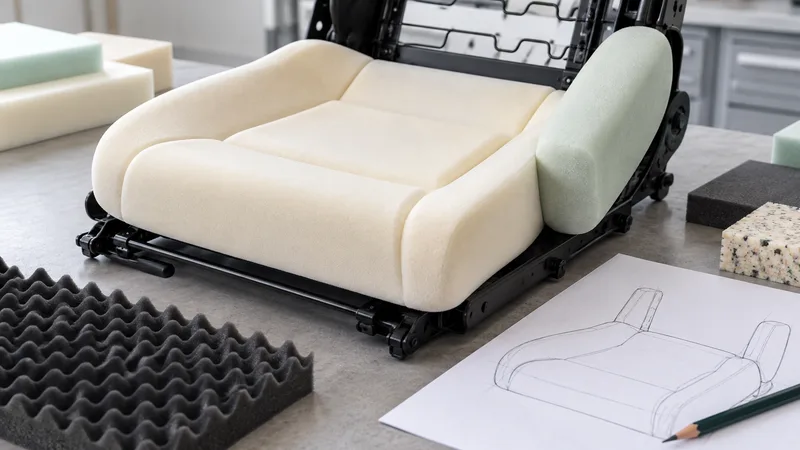
Give the seating project a controlled identity
A PU Foam Cushion brief for office, auto and equipment seating should begin with the assembly identity. Record the seat or equipment reference, cushion drawing number, revision, project owner and purpose of the request. State whether the work concerns a new design, an existing replacement or a change to a current cushion.
Provide the seat base and cover references with the cushion drawing. A cushion outline without its counterparts cannot communicate the support surface, clearances or installation sequence. Mark which components are fixed and which may be modified after evaluation so the converter can suggest a route within the actual design boundary.
Describe the intended seat positions and contact regions. A central sitting area, front-edge transition, back cushion and equipment contact pad can involve different directions and access constraints. Name the regions that require review instead of using an unqualified request for “comfortable foam.”
- Keep the seat, cover and base revisions identified.
- Record the proposed material and unresolved evidence separately.
- Assign an owner to the observation or specification question.
The client knowledge base lists office chairs, automotive seats and equipment cushions as PU application directions. It does not establish completed projects, certifications or measured comfort results for those applications. Use the directions to organize the request, then make project-specific evidence and capability questions explicit.
The PU Foam Cushions product page is the hub for this discussion. Attach the same controlled record to each quotation request. That consistency lets procurement compare proposals against a seat construction instead of comparing unexplained material names.
Separate office, automotive and equipment conditions
An office-chair brief should identify adjustment positions, frame and seat-pan references, cover attachment and the sitting configurations selected by the project owner. Record whether the cushion is reviewed independently or as part of the complete chair. Keep appearance observations, seated response and any required formal testing in separate fields.
An automotive-seat brief needs the responsible program owner to identify interfaces and applicable requirements. Record neighboring components, attachment references, available space and any equipment that affects cushion geometry. Do not infer compliance, fire behavior or safety suitability from PU density or ILD values.
An equipment cushion may involve a different contact direction, access restriction or maintenance sequence. Describe the equipment surface beneath the cushion and how the operator installs, uses and removes it. If the term “seat” is being used loosely for a contact pad, clarify the function before selecting a sample configuration.
Record environment as a question with an owner. Temperature, storage, cleaning and other exposure requirements need project-specific conditions and evidence. The knowledge base does not provide a verified operating range or a universal compatibility result for these seating applications.
Keep a common brief template while preserving these differences. The same field headings can help coordination, but the contents and approval scope must belong to the actual assembly. A chair sample accepted for one use cannot become evidence for an automotive or equipment construction through a change of title.
| Decision field | Project input | Review purpose |
|---|---|---|
| Identity | Seat, cushion drawing and revision | Designer and purchasing owner |
| Context | Office, auto or equipment conditions | Application and evidence owner |
| Counterparts | Base, cover, hardware and layers | Assembly reviewer |
| Material | Density and full ILD notation | Technical record owner |
| Release | Sample configuration and open questions | Named approval scope |
Specify geometry, cover and manufacturing questions
Provide a plan view and local sections with seat datums. Mark total envelope, central thickness, front-edge contour, underside pockets, lateral transitions and important clearances. Explain which dimensions control support, which control hardware access and which are primarily visual. This helps prioritize questions during drawing review.
The cover record should include construction, seams, attachment references and fitting sequence. If the supplier is only reviewing the foam, state that cover development remains with another owner. If the covered assembly is the requested sample, specify the counterpart revision and how it will be supplied for evaluation.
List proposed inserts, bonding, layers and orientation features individually. These are capability questions, not automatic inclusions in a custom cushion request. Ask which features are part of the proposed route and which need further review. Retain [需确认] where dimensions, conversion tolerances or process scope remain unverified.
The shapes and molded options guide helps compare flat, contoured and molded concepts. Use its drawing priorities in the brief, then ask the manufacturer to confirm tooling and finishing assumptions for the particular construction.
Expected volume, packing, identification and revision timing belong in the request. They give the reviewer context for a process proposal, while actual minimum order, lead time, cost and stable capacity remain commercial confirmations. Do not publish them as established terms without an approved client record.
Attach density and ILD as evidence fields
Retain the source values 25–70 kg/m³ and 25% ILD 100–350 N/314cm² as [需确认]. Ask for the proposed grade, density method, indentation procedure, specimen thickness, area and conditioning. A brief should preserve the full notation rather than compressing it into an ambiguous “hardness” field.
Use the PU cushion density and ILD guide to keep the measurement vocabulary consistent. Density and ILD can support a material comparison, but they do not establish comfort, fatigue life, safety or the response of a finished covered seat.
Assign an evidence owner to each requirement. Engineering may request a material record, quality may define specimen or part inspection, and the program owner may define an application test. Ask which information can be observed in the sample review and which requires another approved evaluation.
Refer to ASTM International and the ISO standards catalogue with those owners when clarifying terminology. These public references do not mean the proposed grade has a report or that the whole seating system is certified.
Keep missing evidence visible. A supplier may be able to propose a sample while a specification field remains unresolved, but the approval record must state that boundary. It is better to ask a focused follow-up than to convert a planning range into a purchase requirement that nobody has confirmed.
Define sample acceptance and revision handoff
Prepare the sample review with the actual seat base and cover wherever practical. Identify the sample, drawing, material proposal and assembly configuration. State the installation order and chosen seating positions. The reviewer should know which question the sample is intended to answer before making observations.
Check dimensional fit and assembly access first. Inspect the base-facing surface, contour location, cover seams, attachments and surrounding mechanisms. Record changes needed to install the sample. Then ask the responsible seating reviewer to assess the intended positions under the agreed conditions.
Keep separate decisions for geometry, appearance, seated response and formal evidence. A fit approval does not prove comfort, a user comment does not prove fatigue resistance, and a material record does not establish system compliance. Each decision should name its owner and the scope of the accepted configuration.
Use the seating selection guide if the sample reveals an unresolved support or geometry question. Revise the appropriate component and record which variables changed. If the cover, base and material all change, identify the next sample as a new construction review.
Close the brief with an approved revision list, sample identity, remaining questions and next action. Preserve that record during quotation and any later substitution. A controlled handoff gives engineering and purchasing the same basis for discussion and avoids turning an informal seating trial into an unsupported manufacturing or performance promise.
Prepare a quotation comparison without losing the seat intent
Ask each proposal to identify its assumptions. A supplier may suggest a changed contour, a different material record or another forming route. Capture those differences alongside the original requirement so purchasing can see what is being offered. Two prices describe comparable work only when the cushion, cover, sample scope and open evidence are understood.
Separate optional scope from the baseline request. Tooling, cover fitting, inserts, additional layers, packing and formal testing may be included or excluded. Request a clear description without assuming that custom manufacturing includes every item. The client knowledge base does not establish universal commercial terms for these services.
State how the project will respond to an alternative. A revised material can require another seated review; a different underside feature can require a clearance check; a cover change can require fitting approval. Let the responsible owner decide the necessary evidence before procurement treats the proposal as equivalent.
Preserve correspondence that resolves an assumption by updating the controlled brief. A clarification should become an identified drawing or requirement revision rather than remaining in an untracked message. This gives the next reviewer an understandable basis for sampling and avoids conflicting instructions reaching assembly or quality.
When the project is handed to another buyer, include the accepted proposal boundaries and unresolved items. The new buyer should know which construction was reviewed, which evidence is still pending and who can approve a change. A brief that supports this handoff is more useful than a long list of unsupported material benefits.
- Confirm drawing and counterpart identities.
- Review the proposed cushion in its intended assembly.
- Record observations, open questions and approval scope.
- Recheck affected conditions when a component or grade changes.