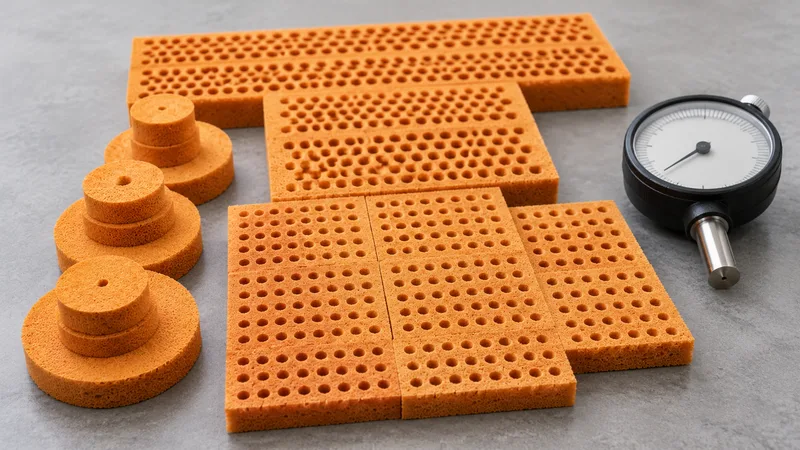
A natural rubber foam density and hardness guide is useful because two numbers can look like a complete material decision when they are only part of a specification record. Density and Shore C describe different observations. Thickness, contact area, load direction and the fixture change the installed response. The Green Foams planning record keeps the NR Foam ranges provisional, so this article focuses on asking for comparable evidence.
The Natural Rubber Foam product page describes the material route for pads, bumpers and grips. It does not replace a grade-specific TDS or a project sample. Use the page to start a brief, then keep the numbers, methods and drawing revision together in the review package.
Separate density from indentation hardness
Density is a mass-to-volume relationship for a stated specimen. It can help a team describe a material family and compare records made with the same method. It does not reveal the complete behavior of a corner, a narrow contact band or a pad around a handle. Ask for the unit, specimen, thickness, conditioning and tolerance with the value.
Shore C hardness is an indentation response on a stated scale. It offers another comparison field, but it is not a direct reading of installed cushioning force. A broad bumper and a thin grip pad can show different assembly responses even when their hardness value is similar.
Keep density and hardness in separate columns in a request for quotation. Ask whether each number is typical, nominal or a release criterion. If a record omits the method or grade, mark the field open rather than treating it as a universal property.
| Field | What it describes | What to request |
|---|---|---|
| Density | Mass per volume for a stated specimen | Value, unit, method, specimen and tolerance |
| Shore C hardness | Indentation response on a stated scale | Scale, method, conditioning, thickness and grade |
| Thickness | Section available at the interface | Nominal, critical zones and permitted variation |
| Geometry | Contact area, edges, holes and reliefs | Controlled drawing, datums and revision |
| Compression response | Observed result for a defined setup | Fixture, direction, conditioning and acceptance owner |
The current planning range is 60–200 kg/m³ and Shore C 10–40, both marked [需确认]. These numbers support an information request; they do not establish stocked grades, tolerances or a compression result. Do not create intermediate grades or a load table from them.
- Record units and methods directly beside density and hardness.
- State specimen thickness, conditioning and measurement timing.
- Ask which grade and construction the quoted value belongs to.
- Keep rebound, fatigue, comfort, traction and compression-set outcomes [需确认].
Connect a value to thickness and geometry
Thickness controls the space available for a pad and the path through which a cover, handle or stop moves. A value that looks acceptable on a flat drawing can interfere with a shoulder or fastener when the assembly closes. Show nominal thickness, critical thin zones and local reliefs on the controlled revision.
Contact area changes the question again. A broad plate distributes a load over one region; a narrow rib or corner concentrates contact. A density or hardness value should therefore be reviewed with contact width and load direction. Keep the assembly orientation beside the material record.
Cell structure and cut geometry can also change the way a sample is handled. The customer record allows open-cell or closed-cell selection as a discussion route, but it does not confirm a universal cell structure, rebound value or environmental performance. Request the proposed construction and compare it in the intended setup.
| Shortcut | Why it fails | Better record |
|---|---|---|
| Pick the middle of 60–200 kg/m³ | The range is provisional and method-dependent | Ask for a grade and measured method |
| Treat Shore C 10–40 as a load scale | Indentation is not installed force | Review hardness with thickness and geometry |
| Compare numbers without units | Specimens and methods may differ | Keep units, method and specimen beside values |
| Approve a loose coupon | The contact and closure are absent | Use a representative assembled sample |
| Reuse a result after a drawing change | A new section changes the setup | Open a new comparison and revision record |
For public terminology and standards research, use the ASTM International standards catalogue and the ISO standards catalogue. Select the method with the project team. These catalogues do not validate a supplier grade, establish a compression target or certify a cushion application.
If thickness changes while hardness stays the same, record it as a new comparison. If the contact width changes while density stays the same, record the geometry change. This simple change log prevents a result from one setup from being reused as evidence for another.
Request a method, not only a number
A technical data request should identify how each value was produced. Ask for the test method, scale, specimen, thickness, conditioning, units and tolerance. Ask whether the value is typical or a release limit and whether the record belongs to the material that will be sampled.
Use precise field labels. “Hardness 20” is incomplete if the scale and method are missing. “Density 120” is incomplete if the unit and specimen are unknown. Keep the reference alongside the number so procurement does not compare unlike records or copy a planning range into a purchase requirement.
Do not convert Shore scales or calculate a cushioning force from one hardness value. If the project needs a closure-force or fit decision, define the fixture, direction, conditioning and acceptance result. That result belongs to the reviewed configuration and should be repeated when a critical dimension changes.
- Identify the grade and construction that the record describes.
- Capture units, method, scale, specimen, thickness and tolerance.
- Relate the fields to the drawing, contact band and load direction.
- Plan a sample with a named approval owner and acceptance checks.
- Record changes before comparing a revised part with the old result.
This sequence helps when suppliers quote different kinds of values. One may send a typical result and another a release limit. The team can ask for comparable records rather than selecting the smallest-looking number. If comparability cannot be established, leave the field open.
Review compression response in an assembled sample
Prepare a sample request with the mating parts, controlled drawing and proposed thickness. State the direction of compression and how the parts are closed or loaded. Ask the operator to install, close, inspect and remove the pad using the planned route. Record the setup beside density and hardness.
Observe fit and handling before calling a result pass or fail. Look for gaps, folds, interference, edge damage and local lift. Note whether the sample reaches the intended position and whether a hard stop changes the contact. These observations connect the value to a real assembly without claiming a universal performance.
Separate dimensional observations from long-term claims. A sample can show that a pad fits a reviewed interface. It cannot by itself prove rebound, compression set, cycling life, comfort, grip safety or certification. If those outcomes matter, add the test method and evidence owner to the brief.
For the selection sequence, read how to choose NR Foam for elastic cushioning. For a project input checklist, use the grip and bumper cushion brief.
- Label the sample with material question, values, thickness and revision.
- Inspect straight runs, corners, holes and transitions under the intended load path.
- Record measured dimensions separately from visual and handling observations.
- Assign approval to the owner of the reviewed interface.
Keep provisional ranges visible in procurement
Procurement needs a clear boundary between a planning range and a contractual requirement. Write 60–200 kg/m³ and Shore C 10–40 with [需确认] until a grade-specific record is approved. Do not copy them into a purchase specification as guaranteed limits or derive a tolerance from them.
Commercial fields belong in the same brief but not in the physics column. State expected volume, destination, timing and sample quantity as project inputs. MOQ, lead time, capacity and pricing require a quotation. Keeping those questions separate makes a material comparison easier to audit.
When another foam family is considered, keep the boundary clear. Density and hardness values from EVA, EPDM or NBR cannot be transferred to NR Foam. A comparison is useful only when each material has its own grade, method, geometry and sample record.
Release a traceable specification
Before release, check that every quoted value maps to a grade, method, specimen and drawing revision. Confirm that the sample used the same thickness, contact and load direction described in the request. Record differences rather than accepting a near match silently.
Preserve the approved density and hardness records with the sample observations, format, dimensions and remaining [需确认] fields. A later buyer should be able to understand what was approved without reopening the original conversation. If the interface or application changes, start a new review.
Density and hardness are useful evidence fields when their limits are visible. They help procurement ask comparable questions and help engineering relate a material record to a specific cushion. They become misleading when a provisional range is treated as a universal promise. Keep method, geometry and sample attached to every revision.
It is useful to keep a short measurement log with every sample. Write down the instrument or method reference, specimen thickness, conditioning time and the person who recorded the result. If a value is transcribed from a supplier document, retain the document revision. This habit makes a later discrepancy visible instead of turning two unlike values into a false trend.
Use the same vocabulary in the drawing, TDS request and purchase review. “Nominal density,” “typical hardness” and “critical thickness” should mean the same thing to engineering and procurement. Where the project has not chosen a method or tolerance, label the field [需确认] and assign an owner rather than filling it with a convenient estimate.
A concise release note can list the approved fields, the fields still open and the trigger for another test. A change in thickness, contact width or closure direction should send the sample back to engineering. The note does not need to predict an outcome; it needs to make the next evidence step unambiguous.