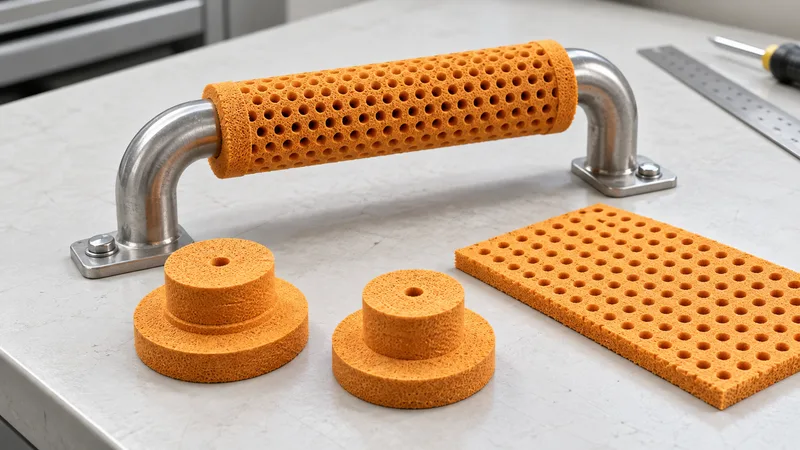
A natural rubber foam cushion brief for grips and bumpers should let engineering, procurement and quality review the same construction. The customer record describes NR Foam for cushioning pads, bumpers and grips in industrial, sports-equipment and footwear directions. It does not identify a named project or confirm impact, rebound, fatigue, comfort or safety results. This brief template keeps those boundaries visible.
Begin at the Natural Rubber Foam product page with a drawing, sample or interface description. Identify the part that the foam touches, the direction of movement and the person who will approve the assembly. A good brief is a controlled package, not a request for a material name with no geometry.
Identify the interface and the decision owner
Describe the mating components first. A grip pad may sit between a hand and a rigid core. A bumper may contact a housing, a stop or a moving cover. Show the surface shape, contact width, texture, coating, fasteners and any edge that can concentrate pressure. Include a section view where the contact is not obvious.
Next, name the action. A part may be compressed during assembly, squeezed repeatedly, pushed sideways or contacted by an impact. Mark the primary direction with an arrow and list secondary movement separately. This keeps a sample from being tested in a convenient orientation that does not represent the product.
| Brief section | Minimum input | Decision it supports |
|---|---|---|
| Interface | Mating parts, contact area and surface condition | Whether the proposed pad or bumper can seat |
| Action | Compression, shear, impact, grip or sliding direction | How a representative sample is oriented |
| Envelope | Open height, clearance, stops and hardware | Which thickness and edge details need review |
| Installation | Tools, sequence, retention and operator access | Whether the route can be repeated |
| Acceptance | Measurements, visual checks and decision owner | How the sample becomes traceable evidence |
Choose an approval owner early. Engineering may own geometry, quality may own dimensional checks and the customer may own fit at the final interface. Record those roles in the brief. If no one is named, a sample can be circulated without a controlled decision.
- Attach the mating parts, controlled drawing or a dimensioned interface sketch.
- Show contact surfaces, load arrows, movement and hard stops.
- List the reviewer for fit, material evidence and final acceptance.
- Keep comfort, traction, fatigue and safety requirements [需确认] until tested.
Define the cushion envelope and geometry
Measure the open space around the grip or bumper. Record the available height, compressed clearance, surrounding walls, fasteners and reliefs. A pad may need to expand into a gap or may be constrained by a hard stop. Show that condition on the section view rather than assuming that nominal thickness describes it.
Geometry should include edges, radii, holes, steps and orientation. A grip sleeve may need a split or a lead-in edge. A bumper can need a hole, shoulder or local relief around a screw. A flat outline may look correct while the corner folds during installation. Put the critical edges on the drawing and inspect them in the assembled sample.
Use the NR Foam sheets, strips and custom pads guide to frame the format question. It compares flat stock, strips and custom outlines while keeping thickness, backing and tolerance as items to confirm. A format name does not establish conversion capability.
| Check | Example observation | Record with the sample |
|---|---|---|
| Fit | Part sits against the intended surface | Contact area, gap and orientation |
| Geometry | Edges, holes and reliefs clear hardware | Measured critical dimensions and revision |
| Handling | Operator can place or retain the pad | Tools, sequence and open questions |
| Surface | No unintended fold, lift or damaged edge | Location, condition and photographs if allowed |
| Approval | Named reviewer accepts the reviewed setup | Signature or controlled decision record |
The planning record lists 60–200 kg/m³ and Shore C 10–40 as [需确认]. Do not select a hardness or density from that range as a guaranteed grip feel, impact response or load limit. Request the grade, method, specimen and thickness, then connect it to the reviewed geometry.
- Mark datums, part number, orientation and drawing revision.
- Dimension contact edges, holes, radii, steps and clearance zones.
- Show the section at a straight run and the most demanding corner.
- Identify which dimensions will be measured on the sample.
Describe installation and use conditions
Installation changes what a grip or bumper can be asked to do. State whether the part is placed, stretched, slid over a core, retained by a shoulder or held by a separate adhesive. Show the tools, operator access and sequence. If the piece is removed for service, record that action as a separate requirement.
Keep backing as its own decision. Adhesive, liner or lamination can change handling and surface compatibility. Name the receiving surface and the time between placement and use. The current record does not confirm a self-adhesive NR Foam route, so request evidence for the exact proposed construction.
Describe the application boundary without making a performance claim. Industrial equipment, sports equipment and footwear are planning directions from the customer materials. They may have different contact pressures, cleaning routines and acceptance owners. Ask which environment and use cycle the sample should represent.
- Record placement, retention, removal and any required tool.
- State the receiving surface and backing question separately.
- List temperature, moisture, cleaning or other exposure questions as [需确认].
- Identify whether the review is for fit, handling, cushioning or a defined test.
For a specification workflow, read the NR Foam density and hardness guide. It explains why a method and specimen must travel with every value. A project brief can then state which fields are material evidence and which are assembly checks.
Plan the sample and acceptance record
Prepare the sample with actual mating parts or a controlled fixture. Label the part, orientation, drawing revision, proposed format and open material questions. Ask the operator to install the grip pad or bumper in the planned sequence, then inspect fit, edge condition, clearance and access.
Check the areas that are easy to miss. Look at the first and last point of a strip, the underside of a grip, a hole around a fastener and every corner. Note lifting, folds, interference or damage. Record measured dimensions separately from visual observations so that an impression does not become a tolerance.
Do not use a fit sample to claim long-term performance. Rebound, compression set, fatigue, comfort, traction, impact resistance and certification need their own method and evidence owner. If a project needs those outcomes, add them as acceptance questions and keep the status [需确认] until the test is approved.
- Confirm identity, orientation, revision and proposed grade questions.
- Install the sample with the planned tools and sequence.
- Inspect contact, clearance, edges, joins, holes and operator access.
- Record observations, measurements, deviations and unresolved inputs.
- Assign the acceptance decision and any repeat-sample trigger.
Repeat the review when the thickness, outline, backing, mating surface or load direction changes. A small geometry revision can change the part route even when the material family remains Natural Rubber Foam. Keep the old record for traceability and create a new comparison.
Keep the sample record concise enough to travel with the part. List the setup, the observed fit, the open questions and the next owner on one controlled page, then attach any detailed measurement sheet. A clear record helps a second reviewer understand why the grip or bumper was accepted without relying on a verbal explanation.
Use authoritative methods without inventing results
When the brief needs test terminology, consult the ASTM International standards catalogue and the ISO standards catalogue. Choose the appropriate method with the project team. These public catalogues are references for method selection; they do not validate a supplier grade or certify a grip or bumper.
Keep external methods separate from internal facts. The knowledge base is the source for the application scope and the provisional 60–200 kg/m³ and Shore C 10–40 records. It does not provide a named customer sample, an impact result or a comfort threshold. Do not fill those gaps with a generic industry number.
Commercial questions also belong in the brief but require a quotation. Expected volume, destination, timing and sample count are useful inputs. MOQ, lead time, capacity and pricing are not established by a material description. Leave them open until the supplier responds for the reviewed construction.
Release a clear project brief
Before sending the brief, check that a new reviewer can understand the interface without a meeting. Include the drawing or sample, contact area, load direction, envelope, format, backing question, installation route, acceptance checks and owners. Mark every unconfirmed value or outcome [需确认].
For the wider cushioning sequence, use the NR Foam selection guide. It keeps material questions attached to deflection space and sample validation. If the part is mainly a format problem, return to the sheets, strips and custom pads guide.
A strong natural rubber foam cushion brief is a decision tool. It does not claim that every grip or bumper has the same response. It records the construction to review, the evidence to collect and the person who can approve it. That approach lets a supplier discuss the right route while protecting the project from accidental claims about durability, comfort or safety.
Keep the brief with its revision and sample record. If the surface, load, hardware or installation changes, update the inputs and reopen the review. Reusing the vocabulary is helpful; reusing an unverified result is not. The next sample should always be understandable on its own.
When procurement asks for a quotation, send the same brief and identify what is still provisional. This prevents a format suggestion from being read as a guaranteed performance statement and gives the supplier a clear list of questions to answer against the reviewed construction.