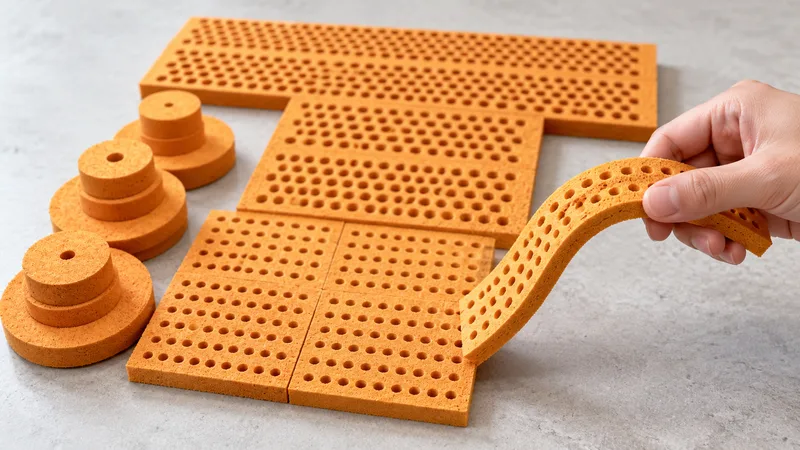
Natural rubber foam selection becomes clearer when the buyer describes the assembly before asking for a material recommendation. The planning record for Green Foams covers NR Foam for vibration pads, bumpers and grips in industrial, sports-equipment and footwear discussions. It does not establish a universal load rating, rebound value or comfort result. This guide turns that boundary into a practical review sequence.
Start at the Natural Rubber Foam product page with a drawing, a sample or a clear description of the interface. State what touches the foam, what moves, and where the part can deform. When those inputs are visible, an engineer can compare a flat pad, a formed cushion or a custom-cut piece without inventing an unverified specification.
Describe the contact before the material
The contact surface is the first useful question. A broad, flat plate presents a different review from a curved handle, a textured grip or a part with ribs. Draw the surface that receives the foam and the surface that reacts against it. Include coatings, grooves, fasteners and any hard edge that could concentrate contact.
Then describe the action at the interface. Is the piece pressed once during assembly, repeatedly compressed, pushed sideways, or exposed to an impact? A project can have more than one action, and the most demanding direction may not be the obvious one. Record the direction with arrows on the drawing so that a sample is oriented the same way.
| Decision field | What to document | Why it matters |
|---|---|---|
| Contact surface | Flat, curved, textured or interrupted interface | Changes the way the pad seats and spreads contact |
| Load direction | Compression, shear, impact or a changing direction | Sets the orientation for a representative sample |
| Deflection space | Open height, hard stops and clearance | Prevents a theoretical thickness choice from colliding with the assembly |
| Part geometry | Edges, holes, corners, radii and reliefs | Defines whether a sheet, strip or cut pad is reviewable |
| Acceptance owner | Engineering, quality or end customer | Makes the sample decision traceable |
The table is intentionally qualitative. The knowledge base does not confirm a universal force, compression set or cycle limit for NR Foam. Those claims need a grade-specific record and a defined test. A clear interface description is still valuable because it tells the supplier which evidence would be relevant.
- Identify the hard mating parts and the surfaces that may abrade or mark the pad.
- Show the primary load arrow and any secondary shear, impact or sliding movement.
- Mark the contact width, corners, holes and any zone that must stay free of foam.
- Name the person who will approve fit and the person who will approve material evidence.
Check deflection space and installation direction
Available space sets the practical envelope for a cushion. Measure the open height before installation, the height after the parts meet and the clearance to nearby walls. If a cover, clamp or handle closes in one direction, show that direction. The foam may need room to spread or may be constrained by a hard stop; both conditions belong in the brief.
Do not turn a nominal thickness into a guaranteed deflection result. The planning range for Natural Rubber Foam is 60–200 kg/m³ and Shore C 10–40, both marked [需确认]. These values are prompts for a grade-specific TDS, not a calculation of how much a cushion will compress in every geometry. A thickness change can alter clearance even when the proposed hardness is unchanged.
Installation also influences the decision. A pad that is inserted from above may need a lead-in edge. A grip that slides over a core may need a split, stretch allowance or controlled seam. A bumper that is retained by a shoulder may need a relief around the fastener. Describe the route and inspect it with the same orientation in the first sample.
For a format comparison, read the Natural Rubber Foam format guide. It separates flat stock, strips and custom pads so that the geometry conversation is not confused with an unconfirmed conversion capability.
- Measure open and closed space, including local clearances and hard stops.
- Show how the operator places, slides, wraps or retains the part.
- Mark orientation, seams, corners and any surface that must remain exposed.
- Repeat the space review when thickness or mating hardware changes.
Use geometry to choose a review route
Geometry decides whether a project should begin with a sheet, a strip or a custom-cut pad. A flat rectangle can be reviewed from a sheet outline. A repeated straight run may be clearer as a strip with defined ends. A bumper with holes, shoulders or compound corners may need a controlled drawing that records every edge.
Keep the route open until the sample demonstrates it. The current customer record mentions open-cell or closed-cell selection and customization discussions, but it does not confirm stable sizes, cutting methods, adhesive backing or tolerances. Ask which route can be supplied for the proposed grade and thickness, and mark capability fields [需确认].
Include edge conditions in the drawing. A sharp edge can fold during insertion; a radius can change the contact band; a hole can create a tear path if its position is not controlled. These are design questions, not evidence that one foam family is universally suitable. A sample lets the team observe the specific construction.
| Shortcut | Risk | Better selection habit |
|---|---|---|
| Choose by material name alone | The interface and space are unknown | Start with the assembly and record the material question |
| Treat density as a load rating | A number is detached from method and geometry | Request grade, method, thickness and sample evidence |
| Approve a loose foam block | Corners and installation are not exercised | Use mating parts and the planned installation sequence |
| Copy a result between projects | A different surface or load changes the setup | Keep each drawing revision and acceptance record separate |
| Promise rebound or comfort | No approved test or customer evidence exists | Mark outcomes [需确认] and define the test owner |
Standards catalogues can help the team identify terminology and measurement methods. Use the ASTM International standards catalogue and the ISO standards catalogue as public starting points. Select the applicable method with the project team; these links do not certify a grade or establish a cushioning performance.
Request grade evidence without overclaiming
A useful request asks for the Natural Rubber Foam grade, density, hardness scale, test method, specimen, thickness and tolerance. Ask whether each value is nominal, typical or a release criterion. If the supplier cannot map a value to the proposed construction, keep the field open. Do not infer that a familiar material name means the same formulation or cell structure across suppliers.
Separate material descriptors from installed outcomes. Density and Shore C hardness describe test observations under stated conditions. They do not, by themselves, prove rebound, fatigue life, impact protection, grip safety or comfort. If those outcomes matter, write the test setup, conditioning and acceptance owner into the project brief instead of turning a planning range into a promise.
For a closer specification workflow, use the NR Foam density and hardness guide. It explains how to keep methods and thickness attached to each value. This separation helps procurement compare offers without ranking unlike measurements.
- Record units, test method, scale, specimen and conditioning beside each number.
- Ask whether the record belongs to the exact grade and construction being sampled.
- List environmental and application questions separately from the material fields.
- Keep rebound, compression-set, fatigue, traction and certification outcomes [需确认].
Validate an assembled sample
A sample review is most useful when it uses the actual mating parts or a controlled representation of them. Label the foam with material questions, dimensions, orientation and drawing revision. Install it using the planned route, then inspect contact, clearance, edge condition and operator access. Record observations before deciding whether a change is needed.
Review more than the center of the pad. Inspect corners, holes, seams, transitions and hard-stop areas. A part can look acceptable on a bench while lifting at a corner or interfering with a screw in the assembly. Note whether the sample remains where it was placed and whether the closure reaches its intended position.
Separate fit evidence from performance evidence. A sample can show that a reviewed outline fits a grip or bumper interface. It cannot prove years of cycling, universal impact resistance or end-user comfort without a defined test. The grip and bumper brief provides fields for installation and acceptance ownership.
- Confirm part identity, orientation, drawing revision and proposed material fields.
- Install the sample with the planned sequence and tools.
- Inspect contact, clearances, edges, joins and hard stops.
- Record deviations, open questions and the owner of the next decision.
- Repeat the review when a critical geometry or format field changes.
Release a traceable cushioning decision
Before a project moves toward production discussion, connect the selected route to a controlled drawing and sample record. Capture the approved outline, thickness question, installation direction and acceptance checks. Keep commercial fields such as volume, timing, MOQ and lead time as quotation inputs; none is confirmed by the Natural Rubber Foam planning record.
When the application is industrial, sports equipment or footwear, keep the boundary visible. The knowledge base identifies those industries as planning directions, not named customer projects or proof of safety. A project-specific brief can add the relevant surface, load and environmental questions without claiming a result that has not been measured.
Review the decision again if the interface changes. A thicker pad, a different grip core or a new bumper corner can change the sample route even when the material family remains NR Foam. Preserve the old record and start a new comparison rather than silently carrying a result forward.
Natural rubber foam selection works best as a sequence of visible questions: what touches the foam, how the load arrives, where the part can move, how it will be installed and who will accept the sample. Keep every unconfirmed performance statement marked [需确认]. That discipline gives engineering and procurement a clear next step while protecting the project from accidental promises.