Define the observation before using the word recovery
Memory Foam recovery and temperature review begins with a controlled question. The client source describes slow-response cushioning, but supplies no validated recovery seconds or thermal limits. An engineer should define the sample, loading condition, unloading event and observation before a buyer interprets a return toward the original shape as a specification.
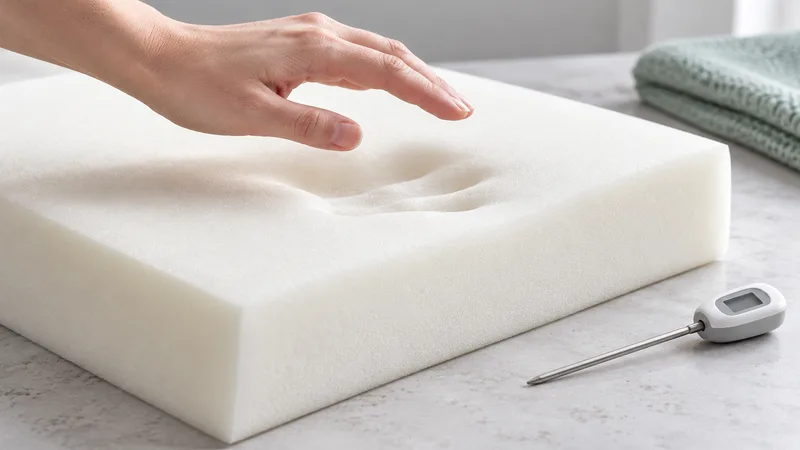
Identify whether the observation concerns a material piece, a layered cushion or a covered seat. Those constructions can have different dimensions and constraints. Record which surface and region is observed, and make the counterpart components visible. A photograph showing a hand mark does not identify all of these inputs.
Write what the observation can answer. It might help compare a proposed contact layer under one preparation condition or identify the need for a different thickness trial. Keep that purpose separate from claims about support, ergonomic benefit, fatigue life or comfort. The current knowledge base does not establish those outcomes.
- Identify the sample and counterpart revisions.
- Separate observations from requirements still awaiting evidence.
- Assign the next review question to its responsible owner.
The Memory Foam Cushions product hub connects the observation to a material request. Send the sample identity and assembly section with the question. If the seat construction is not yet defined, review the memory cushion selection guide first.
Avoid an undocumented pass criterion. “Returns slowly” can mean different things to different reviewers. Ask the project owner to define the observation and any required record. An honest qualitative review is useful when its scope is explicit; an invented numeric threshold would make the decision less reliable.
Record preparation and conditioning
Ask how the sample was prepared before observation. Record storage, handling and the procedure used to bring it to the agreed state. If a technical method specifies conditioning, keep that reference with the result. The project record should explain the actual preparation rather than assume every sample arrived under identical conditions.
Record sample thickness, construction and previous handling. A layered part can include interfaces or a support material that a loose memory piece does not have. If the sample was covered, note the cover revision and attachment state. These fields make a later repeat observation understandable without relying on memory or a filename.
Temperature belongs in the review as an identified condition and evidence question. Ask the technical owner which expected use and storage conditions require evaluation. Do not infer a universal range from a room observation, from another foam family or from the material name. The client source does not provide such a range.
If preparation differs between candidates, record the difference before ranking them. A reviewer should know whether a result came from a newly unpacked piece, a prepared specimen or a previously used seat sample. Those are descriptions of the setup, not automatic explanations of an outcome.
Use a consistent record format so a new reviewer can reproduce the intended comparison. Include who prepared the sample, what procedure was followed and what remains unresolved. If a required field is unknown, ask for clarification rather than replacing it with an assumed laboratory or ambient condition.
| Decision field | Record input | Review purpose |
|---|---|---|
| Identity | Material piece, layered cushion or covered seat | Avoid mixing unlike setups |
| Preparation | Storage, handling and conditioning reference | Record unknown fields |
| Loading | Direction, region and history | Owner defines the procedure |
| Temperature | Expected use and evidence questions | No universal range supplied |
| Observation | Location, method and scope | No implied recovery or life guarantee |
Describe loading and unloading history
Define how contact is applied and removed in the agreed review. A hand press, a fixture and a seated assembly observation are different setups. Record the direction, region and support surface involved. The current source does not provide a load, duration or cycle count to publish as a general test protocol.
Ask the evaluation owner to identify the loading history needed for the project question. A comparison intended to review an initial contact observation may differ from a formal material method or a finished-seat test. Keep these purposes separate and request the applicable procedure where quantitative conclusions are required.
Record when and where unloading occurs relative to the observation. In a layered cushion, the cover or supporting layer may remain engaged while the contact is removed. A loose specimen may not share that configuration. The record should identify those counterpart conditions so that a change is not attributed to the memory layer without evidence.
Retain observations as observations. Describe the location and visible behavior under the setup without claiming a universal response rate. If timing is used by the project, it needs a defined method and an approved record; this article does not create a recovery-seconds claim for Green Foams.
When a review is repeated, record the sample identity and earlier exposure. Repetition may help the team see whether another question needs investigation, but it is not a substitute for a fatigue method or a service-life result. Do not turn an informal workshop sequence into a durability guarantee.
Keep temperature questions linked to the grade
The expected environment must be described by the project owner. An office assembly, a home cushion and an automotive seat can involve different storage, handling and use conditions. Record the relevant questions in the brief instead of treating a shared material family as proof that one sample represents all environments.
Request evidence for the proposed grade and construction. A supplier should identify the method, sample and condition associated with any performance record. If the record refers to another grade, another layer stack or another thickness, note the difference and ask whether it supports the current decision.
Consult ASTM International and the ISO standards catalogue with the test owner for method terminology. Catalogue availability does not prove that a memory material has been tested, nor does it certify the covered seat.
Keep use-temperature evidence distinct from recovery evidence. A documented observation under a stated condition may answer one comparison while leaving an environmental requirement open. The project needs to know which question each record addresses, especially when procurement asks about a proposed substitution.
The density and SH guide explains the other unresolved source fields. Neither recommended density ≥50 kg/m³ nor undefined SH notation establishes temperature suitability or a recovery time. Keep those fields as separate evidence requests.
Compare assembled cushions without losing variables
An assembled cushion includes layer order, local thickness, cover, base and retention. Record these inputs with the material identity. A sample with another support layer is a construction comparison, even if both user-facing layers are described as memory foam. The observation should name that distinction rather than pretend the materials were tested in isolation.
Identify locations that matter to the seat decision. The central sitting region, front edge and back transition may have different geometry. Observe the same locations on comparable configurations and describe where a result occurred. A general comment about the whole cushion can hide a local fit or cover issue.
Use the layered cushion brief to document the counterpart inputs. Mark whether bonding, cover fitting and support-layer construction are proposed or confirmed. Those capability questions remain [需确认] until the specific route is reviewed.
Separate visible fit from user preference and formal evidence. A cover wrinkle is a geometry or assembly observation; a seated comment belongs to its evaluation context; a recovery observation belongs to its preparation and loading history. These can all inform development without becoming a single unsupported comfort score.
If several variables change, call the next review a new construction trial. Record the old and new configurations, the question being investigated and who will interpret the result. This makes the sample useful for engineering and prevents procurement from treating unlike trial pieces as interchangeable approved grades.
Hand off the observation record responsibly
Prepare a concise record with sample identity, construction, preparation, condition questions, loading history, observation location and owner. Attach the drawing or section that identifies thickness and counterpart components. Keep the original terminology of any technical report so a reviewer can trace the observation to the method used.
List unresolved fields and the next action. The team may need a grade-specific method, comparable preparation, clarification of SH or a reviewed seat stack. A missing field is not a reason to invent a universal claim; it is a concrete request for the evidence needed to continue.
Preserve approval scope. A qualitative sample may be accepted for a shape-development step while recovery or environmental requirements remain open. State that boundary in the handoff so a later buyer does not convert development acceptance into blanket grade or application approval.
When a grade, layer, thickness, cover or condition changes, revisit the affected observations. A traceable record lets the project decide whether the old evidence remains relevant. The useful result is a controlled comparison and an understandable next step, rather than a dramatic but undocumented demonstration of slow recovery.
- Confirm the sample construction and drawing.
- Document conditions and observations.
- Review evidence gaps with the responsible owner.
- Preserve approval scope before a substitution or revision.