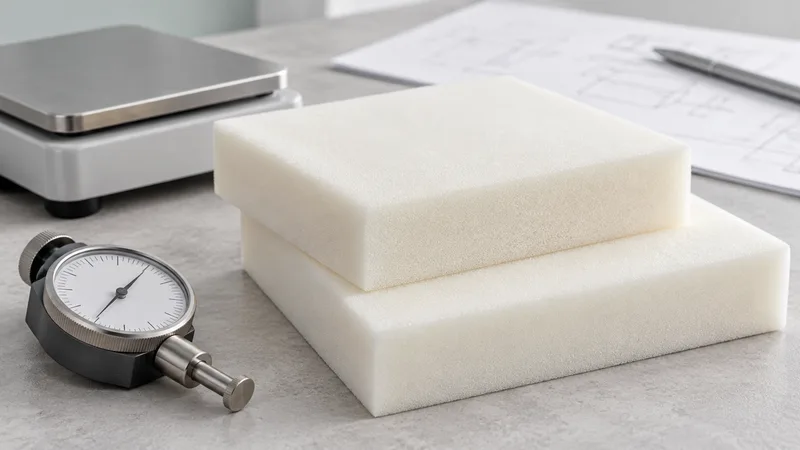
Preserve the original density recommendation
Memory Foam Cushion density and SH specifications begin with a careful reading of the client source. It records recommended density ≥50 kg/m³, marked [需确认]. That notation should be retained as a recommendation pending evidence, rather than rewritten as a universal supplied minimum or a confirmed material-grade table.
Density describes mass relative to volume for an identified specimen. Request the grade, sample identity, measurement method and tolerance with the result. If the record refers to another construction or thickness, note that distinction. A total cushion shipping mass cannot substitute for a density measurement because its geometry and other components also contribute.
Ask why the recommendation appears in the source and which application or grade it describes. The current knowledge base does not resolve that context. A buyer can use it to frame a technical question, but should not create imagined intermediate grades, stock positions or support ratings from the symbol ≥.
- Identify the sample and counterpart revisions.
- Separate observations from requirements still awaiting evidence.
- Assign the next review question to its responsible owner.
The Memory Foam Cushions product hub connects the data request to a proposed cushion. Attach the drawing and layer stack so the reviewer knows whether the specimen is intended as a contact layer, a complete single-material cushion or part of a composite proposal.
Keep density separate from recovery, comfort and durability. A sample can have an identified density while the seat function and environmental questions remain unresolved. A useful technical sheet clarifies one field at a time; it does not make every desired seating outcome an established result.
Keep SH undefined until its scale is identified
The source uses SH16–30 and a second SH16–35 range in the customization description. The current knowledge base does not identify what SH means as a measurement scale. Preserve the symbol, source location and conflict together. Do not label it Shore C simply because another cushion or rubber family uses that term.
Request the original technical record from the client or proposed grade owner. Ask for the scale, method, instrument or procedure, specimen thickness, conditioning and tolerance. A number has limited comparison value when the test context is missing. The correct next action is clarification rather than an invented conversion.
A polyurethane cushion ILD record is not a replacement for SH. The PU source supplies a separate 25% ILD notation with force and area, while the memory source does not define SH. Combining the two into a single firmness scale would erase the evidence boundary and create a false relationship between different source records.
If a supplier proposes another notation, retain both labels and ask which one identifies the proposed material. The technical owner should explain whether the records are comparable. Procurement should not choose the label that appears more familiar and discard the unresolved original.
The article title keeps SH visible because the unresolved notation is the actual reading problem. It is better for a draft resource to show the missing definition than to present a polished but unsupported grade comparison. The page remains review-draft while the original scale and data are being confirmed.
| Decision field | Record input | Review purpose |
|---|---|---|
| Density | Recommended ≥50 kg/m³ [需确认] | Do not treat as confirmed grade table |
| SH source A | SH16–30 [需确认] | Scale and grade not identified |
| SH source B | SH16–35 [需确认] | Client must reconcile source conflict |
| Method | Scale, specimen, conditioning and tolerance | No supported conversion to ILD/Shore C |
| Construction | Material layer and assembly identities | Data does not approve the whole seat |
Resolve the two ranges with grade-specific evidence
Treat SH16–30 and SH16–35 as a documented source conflict, not as two automatically available product bands. Ask whether they refer to different grades, construction options, revisions or an error. The current client record does not establish the answer, so neither interpretation should be published as confirmed supply.
Request a grade map linking each proposed sample to its technical sheet. The map should identify the source document revision, method, specimen and applicable tolerance. If one range is corrected, retain the correction history in the knowledge base rather than rewriting the original collection files as if the conflict never existed.
Give procurement an interim field that says the value is to confirm. State the material family, proposed sample and unanswered notation question. This allows a quotation discussion to continue without making an unsupported number part of the accepted requirement.
Check that the drawing, sample label and technical record identify the same construction. A supplier may propose a layered cushion with a memory contact layer and another support material. The density or SH record should name which material it describes; it must not be assigned automatically to the whole assembly.
Do not widen the range to simplify development. A wider band may look convenient, but it would create a new specification not supported by the source. Ask the grade owner to resolve the conflict and state what evidence permits the next review or release.
Compare methods and specimens before comparing numbers
Once the notation is identified, keep method and specimen fields beside every reported value. Thickness, conditioning, preparation and the measurement procedure can distinguish records that appear numerically similar. The comparison should make those inputs visible instead of ranking samples by the largest or smallest number.
Consult ASTM International and the ISO standards catalogue with the responsible technical owner for method terminology. These directories do not define the client SH symbol by themselves, certify a grade or prove that a Green Foams report exists.
Record which part of the construction was sampled. A loose contact material, a formed cushion and a layered assembly are not interchangeable descriptions. If a report is based on a specimen that differs from the seating sample, ask the engineer what question it can support and which assembled review is still needed.
The recovery and temperature review guide covers another set of conditions. Density or a clarified SH value does not eliminate the need to define preparation and loading history when discussing slow-response behavior.
Keep missing details as explicit questions. A technical record can be useful even when another field remains open, provided the approval scope is understood. Filling the gap with a guessed scale or method would create a more confident looking document with less reliable content.
Connect the record to a layered seating construction
Identify the memory layer and any supporting material in a section drawing. Record local thickness, cover, base and retention. A density value for the memory layer describes that material only; it does not establish the support response or total performance of the completed seat.
The layered cushion brief keeps layer roles and interfaces traceable. Ask for actual material identities and bonding scope where those are proposed. Composite construction is a planning direction in the client source, while its specific conversion capability and compatibility remain [需确认].
A change to the supporting layer can require another assembly review even if the memory material record stays the same. A cover change can require a fit check. A local thickness change can make an old specimen observation less relevant. List those changes with the sample so a buyer does not treat one data field as approval for every construction.
Use the memory seating selection guide when deciding the function of the contact and support layers. It helps frame the desired observation without turning a density recommendation into a user-weight, comfort or ergonomic claim.
Separate evidence owners. The material owner should clarify grade data, the designer should identify geometry, assembly should review handling, and the project owner should define any formal evaluation. A clear record makes those responsibilities visible rather than asking a single undefined SH number to answer them all.
Release an understandable specification revision
Before a technical field is approved, identify its source, scope and owner. Retain the provisional density recommendation and SH conflict until the applicable evidence is received. Do not add a tolerance, operating range, recovery time or grade availability statement that the record does not establish.
When clarification arrives, update the controlled specification and sample map together. A correction to SH notation should not leave the drawing or quotation request with an outdated value. Preserve the source reference so another reviewer can understand why the requirement changed and which construction it now covers.
List unresolved questions beside the approved fields. A sample may proceed for shape review while a quantitative material criterion remains pending. State this boundary clearly so a development acceptance cannot be mistaken for complete specification approval or an application guarantee.
During a later substitution, request the same set of fields and compare the relevant evidence. If the method, specimen or construction changes, ask the responsible owner which checks to repeat. The practical purpose of specification reading is a traceable material decision, not a conversion that makes incomplete numbers appear comparable.
- Confirm the sample construction and drawing.
- Document conditions and observations.
- Review evidence gaps with the responsible owner.
- Preserve approval scope before a substitution or revision.