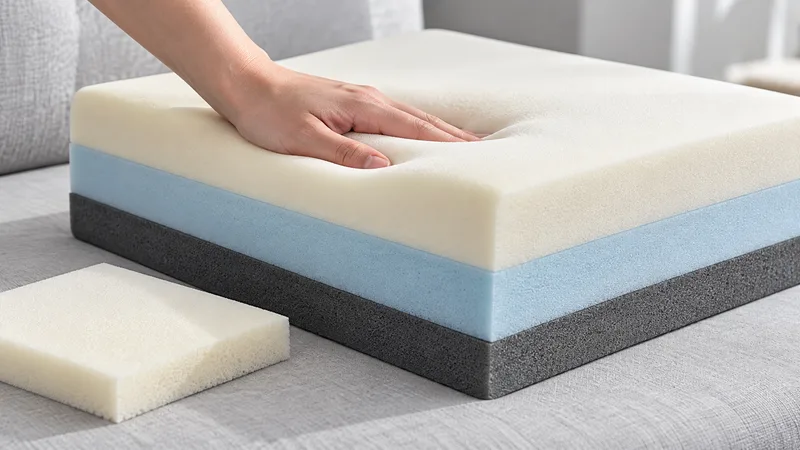
Make the layer stack an identified construction
A Memory Foam layered cushion brief for office, auto and home should begin with the section drawing. The client knowledge base describes slow-response and composite selection as planning directions. It does not define a universal layer stack, bond method or supported performance outcome. The brief must identify the actual proposal instead of relying on the word composite.
Label the memory contact layer and the function of each supporting layer. State the proposed material identity when known and mark open fields [需确认]. Show layer order and the surface that meets the base. A photograph of stacked samples cannot reliably communicate a controlled construction or the thickness at a contoured region.
Identify the seat or cushion reference, drawing revision and development purpose. A new office seat, an automotive cushion and a home-use replacement can require different counterparts and approval owners. State whether the project is discussing a new stack, a changed layer or a replacement for an existing assembly.
- Identify the sample and counterpart revisions.
- Separate observations from requirements still awaiting evidence.
- Assign the next review question to its responsible owner.
The Memory Foam Cushions product hub is the starting point for the material discussion. Attach the section and counterpart references to the request. This allows a reviewer to distinguish the memory layer question from the support material and assembly questions.
Keep a baseline construction and identify proposed alternatives separately. If the layer order or supporting material is still open, the next sample should state which option it represents. That identity protects the quotation discussion from combining features of different exploratory samples into one imaginary approved cushion.
Record local thickness, base and cover relationships
Show total thickness and each layer at critical sections. A flat center, tapered front edge, side contour and underside clearance can produce different local stacks. Mark which dimensions affect support, fit, cover appearance or mechanism clearance so the designer can prioritize the next drawing review.
Describe the base as a counterpart component. Identify whether the sample sits against a continuous support, a contoured seat pan or another structure. Record attachment points and nearby hardware. The supporting layer and base together form a construction question; neither can be omitted when reviewing the finished cushion.
Retain the cover material, seam pattern and attachment sequence. If the cover is fitted under tension or includes another backing, identify the construction and revision. An uncovered stack is useful for some development questions, while the covered assembly is needed to review counterpart interaction.
Provide orientation and identification references. A stack may have similar looking upper and lower surfaces or closely related versions. Decide how assembly recognizes the correct layer order and how quality can inspect critical sections before they are concealed by the cover.
The memory seating selection guide connects these interfaces to the seat function. Use it to distinguish contact and support questions without inventing a universal thickness ratio or a user-weight recommendation for the proposed materials.
| Decision field | Record input | Review purpose |
|---|---|---|
| Layer identity | Material and intended role | Separate memory from supporting material |
| Geometry | Order, local thickness and counterpart sections | No universal ratio assumed |
| Interface | Retention or bonding proposal | Confirm capability and evidence |
| Conditions | Application and sample setup | Separate office/auto/home scope |
| Handoff | Revision, owners and unresolved fields | Quote the reviewed construction |
Treat retention and bonding as separate scope
Describe how the layers are intended to stay together. The proposal may involve mechanical retention, a cover-controlled stack or a bonding route that needs review. Record the actual concept and interface surfaces. Do not assume every layered cushion is adhesively bonded or that the source confirms an in-house bonding process.
If bonding is requested, identify the materials, local thicknesses, assembly sequence and relevant environment questions. Ask the process owner to confirm compatibility evidence and manufacturing scope. The knowledge base does not provide a universal bond result, an adhesive specification or a durability claim for all memory composites.
A retained stack should still be reviewed for placement and handling. Check whether layers can shift during covering, installation or the agreed sample observation. Describe any movement by location and configuration. That finding is a development input and should not be rewritten as a measured fatigue or lifetime outcome.
Keep optional scope visible in the quotation. Conversion, contouring, cover fitting, inserts, packing and formal evaluation may involve different owners or routes. Request confirmation of what the proposal includes rather than treating custom manufacturing as a promise that every associated capability is available.
Commercial inputs should identify expected volume and revision timing. Actual supply format, grade availability, capacity, minimum order and lead time remain to confirm. A clear layer brief helps the manufacturer frame a proposal while preserving the boundary between a requested capability and an established fact.
Attach material records without hiding source gaps
The memory source retains recommended density ≥50 kg/m³ and SH16–30, with SH16–35 in another customization description, all [需确认]. Identify which layer each requested record describes. Keep the SH conflict visible until the client provides grade mapping and the original scale, method and specimen context.
Use the density and SH specification guide when preparing the fields. Do not convert SH into Shore C or ILD, and do not assign the memory density recommendation to the whole layered cushion or to the supporting material.
If PU Foam Cushions is proposed as another material route, retain its separate technical record. A supporting material should be identified by its own grade and method. There is no supported numerical equivalence between the undefined memory SH notation and the PU source ILD field.
Consult ASTM International and the ISO standards catalogue with the technical owner for method terminology. These links do not certify a composite cushion or prove a client measurement.
Assign owners to the open fields. Material identity, specimen data, geometry, bonding and application evidence are different responsibilities. Keeping those questions separate makes the next clarification useful and prevents the appearance of a technical sheet from becoming blanket approval of the assembled seat.
Separate office, automotive and home acceptance
An office-seat record should identify the base, adjustment positions, cover and selected sitting configurations. A home cushion may involve another support, removable cover or handling sequence. Preserve those counterpart details with the sample so an acceptance observation can be understood within its intended use.
An automotive request needs its program owner to identify interfaces and applicable requirements. Record nearby components, available space and evidence ownership. Slow-response material, a density recommendation and a layered fit sample cannot establish safety, fire behavior or automotive compliance.
Record preparation, use-temperature questions and loading history for the sample observation. The recovery and temperature review guide provides a record structure without inventing recovery seconds or an operating range. Use the conditions defined for the actual project.
Separate fit, appearance and response observations. An assembly reviewer may check layer position; a designer may review cover presentation; the seating owner may evaluate the intended positions. Any formal testing should have its own method and acceptance owner rather than being implied by these development checks.
If the project changes application context, revisit the conditions and evidence plan. A common brief format can simplify coordination, but a label change from home to auto does not extend an old approval. The useful record identifies one construction under one defined scope and states what remains open.
Control revisions through sampling and quotation
Before sampling, freeze the layer order, local sections, counterpart references and proposed material identities for that trial. State the question the sample should answer. If some fields remain exploratory, mark them clearly so procurement does not treat the trial drawing as a fully released production specification.
Inspect the stack before covering and after installation. Record layer identity, positioning, hidden-feature checks, edge transitions and handling. During the agreed seated or loading observation, name the location and condition involved. Keep photographs tied to sample identity when the project allows them to be retained.
When a component changes, identify the affected approval. Another support material, a different bond route, changed layer thickness, cover revision or new base can require further review. The responsible owner should decide the necessary checks instead of assuming a visually similar cushion is equivalent.
Close the handoff with the accepted revision, sample identity, evidence received, unresolved fields and next action. Preserve proposal inclusions and exclusions alongside the technical construction. That record lets the next buyer compare a quotation responsibly without inventing comfort, compatibility, regulatory or supply claims for a layered memory cushion.
- Confirm the sample construction and drawing.
- Document conditions and observations.
- Review evidence gaps with the responsible owner.
- Preserve approval scope before a substitution or revision.