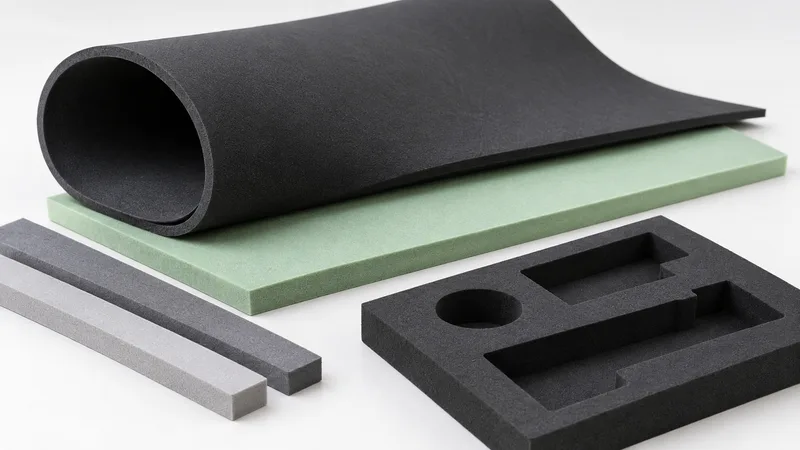
EVA foam sheets, rolls and custom inserts can all appear in an early packaging discussion, but they do not describe the same finished component. A sheet may become a separator or pad. A roll may support repeatable conversion into strips or wraps. A custom insert may locate a product with pockets and controlled clearances. The customer record covers EVA for packaging inner liners and cushioning pads, while exact formats and production conditions remain subject to project confirmation.
The EVA Foam material page is the hub for this review. Send the product drawing or sample, surrounding package, expected volume and handling sequence before selecting a route. This guide explains how to compare formats without implying that a photograph, file name or general material description is a production specification.
Define the job before choosing the format
Describe the product surfaces that need protection and the surfaces that may provide support. Mark projections, handles, openings and finishes that require clearance. Include accessories or loose parts that share the package. A flat profile may separate two items, while a shaped insert may control several interfaces; those decisions begin with the geometry.
Explain the package envelope and closure. Include the carton or case dimensions, adjacent layers and the space available for installation. If an operator folds, wraps, slides or lifts the foam, show the sequence. A format that looks efficient in a drawing can become awkward when a hand cannot reach a removal edge or when a lid compresses an unintended feature.
State the protection task as an acceptance question. The goal could be separation, location, surface cushioning or a controlled gap. Avoid general terms such as “shockproof” unless the project has a defined method and condition. The format discussion should remain linked to the actual product and handling route.
- Provide product geometry, sensitive surfaces, projections and required clearances.
- Show the package envelope, closure, adjacent layers and loading orientation.
- Describe placement, removal, retention, inspection and replacement steps.
- Define the protection question and the sample observations that will answer it.
Volume and repeatability influence the conversion conversation, but they do not establish an automatic process choice. A recurring strip may suit a roll-to-cut workflow, while a low-volume shaped component may start with a different route. Ask which assumptions are included in the proposal and which require confirmation. Keep tooling, fixture, minimum order and lead time questions open until quoted.
If the package changes, revisit the format. A new closure, product projection or orientation can change the available thickness and access. Preserve the drawing revision and sample reference so a later order does not silently reuse an obsolete profile.
Compare sheets, rolls and custom inserts
A sheet is a useful starting point for a flat pad, divider or layer. The team still needs to decide how it will be cut, retained and replaced. Edge quality can matter when an operator handles the piece repeatedly. A flat sheet may also be assembled into a set, which introduces registration and inspection questions.
A roll can support a repeatable length or strip when the packaging process accepts a continuous supply. Discuss roll width, winding direction, cut pattern, storage and protection from contamination. Conversion into pieces changes the labor and handling route. Do not assume that a roll is interchangeable with a sheet of the same nominal thickness.
A custom insert can provide cavities, steps, walls or local pads around a product. The shape should follow the product and the package, including access for loading and removal. Confirm critical dimensions and the proposed conversion or assembly route. If fixtures or tooling are considered, record their scope instead of inferring it from the insert shape.
| Format | Useful starting task | Questions to resolve |
|---|---|---|
| Sheet | Flat pad, separator or protective layer | Cut profile, retention, edge condition and replacement |
| Roll | Repeated strip, wrap or continuous conversion | Width, winding, cut pattern, storage and installation |
| Custom insert | Pocketed, shaped or multi-interface protection | Geometry, access, tolerance, assembly and process route |
| Layered set | Several pads or separators in one package | Registration, sequence, seams and inspection |
| Sample route | Early review before release | What the sample represents and what remains open |
Layered constructions deserve their own review. Multiple separators can simplify replacement, but seams and registration may create new contact points. A layered pad may also change how force or pressure reaches the product. Describe the layer order, retention and inspection criteria in the drawing.
Use format language consistently in the quotation and sample record. “Custom insert” should identify the geometry and interfaces, not merely a desire for a different shape. “Sheet” should identify the profile and conversion steps. “Roll” should identify the repeat pattern and finished handling. Clear terms reduce the risk that purchasing and engineering review different deliverables.
The EVA packaging selection guide provides a brief checklist for these inputs. Keep the format choice attached to that same product and package context.
Connect conversion to dimensional and handling evidence
For a sheet or roll route, list nominal thickness, cut profile, edge condition and any registration marks. For a custom insert, list cavities, steps, locating surfaces and the dimensions that control the fit. Identify tolerances as questions for confirmation when the source data does not provide a verified production range.
Review how the component is installed. A sheet may slide into a channel or sit under a product. A roll-converted strip may wrap around a corner or arrive as repeated pieces. A custom insert may need a specific orientation so a locating wall contacts the intended surface. These details should be observable in the sample review.
Hardness, color and thickness belong in the same conversation. The planning record lists 50–190 kg/m³ and 15–75 Shore C for EVA as [需确认]. Do not convert those planning ranges into a promised grade. Ask for the proposed value, method and specimen, then review it with geometry and handling.
| Review dimension | Sheet / roll route | Custom insert route |
|---|---|---|
| Geometry | Flat profile or repeatable strip | Pockets, steps, edges and locating features |
| Handling | Placement, folding, wrapping or replacement | Loading, removal, orientation and retention |
| Evidence | Thickness, cut quality and assembled fit | Critical dimensions, interfaces and agreed checks |
| Commercial scope | Material, conversion and quantity | Material, conversion, tooling or fixture assumptions |
| Change control | Revise profile or repeat pattern | Revise cavity, part set or assembly sequence |
External standards catalogues can help identify terminology and candidate methods. Refer to the ASTM International catalogue and the ISO standards catalogue with the project team. These references do not mean the EVA material, insert or packaging has passed a test or carries a certification.
- Record the format, profile, thickness and conversion steps for the reviewed sample.
- Identify product interfaces, package interfaces and operator access points.
- Connect hardness, color and other material questions to the proposed construction.
- Keep process, tolerance, tooling, compliance and commercial assumptions visible as [需确认].
Inspect cut edges and assembled interfaces at the same time as fit. A clean edge may support easier handling, while a small burr or loose seam may require a defined criterion. Color variation may be acceptable for an internal separator but important for orientation. Record the decision instead of relying on an informal visual impression.
Approve the format with a representative sample
Sample approval should reproduce the intended package as closely as the development stage allows. Include the product, carton or case, adjacent layers and closure. Observe loading, removal and orientation. For a roll-derived component, show the conversion and placement sequence; for a custom insert, show the locating features and access path.
Check whether the foam remains in the intended position while the package is moved. Review contact at sensitive surfaces and the ability to replace or inspect the component. If a layered set is proposed, confirm the order and registration. If a sample does not represent the production process, label its limitations in the approval record.
- Share the product drawing, package envelope, format request and protection objective.
- Compare sheet, roll and custom-insert routes with their conversion assumptions.
- Review fit, handling, edge condition, appearance and agreed protection checks.
- Record the approved scope, open requirements and controlled drawing revision.
Do not make the format carry claims it cannot prove. A custom shape shows geometry, not automatically transport performance. A roll format shows supply direction, not automatically repeatability under every process. A sheet shows a material form, not automatically compatibility with every package or adhesive.
Review storage and line-side handling as part of the format decision. Sheets may need a flat storage area, while rolls may need controlled unwinding and protection at the cut station. A custom insert may arrive as a set that must be counted and oriented. Describe these practical conditions when they affect contamination control, operator time or replacement.
Waste and nesting questions can be documented without promising a cost outcome. Ask how the proposed profile is laid out, whether offcuts are controlled and how the buyer wants to handle unused material. The answer may change between a prototype and a recurring order. Keep the discussion attached to the proposed geometry and quantity rather than generalizing from a different project.
When several formats remain plausible, request one sample for each with the same product and package. Mark the samples clearly and use the same review checklist. This makes access, retention and inspection differences visible before a quotation is released.
Keep the approved format understandable to the next operator and buyer. Name the finished piece, its orientation and its intended location in the package. A short assembly note can prevent a flat separator from being mistaken for a shaped insert or a roll-converted strip from being installed in the wrong sequence.
For a specification-focused discussion, read the EVA hardness, color and thickness guide. To compare packaging materials under the same brief, use EPE Foam vs EVA Foam comparison. Then send the drawing and sample request through the EVA customization workflow. A concise record lets the next review focus on feasibility, evidence and remaining decisions.
Ask for a small drawing of the finished format even when the first request is only for sheet or roll material. The drawing can show cut length, orientation, edge treatment, repeat direction and the surfaces that will be visible. It also makes it easier to compare a converted piece with a custom insert because both routes are reviewed against the same package interfaces.
At handover, include the installation sequence and replacement instruction with the drawing. State which edge the operator grips, which face is visible, and how the piece is checked after insertion. If a roll-derived part is supplied in repeats or a custom insert has a required orientation, mark that direction directly on the sample and the production reference. This keeps a format decision useful beyond the first prototype review.