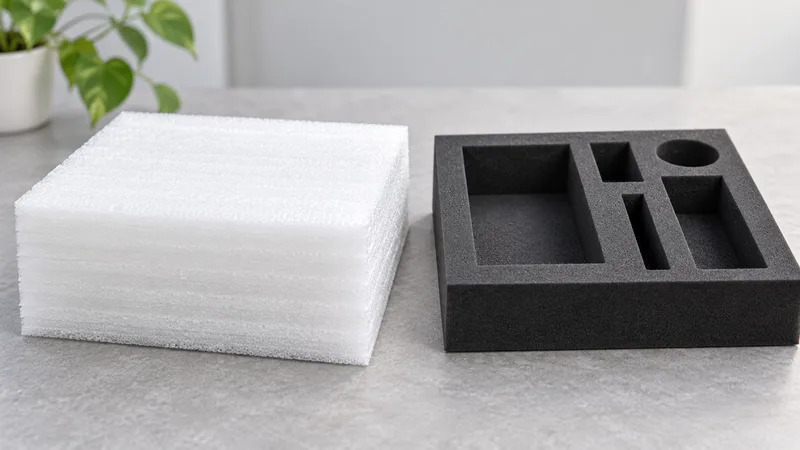
An EPE foam vs EVA foam decision begins with the packaging task and the selection directions supported by the source material. EPE is recorded for electronics and precision-instrument transport protection, with sheet, roll and custom die-cut delivery directions. EVA is recorded for packaging inserts and cushioning pads, with hardness, color and thickness as selection directions. These records do not confirm one shared set of formats for both materials. Review the proposed grade and construction independently against the same product and acceptance criteria.
The EPE Foam product page describes EPE as a material and format route for packaging conversations, including sheets, rolls, tubes or profiles and custom die-cut inserts. The EVA Foam product page is a separate route for reviewing EVA material and components. Neither page should be read as a universal specification for every part. Grade, dimensions, conversion and availability require a project review and confirmation before release.
Set the same packaging brief for both candidates
Start with the part rather than a preferred material. Supply the overall envelope, projections, fragile features and surfaces that must remain clear. Mark connectors, displays, controls, cables and finished surfaces on a drawing or explain them with a representative sample. Include accessories that will occupy the finished pack. Without this context, a comparison can reward a convenient photograph instead of a package that works.
Describe the enclosure at the same time. Internal length, width and height, closure flaps, partitions and usable corner space can determine whether a layer or insert fits. A material that cushions the part on an open bench may prevent the carton from closing. A cavity that locates the main product may leave no room for its cable or accessory. EPE foam vs EVA foam comparisons are meaningful only when the same enclosure and accessory set are tested.
Map loading and removal. State which face enters first, whether the operator rotates the part, when a cover or separator is added and how the recipient removes it. If the pack is reused, record how the material is stored and reloaded. The sequence can favor a flat sheet, a wrap or a shaped insert independently of the material family. Treat handling as a requirement that both candidates must answer.
- Provide the product, accessories and enclosure in the proposed packed configuration.
- Mark support, contact, keep-out and clearance surfaces on the drawing or sample.
- Describe loading, closure, transport handling, unpacking and any planned reuse.
- List electrical, cleanliness, chemical or regulatory requirements separately from fit.
Define the protection objective in observable terms. The requirement may be separation from another part, orientation control, surface protection or a buffer during handling. If transport performance is needed, name the agreed evaluation method and acceptance criteria. Do not replace an evaluation plan with an unsupported promise about drops, impact or cushioning. Both materials should be reviewed against the same defined objective.
Understand what the material names do and do not tell you
EPE identifies a polyethylene foam route used in the project source for packaging formats such as sheets, rolls, profiles and custom inserts. That description helps a buyer choose a conversation path. It does not establish one density, thickness, color, cell structure or conversion tolerance for every order. The current planning record lists EPE density of 18–45 kg/m³ and sheet thickness of 0.5–100 mm as customer-provided parameters marked [需确认]. Treat them as discussion ranges until a grade and construction are confirmed.
EVA identifies an ethylene-vinyl acetate foam route. An EVA product page can be a starting point for another material discussion, but it does not make an automatic claim about resilience, hardness, compression, chemical behavior or packaging performance for a proposed insert. Ask which EVA grade and construction apply to the part. Keep the evidence attached to that grade and to the dimensions being sampled.
Color and surface appearance are weak comparison criteria. White EPE and colored EVA may look different because of a grade, conversion or presentation choice. A photograph cannot establish a mechanical property, electrical property or regulatory result. If appearance matters for identification or inspection, write it into the brief. If a functional property matters, request the relevant data and test conditions.
Property names also require context. Density, hardness, compression behavior and recovery can be measured using different methods, specimen dimensions and conditions. A value without its method is difficult to compare. Ask the supplier to identify units, test method and conditioning, then agree which values are acceptance limits and which are reference information. Keep estimated values out of the release specification.
| Review point | EPE foam | EVA foam |
|---|---|---|
| Source-backed application | Transport inner protection for electronics and precision instruments | Packaging inserts and cushioning pads; other source applications include footwear components |
| Source-backed selection direction | Sheets, rolls and custom die-cut delivery directions | Hardness, color and thickness selection directions |
| Initial review question | Does the task need a layer, wrap or product-specific cut form? | Which hardness, color and thickness requirements should the proposed grade address? |
| Project confirmation | Grade, dimensions, conversion feasibility and test evidence | Grade, dimensions, available construction and test evidence |
Use the source-backed differences to choose the first review question. When the packaging task involves a continuous wrap, a separation layer or a custom-cut form for an instrument, begin with the EPE format discussion. When the brief emphasizes hardness, color or thickness for an insert or cushioning pad, make those requirements explicit in the EVA grade discussion. Neither direction establishes a performance advantage. A project can justify reviewing both candidates, but each proposal must explain its construction and the evidence behind it.
Compare format and conversion with the part in view
For EPE, a sheet may serve as a separator, pad or blank, a roll may support wrapping and a custom insert may create product-specific cavities. These formats are shown on the EPE route, but the right choice still depends on the loading method and enclosure. Ask whether a flat layer provides enough location control or whether the part needs a shaped profile. Review interfaces when a sheet, wrap and insert are used together.
The EPE sheets, rolls and custom inserts guide develops those format questions in detail. For the broader sequence from product geometry to a sample decision, use the EPE protective-packaging selection guide. Keep their format advice attached to the EPE route rather than assuming that EVA has the same confirmed delivery options.
For EVA, discuss the format needed by the same brief. It may be a flat pad, a cut component or an insert with defined cavities. Do not assume that a process label such as die-cut or CNC establishes a tolerance. Ask which dimensions will be inspected, how edges and layers are handled and how a revision is controlled. The conversion route must be tied to the actual drawing and proposed grade.
Keep cavity dimensions and material construction together in the sample review. A change in thickness can affect carton closure; a change in cavity depth can affect support; a different layer arrangement can change removal force. Check the product, accessories and enclosure as one assembly. EPE foam vs EVA foam comparisons often fail when one material is tested as a loose pad and the other as a complete insert.
Where the package needs tubes or shaped profiles, identify the feature being protected and how the profile is retained. Where a layered insert is proposed, specify the role of each layer and the assembly sequence. These decisions are not settled by a material family. Record the design hypothesis for each candidate so sampling compares equivalent protection tasks.
Use evidence and standards references carefully
Standards organizations can help a team identify terminology and test methods for a brief. The ASTM International standards catalogue and ISO standards catalogue are useful starting points. A catalogue link does not prove that a particular EPE or EVA grade complies, and it does not establish that Green Foams holds a certification. Select an applicable method with the project team and request records connected to the proposed construction.
Separate mechanical fit from special requirements. Electronics packaging may require electrical, cleanliness or contact-material evidence. A successful cavity review does not prove an electrostatic property. A material color does not prove compliance. Record those requirements in the brief and ask for grade-specific evidence before approval. If a requirement is not confirmed, mark it pending rather than inferring it from a general description.
Environmental or reuse statements need the same scope discipline. If a buyer asks about reuse, recycling or a collection route, define the intended package, destination and evidence needed. Avoid making a universal claim about either foam family. Compare the actual construction and end-of-use context under review.
Commercial terms are also part of a realistic comparison. Share expected volume, delivery context, packing instructions and repeat-order assumptions. The current source set does not confirm minimum order quantities, sample fees, production capacity or lead times for either route. Request a quotation based on the selected construction. A technical sample supports a commercial discussion but does not create a fixed commitment by itself.
Run a side-by-side sample review
Prepare equivalent samples for the same product revision. Use the same enclosure, accessories, closure and packing sequence. Record the proposed material grade, dimensions and conversion details for each sample. Check that the product enters in the planned orientation, that sensitive features stay clear and that the package closes without unintended interference. Then remove the product using the planned method and record any snagging, excessive movement or trapped accessories.
Review fit before transport performance. Fit establishes whether the construction accommodates the part and enclosure. A transport evaluation examines the packed assembly under an agreed method and conditions. Passing a fit check does not automatically establish transport protection, and a transport result cannot resolve an operator who cannot load the insert consistently. Keep both acceptance questions visible.
- Send the same drawing, sample, enclosure details, accessories and protection criteria for both candidates.
- Request the proposed EPE or EVA grade, construction, dimensions and supporting test information.
- Review loading, closure, removal, surface contact and agreed protection criteria with representative samples.
- Record the selected material, revision, inspection points and unresolved requirements before release.
Use revision control after the comparison. A product feature, accessory or enclosure change can alter either candidate's cavity or clearance. Record the drawing and sample that the decision covers. If the packing sequence changes, revisit the points that depend on operator handling. An EPE foam vs EVA foam decision is specific to the reviewed configuration until a new review confirms otherwise.
For the EPE route, use the EPE Foam drawing-to-sample workflow to share the part brief. For a different material route, keep the same evidence discipline and discuss the EVA Foam product page separately. The useful outcome is a documented choice that explains why the proposed material, format and grade answer the product requirement.