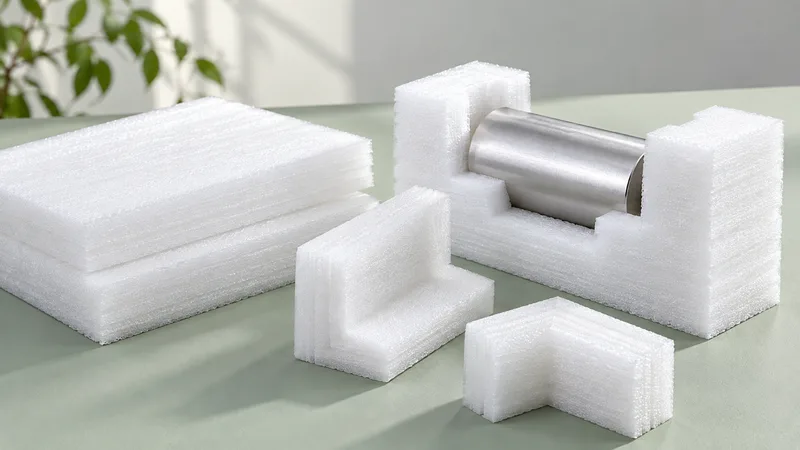
This EPE foam selection guide starts with the product and its package rather than a universal thickness recommendation. EPE is a packaging material route for electronics, precision instruments and other goods requiring separation and cushioning. The right construction depends on the surfaces being protected, the packing operation and the conditions the package will encounter. A material name alone cannot establish whether the completed package will meet those requirements.
The EPE Foam material and format review presents the available discussion routes: sheets, rolls, tubes and custom die-cut profiles. These routes provide a useful starting point for a brief, while dimensions and grade remain project decisions. This EPE foam selection guide explains how to organize that decision without assuming that every pictured format or published parameter represents an approved production specification for your application.
Define the part, its contact surfaces and the handling route
Begin by describing the part as it will actually be packed. A drawing should show the overall geometry, relevant projections and the features that require clearance. A representative sample can help explain surfaces that are difficult to describe in a drawing. Identify which features can support the product and which should remain free of contact. That distinction prevents a convenient cavity shape from becoming an unsuitable support arrangement.
For an instrument, the outside envelope may include controls, connectors or a delicate display that should not carry packaging loads. For an electronics component, the packing arrangement may need room for leads, cables or accessories. Those examples are questions to resolve with the buyer, not statements about completed customer projects. Use the EPE foam selection guide to record the actual contact requirements instead of borrowing assumptions from an unrelated product.
Next, follow the package through the intended workflow. Describe how the part is placed in the insert, how the carton closes and how the recipient removes it. Include intermediate handling when a part is packed, unpacked or repacked before shipment. An insert that fits on a workbench may still obstruct a connector or complicate removal in the real packing operation. The review needs the complete sequence rather than a single photograph.
- Identify the product orientation, support surfaces and features that need clearance.
- List the main product, accessories and separate compartments required in the finished pack.
- Describe loading, closing, handling and removal steps, including any planned reuse.
- Separate confirmed conditions from open questions about storage, transport or contact requirements.
Keep the outside package in the same discussion. The insert interacts with a carton, case or other enclosure; it is not an independent protection system. Supply the available internal dimensions and describe closure features that may reduce usable space. A change to the enclosure can alter the fit even when the part is unchanged. This EPE foam selection guide therefore treats the product and enclosure as one design brief.
Be precise about what protection means for the project. It may involve preventing parts from touching, keeping an instrument in a defined orientation or creating a buffer during handling. A requirement for shipping performance needs an acceptance method and a representative packed product. Avoid replacing that requirement with an untested claim such as a guaranteed number of drops. The brief should state what must be evaluated and who will approve the result.
Compare sheets, rolls and custom inserts by the packing task
Sheets are a route for flat pieces, separation layers and secondary cutting. They can be reviewed where the packaging operation needs a defined blank rather than a shaped cavity. Specify the dimensions of the blank and explain where it sits in the assembly. The EPE foam selection guide asks whether the sheet is separating surfaces, supporting a part or contributing to a layered construction, because those uses create different sample checks.
Rolls are a route for wrapping, continuous layers and general cushioning in a packing process. A roll discussion should include how the material is dispensed, positioned and removed, rather than only the finished package dimensions. If coverage depends on an operator's wrapping sequence, show that sequence during the sample review. Do not assume that a wrapping format will provide the same location control as a cavity-based insert.
Custom inserts are reviewed around product-specific geometry. Their cavities or cut profiles can organize the part and accessories within the available enclosure. The drawing needs to distinguish dimensions that control fit from dimensions that simply describe the overall blank. A sample should show how the product enters the cavity, where it contacts the material and whether it can be removed without forcing sensitive features. This is a central check in the EPE foam selection guide.
| Decision | Sheets | Rolls | Custom inserts |
|---|---|---|---|
| Starting geometry | Flat pieces or separation layers | Wrapping and continuous layers | Part-specific cavities or profiles |
| Packing question | Where should a layer separate surfaces? | How will the operator wrap the part? | Where should the insert support the part? |
| Sample review | Cut dimensions and layer placement | Coverage, overlap and removal | Cavity fit, orientation and handling |
| Information to supply | Blank dimensions and contact surfaces | Part dimensions and wrapping sequence | Drawing, sample and critical dimensions |
Tubes and shaped profiles are another discussion route when rods, pipes or a particular product outline need protection. Their suitability still depends on contact geometry and the packing arrangement. Describe the feature being protected and how the profile is retained during handling. A profile image demonstrates an example of form, not a verified fit for a different part. Use a drawing or sample to connect that form to the proposed application.
Layered protection can be reviewed when the brief calls for additional separation or a different support arrangement. Identify the purpose of each layer before discussing a construction. A base layer, compartment layer and cover layer may have different fit questions even when they share a material family. This EPE foam selection guide does not prescribe a layer count; the sample should establish whether the proposed assembly answers the actual packing requirement.
If another material route is being considered, keep the comparison focused on the same part and acceptance criteria. The EVA Foam product page offers another packaging material discussion, with grade and construction to be confirmed independently. Avoid ranking the two families from unrelated numerical ranges or appearance alone. A useful comparison asks how each candidate behaves in the same proposed package and what evidence supports the selection.
Confirm grade and evidence without turning a range into a promise
Material density, thickness, color and construction belong in the review, but they do not replace a functional brief. A broad range on a product page is not evidence that every combination is available for every geometry. Ask for the proposed grade and the dimensions that will be reviewed in the sample. Where supporting data are required, connect them to that grade. The EPE foam selection guide keeps this connection visible throughout procurement.
Different reported properties may use different test conditions, specimen dimensions or units. A number without its method can be difficult to compare, even when the property name looks familiar. Request the relevant data sheet and test method before using a value as an acceptance limit. Confirm which properties need supporting documentation and which can be evaluated through the packaging sample. Do not infer a certified result from a general description of material behavior.
Standards organizations can help a buyer identify the terminology and methods relevant to a testing brief. The ASTM International standards catalogue and ISO standards catalogue are reference starting points. A catalogue link does not establish that a particular standard applies or that Green Foams holds a certification. Select an applicable method with the project team and confirm the evidence needed for the proposed grade.
Electronics packaging may also involve requirements beyond mechanical fit. Record any electrostatic, cleanliness or contact-material conditions explicitly rather than assuming that ordinary EPE appearance proves them. These requirements need grade-specific review and evidence where requested. A white insert shown in a photograph cannot establish a special electrical property. The EPE foam selection guide treats this as a separate qualification question before the material is approved for the application.
- Ask which proposed grade and construction the data sheet describes.
- Record units, test method and conditions for any property used in acceptance.
- Confirm whether electrical, chemical or regulatory requirements need additional evidence.
- Keep open parameters marked as pending review rather than inserting estimated production values.
Packaging environmental claims require the same discipline. A claim about reuse, recycling or another environmental attribute needs a defined scope and supporting information. Consider the complete package and the intended collection route when those questions matter to the buyer. Avoid a universal statement about all materials or all destinations. This EPE foam selection guide recommends asking for the evidence relevant to the actual project, without turning a material family into an unsupported sustainability promise.
Commercial requirements should be recorded alongside the technical brief. Share the expected volume, desired delivery context and any packing instructions needed for review. The current guide does not promise a minimum order, sample turnaround, production capacity or fixed lead time. Those terms need a quotation based on the approved construction and order requirements. A technical sample can support a quotation discussion, but it does not silently establish the commercial agreement.
Use the sample to close fit, handling and release questions
A sample is most useful when it answers a written set of questions. Prepare the part, enclosure and accessories in the configuration expected for production. Check the dimensions that control fit, then load and remove the product using the planned procedure. Record any interference, excessive movement or difficulty closing the package. This EPE foam selection guide recommends reviewing the complete packing operation so the result can be traced to a repeatable configuration.
Distinguish a fit review from a transport-performance evaluation. Fit checks whether the proposed construction accommodates the part and the enclosure. A transport evaluation considers the packed assembly under the agreed conditions and method. Passing one does not automatically establish the other. State the acceptance criteria for each review and record the configuration tested, including accessories and closures, so a later revision does not inherit approval without an appropriate assessment.
- Send the part brief with a drawing, representative sample, critical dimensions and expected volume.
- Review the proposed material, format and cutting direction against the packing requirements.
- Check the sample for fit, loading, removal and the agreed protection criteria.
- Record approved dimensions, grade, revision and production requirements before release.
Use revision control when the sample changes. A small alteration to a product feature can affect cavity fit, while a new accessory can change the layout or removal sequence. Record which drawing and sample the approval covers. If the buyer changes the enclosure, revisit the dimensions that depend on it. The EPE foam selection guide treats the approval as specific to a defined package rather than a general authorization for future variations.
Agree on the production checks that matter to the finished component. These might include drawing dimensions, material grade, color or assembly features named in the brief. Discuss how those checks will be communicated and which documents accompany approval. Do not invent inspection tolerances without a source or agreement. The useful outcome is a clear set of requirements that the buyer and supplier can understand in the same way.
Finally, retain a concise record of the decision. Summarize why the chosen format fits the packing operation, which evidence supports the material choice and which open questions were closed by the sample. That record helps purchasing explain the selection and helps engineering assess a later change. Return to this EPE foam selection guide when a new product uses a different geometry or handling route; reuse the process while reviewing the new requirements independently.
For the next discussion, use the EPE Foam drawing-to-sample workflow and prepare the part information before requesting a component review. A complete brief creates a practical starting point for material, format and cutting choices. It also keeps the conversation focused on requirements that can be checked. The aim of the EPE foam selection guide is an approved, usable packaging component with clearly recorded decisions.