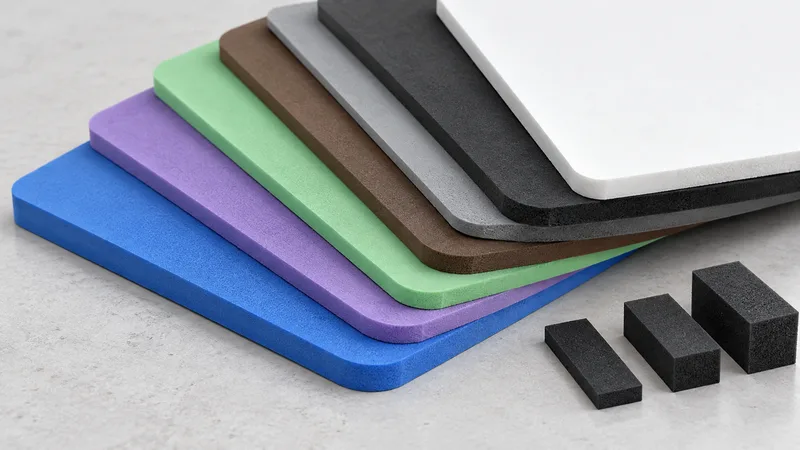
An EVA foam hardness, color and thickness guide helps a packaging team turn a general request into questions that can be reviewed. The customer record describes EVA for packaging inner liners, shoe materials and cushioning pads. For this topic, keep the application on packaging liners and cushioning pads. The planning data lists 50–190 kg/m³ and 15–75 Shore C as [需确认], and exact hardness, color and thickness choices remain project decisions.
The EVA Foam product page is the starting point for a drawing-to-sample discussion. Share the product, package envelope, format and expected volume before requesting a value. This guide shows how to connect a specification field with an observable package check without presenting an unverified range as a catalogue promise.
Describe the interface before selecting a value
Mark every surface that may contact the foam. Identify sensitive finishes, edges, protrusions and openings that require clearance. A broad product face may accept a liner, while a narrow edge may need a local pad or a gap. The same nominal hardness can feel different when the contact area and geometry change.
Explain the package and the handling sequence. Include the carton, case, closure and adjacent layers. Show where the operator grips the product and how the foam is installed or removed. A thickness that fits on a drawing can interfere with a closure or prevent a hand from reaching an edge. The specification should anticipate those practical checks.
Write the protection objective in a testable way. Separation, surface cushioning, locating and controlled clearance are different tasks. If a buyer expects transport or impact evidence, define the packed configuration and method separately. Hardness, color and thickness alone cannot establish a package-level result.
- Identify product contact, support, keep-out and inspection surfaces.
- Show package envelope, closure, available space and installation orientation.
- Describe the cushioning, separation or locating question the foam must answer.
- List the sample observations and evidence needed for acceptance.
Include format in the same brief. A sheet, roll-derived piece or custom insert may expose different edge, seam and retention questions. If a set contains several pieces, define their order and registration. Format affects the meaning of thickness and handling, so it should not be left as an afterthought.
Commercial context helps organize the review without creating a promise. State expected volume, destination and revision frequency. Tooling, minimum order, lead time and production capacity require project confirmation. Keep them separate from the material choices so the specification remains technically clear.
Use hardness to discuss contact and cushioning
Hardness is useful only when connected to the interface and the purpose of the part. A locating pad may need enough support to keep a product oriented. A cushioning pad may be judged by how it manages contact under a defined condition. A liner may need a balance between conforming to a surface and allowing removal. Ask the manufacturer to relate the proposed value to the construction.
The planning range of 15–75 Shore C is marked [需确认]. Do not select a value simply because it appears inside that range. Request the proposed grade, measurement method, specimen condition and any tolerance that applies. If two samples have different hardness, record whether thickness, density, color or process also changed.
Contact geometry can dominate the result. A small rib may create a local pressure point while a wide pad spreads contact. A pocket wall may guide a product but make removal difficult. Review the sample with the actual product and operator sequence. The useful question is whether the proposed construction meets the defined task under the intended conditions.
| Choice | Define in the brief | Confirm in the sample |
|---|---|---|
| Hardness | Proposed value, method and cushioning purpose | Contact, support, removal and observed behavior |
| Color | Color reference, variation and identification role | Appearance, orientation and consistency |
| Thickness | Nominal, critical sections and available space | Clearance, closure, compression and fit |
| Geometry | Pockets, pads, edges and keep-out surfaces | Product interface and operator access |
| Release | Revision, tolerance and open requirements | Approval scope and restrictions |
Request relevant material evidence when it is needed for the decision. The ASTM International standards catalogue and ISO standards catalogue are reference starting points for terminology and methods. Select a suitable method with the project team. These links do not confirm a Green Foams material grade, test result or certification.
Keep hardness separate from absolute claims about durability, recovery or service life. Those outcomes depend on material, geometry, load and conditions. If the buyer needs such evidence, define the conditions and request project-specific support. A visual fit check should not be described as proof of an untested property.
Use color for identification and controlled appearance
Color can help an operator identify orientation, distinguish a layer or coordinate the package with a visual system. Specify a reference, acceptable variation and the surfaces on which the color must be consistent. If one side is visible and another is hidden, state whether both require the same appearance.
Do not infer hardness, density or cleanliness from color. A color change may accompany a different grade or process, but that relationship must be confirmed. Compare samples only after recording whether their material and construction are equivalent. If a buyer needs a color match, treat it as an appearance requirement with a defined inspection approach.
Color also affects revision control. A new color may be introduced for operator identification without changing geometry. Conversely, a color change can accompany a material revision. Record the change and decide which fit, handling or protection checks need to be repeated.
- Specify the color reference, visible surfaces and acceptable variation.
- Use color for identification or appearance, not as a performance proxy.
- Record whether a color change also changes the proposed grade or process.
- Define the visual inspection point for sample and production review.
Use thickness to balance protection and package space
Thickness begins with the available package space and the required separation. Measure the assembled envelope, including closures and adjacent layers. Identify nominal thickness and critical sections where a tolerance matters. A custom insert may have several thicknesses; list each one against its interface.
More material does not automatically mean more protection. It can change closure force, access and product location. A thin layer may be adequate when the package supplies support, while a thicker pad may be needed at a local contact. Ask which dimension controls the decision and how it will be inspected.
Review compression or contact only under an agreed condition. A package drawing can show clearance, but it cannot establish behavior under every load or transport event. If a test is required, define the specimen, configuration, method and acceptance threshold with the buyer. Keep the result attached to the reviewed revision.
| Question | Material evidence | Package evidence |
|---|---|---|
| Value | Grade, unit, method and specimen | Observed result on the actual construction |
| Fit | Nominal thickness and proposed tolerance | Critical interfaces, closure and clearance |
| Handling | Format and surface condition | Loading, removal, replacement and orientation |
| Protection | Relevant property information | Defined configuration, method and acceptance |
| Change | Effect of grade or color revision | Checks to repeat on the new package revision |
When format or thickness changes, repeat the checks affected by that change. A new edge may alter access. A thicker liner may contact a closure. A thinner pad may change product movement. Document the reason for the revision so a later sample can be compared with the correct baseline.
Approve a specification through a controlled sample
Prepare the sample record with the product drawing, package, proposed format, hardness question, color reference and thickness dimensions. Identify the reviewer for fit, appearance, handling and any defined protection evaluation. Label what the sample represents and what remains open.
Observe loading, removal, orientation and retention. Inspect contact at sensitive surfaces and clearance at closures. Confirm color on the visible surfaces and measure critical thicknesses with the agreed method. If a sample is cut or assembled differently from the proposed production route, record that limitation.
- Define the product interface, package envelope and protection objective.
- Request proposed hardness, color, thickness, grade and relevant evidence.
- Review fit, handling, appearance and the agreed protection condition.
- Record approval scope, restrictions, revision and checks to repeat after changes.
Include the people who will use the package in the review. An operator may notice that a locating wall is difficult to reach, that a color cue is unclear or that a thick pad slows removal. These observations complement dimensional inspection. Record them alongside the drawing so the chosen hardness and thickness serve the real handling route.
Plan a small change review before routine supply begins. Ask what happens if the product finish, carton, color reference or available space changes. Identify which dimensions and appearance checks must be repeated and which records remain valid. This prevents an old sample from becoming an informal approval for a new construction.
Keep measurement tools and conditions consistent when comparing samples. State where thickness is measured, how a critical section is located and which surface is inspected for color. If the method changes, note that the values may not be directly comparable. The goal is a decision record that another reviewer can reproduce.
For a broader selection sequence, read How to choose EVA foam for protective packaging. For format decisions, use EVA sheets, rolls and custom inserts. If another packaging material is being considered, review EPE Foam vs EVA Foam comparison. Send the controlled brief through the EVA customization workflow so the next discussion can address feasibility and evidence.
A strong specification states what the material should be, where it sits, how it is handled and how acceptance will be decided. It also states which values remain [需确认]. That discipline keeps hardness, color and thickness useful to engineering and purchasing without turning a planning range into an unsupported guarantee.
Use one controlled record for the specification and the sample observations. Record the proposed grade, test method, specimen condition and drawing revision beside each hardness or thickness value. Add a simple visual reference for the approved color and identify which surfaces were inspected. If a value is still open, leave it marked [需确认] until the project team supplies evidence; do not let a provisional number migrate into a purchase description.
When the package contains several EVA pieces, review their interaction as a set. A thicker wall on one piece may reduce clearance for another, and a color or hardness change may affect how operators identify the order of assembly. Label each component, inspect the complete package and record which dimensions are shared. This makes later revisions easier to assess without assuming that a change to one piece is isolated.