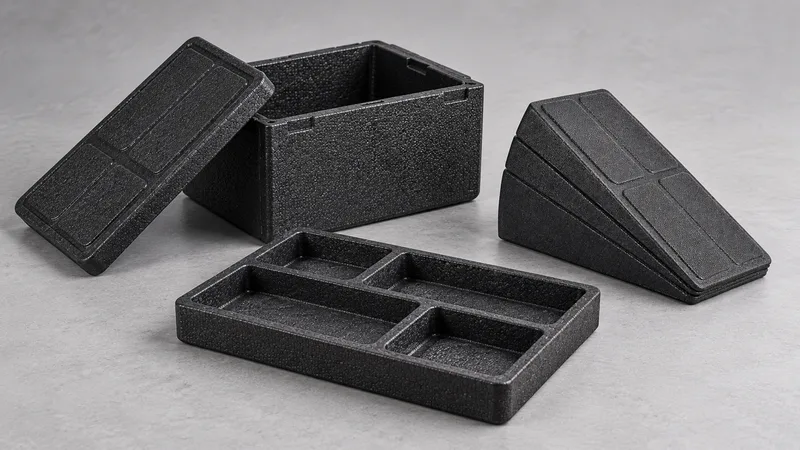
Molded EPP foam parts are component concepts reviewed around a defined shape and function. The customer source describes EPP for turnover containers, trays and energy-absorbing protective parts, with in-mold forming and insert concepts for further assessment. That source identifies a material family and application routes. It does not establish that every shape, interface or performance requirement has an approved production solution.
The EPP Foam product page is the starting point for discussing those routes. Use a drawing or representative sample to show how the component interacts with the product and its surrounding assembly. This guide distinguishes molded EPP foam parts by the questions they need to answer, helping buyers prepare a focused brief without transferring unrelated material claims into the project.
Start with the function of the molded geometry
A shape is useful when it answers a handling or protection requirement. Begin by explaining whether the proposed component encloses a product, locates several parts, separates contact surfaces or performs another defined protective task. Show the product in its intended orientation. An outside envelope gives context, while contact and clearance features explain what the geometry actually needs to achieve.
Identify the complete assembly before discussing details. Molded EPP foam parts may interact with a lid, another tray, an outer package or a mating component. List these elements and provide their relevant dimensions. If the review omits an interface, a satisfactory standalone sample may still create a problem when assembled. Treat the component and its neighbors as one configuration for the fit discussion.
Mark the surfaces allowed to make contact and those that need clearance. A locating feature can be helpful on one face and unsuitable on another. Include projections, connection areas and other sensitive features in the drawing. Explain where the operator grips the product during loading and removal. These details connect the proposed shape to a repeatable workflow rather than to a static product image.
- State the function of the component within the package or installed assembly.
- Identify product orientation, contact regions and keep-out areas.
- List neighboring parts, closures and mating interfaces that affect usable space.
- Describe the loading and removal sequence used to review the sample.
Define the acceptance approach for each function. Dimensional fit, loading access and protective behavior may require different checks. Keep them separate in the brief so approval can identify which question has been answered. Molded EPP foam parts should be evaluated under the conditions relevant to the project. A material-family description cannot replace that configuration-specific decision.
Review containers, trays and local protective parts
A molded container concept places the enclosure at the center of the review. Explain its opening, internal arrangement and relationship with a lid or other closure. Identify how the loaded package is gripped and moved. If the buyer intends to reuse the container, describe the empty handling route as well. These requirements guide the discussion without establishing an unverified service-life claim.
A molded tray concept places product arrangement at the center of the review. Show each product position, the direction of loading and the space around neighboring items. Describe any other layers or outer enclosure that interact with the tray. Molded EPP foam parts used as trays need a sample of the actual arrangement, since an individual cavity cannot resolve every interface in a loaded assembly.
A local protective part concept centers on a specific contact or retention task. Show where it is installed, what keeps it in position and which surfaces it supports or separates. If energy absorption is required, define the relevant evaluation method and configuration. The customer source describes that application direction, but it does not provide a performance result for an unspecified geometry.
| Component route | Main geometry question | Sample focus |
|---|---|---|
| Molded container | How do enclosure, opening and closure accommodate the product? | Loaded package, lid interface and removal |
| Molded tray | How are products located and kept clear of neighboring parts? | Arrangement, contact surfaces and loading sequence |
| Protective part | Where does the part support, retain or separate the product? | Installed interfaces and specified protective task |
| Insert concept | What role does the additional element have in the component? | Mating geometry, assembly and agreed evidence |
These routes can occur within one assembly, but their approvals should remain clear. A tray inside a container creates interfaces between the product, tray, enclosure and closure. A protective part attached to another element adds a retention question. Identify each component and the combined configuration. This keeps molded EPP foam parts from being approved in isolation when their function depends on neighboring elements.
For help organizing the first material decision, read the EPP foam selection guide for protective packaging. Keep its product geometry and handling questions alongside the component route. The useful outcome is a brief that explains why a container, tray or protective part is proposed and what the sample must demonstrate.
Discuss forming and insert interfaces without assuming scope
The customer source identifies in-mold forming as an EPP discussion route. Review the intended geometry and ask how the proposed process relates to critical dimensions and surfaces. Exact production conditions, tooling details and process availability remain [需确认] for the project. A process name alone cannot establish that every geometric feature is feasible or that an unagreed tolerance can be supplied.
Insert concepts need their own purpose and interfaces. Describe the additional element, its role and how it mates with the surrounding component or assembly. Provide a drawing or representative sample when those interfaces control fit. Ask which steps are proposed for the actual construction. Molded EPP foam parts with an insert concept should be reviewed as assembled components rather than as generic material examples.
Keep geometry changes visible during the discussion. A change to a locating feature may affect product access, while a change to a mating surface may affect closure. Identify which drawing revision is under review and whether a proposed alteration changes the function. Agree on the next sample questions before treating a design revision as a production release.
- Explain the function and mating geometry of any proposed insert element.
- Identify the dimensions that control assembly and those needing inspection.
- Confirm the proposed forming and assembly scope for the actual component.
- Record unresolved tooling, process and production questions as [需确认].
Do not infer commercial terms from a drawing review. The current knowledge base does not establish tooling charges, minimum order quantities, sample schedules, production capacity or delivery periods for a new molded component. Share expected volume and delivery context, then request a project quotation. A technical review of molded EPP foam parts and a commercial agreement each need an explicit scope.
Confirm material evidence and evaluation conditions
Material grade must remain connected to the proposed component. The customer source contains EPP density ranges marked [需确认], and their scope requires reconciliation. Do not treat those draft values as an approved supply range for every container or tray. Request the grade proposed for the sample and the documentation relevant to the project's requirements.
Keep units, methods and reported conditions with material values. A similar property name does not guarantee that two results were obtained in comparable ways. Identify which evidence describes the material and which describes the completed assembly. Molded EPP foam parts can require both kinds of review, but a data sheet alone does not establish a complete-package outcome.
The ASTM International standards catalogue and ISO standards catalogue are reference starting points for suitable terminology and methods. Select an applicable method with the project team and request the relevant records. These links do not prove compliance or establish a Green Foams certification. They support defining the evidence question rather than answering it automatically.
| Release item | Review input | Record to retain |
|---|---|---|
| Geometry | Drawing and critical contact or mating interfaces | Approved revision and sample reference |
| Material | Proposed grade with relevant data and conditions | Grade reference and evidence reviewed |
| Function | Loaded assembly and agreed evaluation method | Configuration and acceptance decision |
| Handling | Loading, unloading and any empty-return arrangement | Reviewed workflow and remaining restrictions |
Separate fit from protective behavior in the review. Fit concerns the product and interfaces within the assembly. Protective behavior concerns an agreed task under defined conditions. A sample that accommodates the product is useful, but it does not prove every transport or energy-absorption requirement. Record the relevant acceptance result for each question rather than combining them into a general approval.
Special contact, cleanliness or environmental requirements need defined scope and evidence. The material name or color cannot establish a grade-specific property. Similarly, an intended return workflow cannot establish a guaranteed number of reuse cycles. Keep open evidence requirements pending. The project review should explain what is known about the proposed molded EPP foam parts and what still needs confirmation.
Use the full configuration for sample approval
Prepare the sample with the product, accessories and mating components relevant to the operation. Check the planned loading direction, contact surfaces and removal path. Close the enclosure when a closure is part of the assembly. For a tray, use the complete arrangement and relevant surrounding layers. Observe the real handling sequence so the decision includes access as well as static fit.
Review empty storage or return handling when required. Use the arrangement described in the brief and identify any interference between neighboring components. Record the configuration and conditions checked. These observations can inform the design review, while longer-term durability or service-life questions require their own agreed evaluation. Keep the distinction visible when discussing molded EPP foam parts intended for repeat handling.
- Identify the drawing revision, proposed grade and full sample configuration.
- Check critical fit dimensions, contact surfaces and mating interfaces.
- Observe loading, closure, removal and any specified empty-return arrangement.
- Complete the agreed functional evaluation and record approval or required revisions.
Retain a decision record that another engineer or buyer can understand. Include the sample reference, reviewed evidence, approved drawing and remaining restrictions. If the product, enclosure or handling sequence later changes, revisit the affected checks. An earlier approval belongs to the defined configuration. It should not silently become approval for a different tray, closure or installed protective part.
Use the EPP molded-parts project brief to organize the next discussion. For a broader comparison, the EPP vs EPE returnable-packaging guide keeps both routes tied to the same requirements. Then share the drawings and sample context through the EPP Foam drawing-to-sample workflow. Clear inputs make molded EPP foam parts easier to review as practical components.