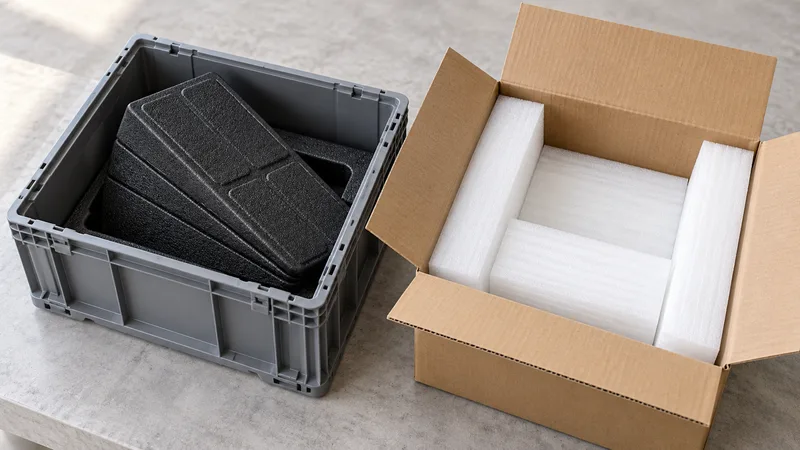
An EPP vs EPE foam comparison for returnable packaging begins with the journey of the product and the empty package. A buyer needs to understand how the product is loaded, transported, removed and returned before judging a material route. The company source identifies EPP foam with returnable containers, pallets and energy-absorbing protective parts. EPE is recorded for transport inner protection, including sheet, roll and custom-cut directions. Those descriptions establish useful discussion paths. They do not establish a universal service life or a finished design.
The EPP Foam material page is the starting point for a molded-part or returnable-component discussion. The EPE Foam packaging page provides a separate route for reviewing EPE protection. Keep these material conversations attached to the same packaging task. An attractive container photograph cannot explain whether the product fits, whether an operator can remove it or whether the empty assembly returns efficiently.
Describe the return loop before comparing materials
A return loop includes more than the loaded transport stage. Identify the point where a product enters the package, the handling equipment used and the location where it leaves. Explain whether the protective component remains with the container, travels separately or is inspected before loading again. These choices affect retention, access and identification. They can also expose a design assumption that a material-only comparison would miss.
Supply the product envelope, mass information and the surfaces that may or must not contact protection. Mark protrusions, finished faces, openings and features that need clearance. Include the other items carried in the same package. When several products share a container, explain their arrangement and the loading sequence. A common external footprint does not mean that every product revision shares the same internal support requirement.
Describe the surrounding container and transport system. Internal dimensions, closure arrangement, stack interfaces and handling access can constrain both candidates. If the proposed EPP part is itself a container or tray, identify which interfaces it must provide. If EPE is a protective component inside another package, identify how it stays in place. The EPP vs EPE foam decision should follow those responsibilities rather than assuming that both routes produce identical assemblies.
- Provide the product drawing, representative sample, accessories and packed orientation.
- Describe loading, unloading, empty return, storage and inspection at each handover.
- Identify contact, support, clearance and handling interfaces on the assembly.
- State cleaning, exposure and protection requirements as separate acceptance questions.
Define what the returnable project is meant to achieve in observable terms. The objective may involve consistent location, product separation, controlled handling or a repeatable packing sequence. Avoid replacing those requirements with an assumed number of trips. Service life needs an agreed evaluation scope and evidence for the actual grade and construction. Record what the buyer expects to inspect when a component is returned.
Separate molded geometry from a protection format
For an EPP concept, discuss which geometry belongs in the molded part. The source material supports an in-mold forming and insert concept for project review, while the applicable production capability remains subject to confirmation. Show cavities, locating features, access areas and interfaces in context. Ask which aspects of the proposed design can be evaluated in an early sample and which require a production-representative molding review.
For an EPE concept, describe where a sheet, roll or custom-cut component supplies the protection required by the brief. A flat separator, wrap or shaped inner component may have a different installation sequence from a molded container. Specify how it is retained and which surrounding structure supports it. The format must be selected for its task; it should not be inferred from the fact that EPE appears in another packaging project.
Keep the geometry discussion qualitative until the proposed grade and route are available. A material family name does not define one density, wall arrangement, tolerance or load limit. The planning sources contain different EPP density ranges that still need reconciliation. This guide does not select a number from those records. Request a grade-specific material data sheet and agree how any property will be used in the design review.
| Review point | Molded EPP direction | EPE protection direction |
|---|---|---|
| Project starting point | Molded container, tray, pallet or protective-part concept | Sheet, roll or custom-cut protection concept |
| Geometry question | Which features belong in the molded part? | Which protection areas need a cut or assembled form? |
| Handling question | How is the formed component loaded, returned and inspected? | How is the protective component placed, retained and replaced? |
| Evidence needed | Proposed grade, molding route, drawing and representative sample | Proposed grade, format, conversion details and representative sample |
| Release boundary | Project-specific fit and agreed evaluation criteria | Project-specific fit and agreed evaluation criteria |
Geometry changes can affect the commercial route as well as fit. A revision to a formed cavity, an insert interface or a cut profile may involve different work. Identify the drawing revision and explain which features are likely to change during development. Ask for the tooling and conversion assumptions behind each proposal. Do not assume that an early sample or a previous project establishes the terms for a new production part.
Compare handling and inspection in equivalent assemblies
Use the same product and accessory set when comparing samples. A loose EPE pad and an empty EPP tray do not perform the same task and cannot resolve the material question fairly. Build the proposed assembly for each route, including its enclosure, partitions and retained components. Review loading, closure, movement and removal using the expected operator sequence. Record the differences at the actual interfaces.
For a returnable container or tray, examine what happens after unloading. Explain whether it is stored full-size, stacked with others or moved in a different orientation. Check access for inspection and identification. If the component must remain with another structure, review retention during the empty return. A well-fitting loaded assembly can still be inconvenient to return or difficult to prepare for the next use.
For an EPE protective component, review its placement and handling across the intended return process. Determine whether the operator can consistently restore the correct orientation. Identify any loose component that needs inspection, replacement or separate storage. These are project questions, not claims that a material will fail. The relevant evidence comes from the actual construction and the conditions agreed with the buyer.
Cleaning requirements also need a defined scope. State the method, exposure, drying and inspection sequence used in the facility. Do not infer compatibility from the material name or color. Ask for evidence covering the proposed grade and the intended exposure. If cleaning remains undecided, keep that requirement open rather than treating a sample fit review as proof that the full return system is ready.
| Evaluation stage | Keep equivalent | Record in the review |
|---|---|---|
| Loading and removal | Observe the same operator sequence | Snagging, interference, orientation and clearance |
| Return handling | Describe unloading, empty return and storage | Retention, stacking arrangement and damage inspection |
| Cleaning requirements | State the actual cleaning method and exposure | Grade-specific compatibility and agreed inspection |
| Transport protection | Evaluate the packed assembly against an agreed method | Acceptance criteria and traceable test records |
| Commercial review | Use the same quantity and delivery assumptions | Tooling scope, sample terms and quotation boundaries |
Distinguish appearance from acceptance. A visible mark may or may not affect the protective task, while a change at a locating or retention surface may need a closer review. Establish inspection points with the project team. Explain who decides whether a returned component remains usable. Avoid informal criteria that depend on a different operator's interpretation on each trip.
Use evidence to test the selected packaging hypothesis
An EPP vs EPE foam comparison should identify what the team still needs to prove. Fit demonstrates that the product and enclosure can be assembled as intended. A handling review examines operator access and retention. A transport evaluation considers the complete packed assembly under an agreed method. These are connected tasks, but a successful result in one does not automatically answer the others.
The International Safe Transit Association provides a reference point for discussing packaged-product evaluation. The ASTM International standards catalogue is another starting point for identifying relevant test methods. Select the applicable method and acceptance criteria with the project team. These links do not establish that a Green Foams material, part or package has passed a test or holds certification.
Ask which data describe the proposed foam grade and which describe the finished package. Material measurements alone cannot establish the behavior of every cavity and enclosure. A package test also has a defined configuration and conditions. Keep reports tied to the product revision, component construction and packed arrangement reviewed. When a feature changes, identify whether the earlier evidence still applies or whether the team needs another evaluation.
Reuse and environmental questions need the same discipline. A returnable concept may be intended for repeated handling, but this guide does not promise a cycle count, recyclability route or environmental advantage. Define the actual collection, inspection and end-of-use process. Request evidence relevant to that process rather than translating a material family into a general sustainability claim.
- Identify the proposed grade, manufacturing route and drawing revision for each sample.
- Agree fit, handling and transport questions separately before evaluation.
- Record the packed configuration, test conditions and acceptance decision.
- Keep unresolved cleaning, compliance and return-life requirements visible.
Release a documented route rather than a material preference
After the sample comparison, record why the preferred construction answers the task. Include the product revision, interfaces, packing sequence, grade and agreed inspection points. Describe limitations of the evidence as clearly as the accepted results. This record helps purchasing, engineering and operators work from the same configuration. It also provides a useful starting point when a later product or container revision appears.
Request commercial information against that configuration. Share expected quantity, repeat-order assumptions, delivery context and the scope of tooling or sample work. The available source set does not confirm EPP-specific minimum order quantities, lead times, tooling prices or service-life commitments. Those terms require a project quotation. Comparing proposals with different quantities or unfinished geometry can obscure the practical difference between routes.
For a deeper view of the molded concept, use the guide to molded EPP parts, containers and trays. If the brief is still being assembled, the EPP molded-parts project brief explains the input required for automotive, packaging and sports-equipment discussions. Both guides support the material page rather than replacing a drawing-specific review.
The practical result of an EPP vs EPE foam comparison is a traceable packaging choice. It describes the task, explains the proposed route and shows what the sample and evidence actually establish. A material preference becomes useful only when it is connected to a product, an assembly and an agreed return process. Send those details through the EPP enquiry route so the next discussion can focus on feasibility and the remaining decisions.