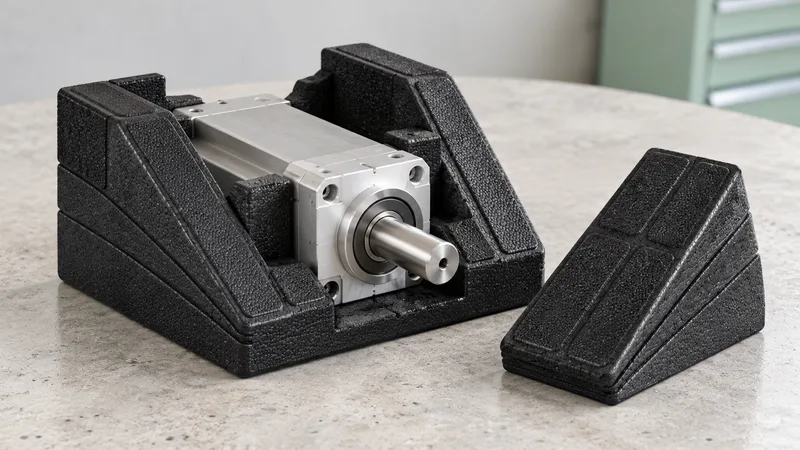
This EPP foam selection guide begins with the component and its handling route. The customer source describes EPP for turnover containers, trays and energy-absorbing protective parts, with in-mold forming and insert concepts available for project review. These descriptions identify useful discussion routes. They do not establish an approved grade, a repeat-use lifetime or a guaranteed result for a new package.
The EPP Foam material and component review provides the family-level starting point. Define the actual geometry and required behavior before selecting a construction from a photograph. This EPP foam selection guide explains the questions that connect engineering, packing and purchasing: what the part contacts, how it moves, what evidence matters and which sample checks will close the decision.
Define the product and the complete handling route
Start with the product as it will be handled. Supply a drawing or representative sample that identifies its outside envelope, projections and surfaces that can support contact. Mark features that need clearance and areas where a locating wall may be acceptable. A simple outside dimension cannot describe every interface. The component review needs enough information to distinguish a support surface from a sensitive feature.
Include the surrounding package or equipment. A molded tray may sit within a larger container, while a protective part may be retained by another component. Describe closures, mating surfaces and the available space around the product. If a lid, frame or adjacent layer changes, the proposed EPP geometry may need another review. This EPP foam selection guide therefore considers interfaces alongside the product itself.
Follow the loaded assembly through its intended operation. Explain where it is loaded, how an operator grips it, how it is moved and how the product is removed. Include any steps that change orientation or place the assembly beside other packages. Do not replace that workflow with a generic label such as transport packaging. Specific handling steps help the team identify what the sample must demonstrate.
- Identify product contact surfaces, keep-out regions and critical dimensional interfaces.
- Describe the enclosure, lid, mating components and other parts of the loaded assembly.
- Record loading, movement, unloading and any planned return or storage steps.
- Define the protection objective and the evidence needed to accept the proposed construction.
For a returnable arrangement, describe the empty route separately. Empty components may be stored or handled differently from loaded ones. State whether the buyer expects stacking, nesting or another arrangement, and identify the space available for it. Those are design requirements to review, not features established for every EPP component. Use the EPP foam selection guide to keep loaded and empty conditions visible.
Translate protection into an acceptance question. The project may need product location, separation, energy absorption or another defined function. Describe the complete configuration and evaluation conditions for that function. An unsupported claim about a number of impacts or cycles cannot replace an agreed review. The useful brief says what must be checked and who will approve the evidence.
Compare molded containers, trays and protective parts
A molded container discussion centers on the enclosure and its interfaces. Identify its opening, internal product arrangement and relationship with a lid or surrounding handling system. The loading route matters because a geometry that locates the part may still restrict access. Ask how the operator will place and remove the product, then use a representative sample to check that process.
A tray discussion centers on product arrangement and repeatable placement. Show the intended orientation and any neighboring products or layers. Specify where a locating feature may contact the part and where it needs clearance. This EPP foam selection guide treats the loaded tray as an assembly: the product, accessories, tray and any surrounding enclosure must be evaluated together.
A protective part discussion may involve a local interface rather than a complete enclosure. Identify what retains the part, the surfaces it supports and the function it is expected to perform. A protective geometry alone does not prove an energy-absorption result. Connect the material proposal and installed configuration to an agreed evaluation method before relying on that result in a specification.
| Review dimension | Molded container | Tray | Protective part |
|---|---|---|---|
| Geometry | Enclosure and loading opening | Part arrangement and location features | Local support and clearance |
| Handling | Loaded movement and empty return | Loading, unloading and orientation | Assembly, retention and removal |
| Interfaces | Lid, base and surrounding equipment | Product, accessories and adjacent layers | Product surface and mating component |
| Approval | Complete package configuration | Loaded tray and intended handling route | Installed part and specified protection task |
In-mold forming and insert concepts belong in the process review. If an insert is proposed, explain its purpose, mating geometry and relationship to the surrounding material. Identify which interfaces need a drawing and which checks apply to the assembled sample. The source supports discussing these concepts, while exact process availability and production conditions remain [需确认] for the project.
Do not treat the three routes as interchangeable shapes. A container may have closure questions, a tray may have location questions and a protective part may have retention questions. Read the molded EPP parts, containers and trays guide when preparing those distinctions. The EPP foam selection guide is most useful when each candidate has a clear purpose.
Connect the grade proposal to reliable evidence
The planning record contains EPP density ranges of 17–100 kg/m³ and separate 30–110 or 20–180 g/L statements, all marked [需确认]. These values need reconciliation before they become a published supply specification. Ask which grade is proposed for the component under review. Do not select a grade merely because a broad range contains a familiar number.
Request relevant property information with its units and test conditions. Two values with similar names may describe different specimens or methods. A material data sheet is useful only when its relationship to the proposed grade is clear. This EPP foam selection guide separates that material evidence from the geometry and the complete-package evaluation so each decision has an identifiable basis.
The ASTM International standards catalogue and ISO standards catalogue provide reference starting points for terminology and methods. Choose an applicable method with the project team. These catalogue links do not establish compliance, a completed test or a Green Foams certification. Request the evidence required for the actual construction.
| Question | Information to request | Approval record |
|---|---|---|
| Material choice | Proposed grade and relevant property documentation | Grade reference and reviewed evidence |
| Dimensional fit | Critical drawing interfaces and agreed inspection approach | Drawing revision and sample observations |
| Protective behavior | Applicable evaluation method and packed configuration | Acceptance criteria and evaluation record |
| Repeat handling | Loaded and empty workflows with defined conditions | Reviewed workflow and open restrictions |
Requirements for contact compatibility, cleanliness or another special condition need their own review. The EPP name and a product image cannot establish a grade-specific property. State those requirements in the brief and identify the evidence expected by the buyer. When a requirement remains open, keep it pending rather than inferring an approval from ordinary material appearance.
- Connect every proposed property value to a grade, unit and reported test condition.
- Separate material documentation from dimensional sample observations.
- Evaluate the complete assembly when protective behavior depends on its configuration.
- Keep unconfirmed process, commercial and compliance requirements marked [需确认].
Environmental and reuse questions also need a defined scope. Describe the expected handling conditions, end-of-use route and evidence needed for the buyer's decision. Avoid a universal lifetime or recycling promise for the whole material family. This EPP foam selection guide asks how the proposed component will actually be used and reviewed, without turning a design intention into a demonstrated result.
Provide commercial context alongside the technical information. Expected volume, delivery destination and revision frequency can help organize the quotation discussion. Current sources do not establish a fixed minimum order, tooling charge, sample period, production capacity or lead time. Those terms remain [需确认] for the proposed construction. A sample approval and a commercial agreement should each identify their own scope.
Approve the sample and preserve the decision
Prepare the sample review before the component arrives. List the drawing revision, product, surrounding enclosure, proposed grade and open requirements. Identify which dimensions control fit and which handling steps must be observed. This EPP foam selection guide recommends using the same configuration expected in operation so a convenient demonstration does not become approval for a different assembly.
Check loading and removal using the planned grip and orientation. Look for interference, unexpected contact or difficulty closing a lid. Review locating and retention features with the actual mating components. For a tray, include the planned product arrangement and neighboring layers. Record observations with the reviewed configuration rather than relying on a general statement that the sample fits.
- Send the product brief, drawing or sample, critical interfaces and intended handling route.
- Review the molded component concept, proposed grade and any insert interfaces.
- Check fit and operation, then evaluate protective requirements by the agreed method.
- Record approval, remaining restrictions and production requirements against a controlled revision.
Separate a fit decision from a protective-performance decision. Fit shows that the assembly accommodates the product and its interfaces. An evaluation under defined conditions addresses the specified protective function. Neither decision automatically resolves every return-handling or service-life question. Keep the EPP foam selection guide checklist focused on the acceptance criteria agreed for this project.
When the product or handling route changes, revisit the affected checks. A relocated projection may alter a tray cavity, while a different lid may alter the available clearance. A changed return arrangement may affect storage interfaces. Retain the approved drawing and sample reference so engineering and purchasing can distinguish a repeat order from a new configuration requiring review.
For a material comparison, read EPP vs EPE foam for returnable packaging and keep the same handling requirements on both sides. To start the component review, use the EPP Foam drawing-to-sample workflow. A concise decision record should explain the selected geometry, supporting evidence and sample outcome. This EPP foam selection guide provides the structure for that record.