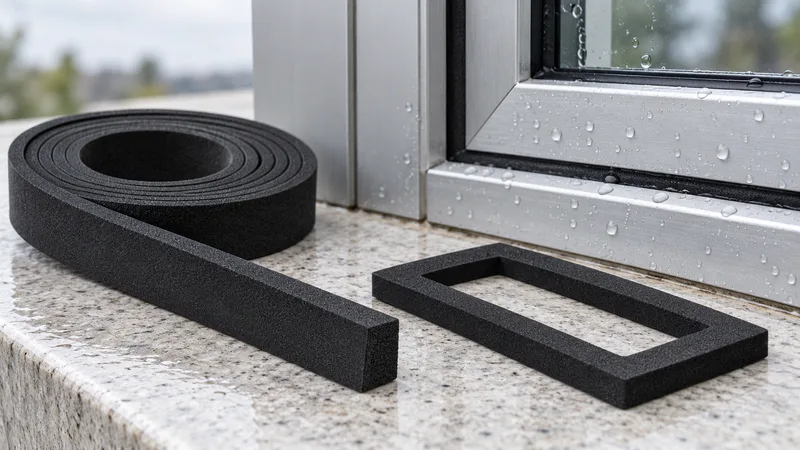
How to choose EPDM Foam for outdoor sealing begins with a joint that can be drawn and reviewed. The client knowledge base identifies closed-cell EPDM sealing material for outdoor lighting, doors and windows, and photovoltaic sealing discussions. It does not establish a universal weathering life, temperature range, ingress rating or verified grade for every outdoor assembly.
Use the EPDM Foam product hub to frame the material request, then attach the mating-part references and drawing revision. The purpose of selection is to connect one joint to a proposed material and evidence plan. A family name or an outside photograph cannot make that connection on its own.
Draw the interface that needs contact
Provide a section through the joint and a plan view of its path. Identify the two mating surfaces, the intended contact band, nearby steps and surfaces that must remain clear. A plan outline alone can hide local features that determine the available section and make a sample difficult to interpret.
Record the gap as geometry, including locations that may vary along the interface. Ask the drawing owner which dimensions control placement and which counterpart revisions define the reviewed gap. Do not assign a universal compression allowance from the EPDM name or from a planning density range.
- Identify the joint drawing and counterpart references.
- Mark the locations that require inspection.
- Keep pending material and application evidence visible.
Name the components that surround the foam. A fastener, clip, cover edge or frame feature can affect the final position and inspection access. Keep those references with the joint drawing so a converter can evaluate the requested outline without guessing which hardware is fixed or which part may be revised.
Separate contact intent from material performance. The design can request a continuous path or clearance around a feature, while the assembled outcome still needs an appropriate evaluation. A visible contact observation is useful for geometry development; it does not by itself prove a water-ingress result or outdoor lifetime.
Describe how the joint is assembled
Write the placement, fastening and removal sequence in practical terms. State which part receives the foam and which counterpart is brought into position. Identify where an operator can see or reach the interface. This helps reviewers find an installation issue before calling it a material-selection problem.
Record whether orientation needs to be identified before assembly. An outline with similar ends or hidden notches can be installed incorrectly even when the material record is appropriate. The drawing should show the reference feature and the sample review should make the intended orientation observable.
Consider access after the counterpart is in position. A joint can become concealed before a reviewer notices a displaced region or missing feature. Ask quality which dimensions and placement conditions need a pre-assembly check, then retain that check with the sample identity rather than relying on the external appearance.
If an adhesive, carrier or retention feature is proposed, request its actual scope and interface evidence. The knowledge base does not confirm universal adhesive backing or bond compatibility. Keep these items [需确认] instead of assuming custom EPDM supply includes every installation aid.
| Decision field | Request input | Review purpose |
|---|---|---|
| Joint | Mating surfaces, gap and required contact | Define the sealing location |
| Exposure | Actual condition and evidence owner | No universal outdoor claim |
| Installation | Placement and fastening sequence | Make handling constraints visible |
| Material | Proposed grade and methods | Keep planning values pending |
| Approval | Sample configuration and scope | Separate fit from rating evidence |
Turn outdoor exposure into specific questions
Describe the actual location and exposed surfaces. A gasket inside an outdoor-lighting cover and a foam component in another assembly can have different exposure and inspection boundaries. Identify what contacts the material, which edges are exposed and which conditions the project owner requires the grade or system to address.
Keep temperature, UV, ozone, cleaning and other environmental questions with their owner and required record. The current source does not provide validated universal limits or service-life data. Ask for evidence that identifies the proposed grade and configuration instead of filling the brief with broad weatherproof language.
A required enclosure or application result belongs to the assembled system. Record the applicable evaluation path with the project team. A material record can inform that work, but it cannot automatically approve the cover, fasteners, mating surfaces or other parts that contribute to the final result.
Separate verified observations from untested conditions. A sample may show placement and contact under one setup while an environmental requirement remains pending. State this boundary so procurement does not interpret an early fit acceptance as a fully released outdoor assembly with every performance question resolved.
Read grade fields as supporting evidence
The knowledge base retains 70–250 kg/m³ and Shore C 10–35 as [需确认]. These are source planning ranges, not confirmed stocked grades or universal purchasing limits. Request the proposed grade, density method, hardness scale and method, specimen thickness, conditioning and tolerances associated with the sample.
Density describes mass relative to volume. Shore C describes an indentation-hardness reading under a stated method. They answer different questions and neither establishes installed sealing force, a temperature rating or a system result. Preserve both fields separately rather than turning a density range into a firmness recommendation.
- Identify the joint drawing and counterpart references.
- Mark the locations that require inspection.
- Keep pending material and application evidence visible.
The density and hardness guide helps identify the missing measurement context. Use it to request comparable records, then relate the records back to the joint geometry and installation questions. A technical sheet should identify the material being reviewed, not replace the assembly brief.
Consult ASTM International and the ISO standards catalogue with the test owner for method language. Catalogue links do not establish Green Foams measurements or certify an EPDM grade or enclosure.
Choose the format after the joint is defined
Discuss sheet, strip and custom-gasket concepts against the same contact path and local sections. A format can simplify a particular geometry question while adding handling or inspection questions elsewhere. Actual dimensions, conversion tolerances and backing options need project confirmation rather than assumptions from the format name.
The EPDM format guide examines outline, strip ends, corners, identification and conversion scope in detail. Refer to it when the route is open, while retaining the mating parts and critical contact regions from this selection record.
An alternative format should identify what changes. A different join location, thickness, backing or outline can require another installed review. Capture the proposal as a construction revision so a buyer does not treat a similar outer size as proof that the sample has the same sealing interface.
State expected volume and revision timing as request inputs. Actual stock, minimum order, capacity and lead time remain commercial confirmations. The resource page should help the buyer ask a precise question without inventing a supply promise to accompany the technical proposal.
Approve the sample with a defined scope
Prepare a sample record with joint drawing, counterpart revisions, material proposal and installation sequence. State which locations and observations matter to the next decision. The reviewer should know whether the sample is intended for geometry development, assembly handling or a separately defined performance evaluation.
Inspect the material position before the interface is concealed, then review the assembled joint. Record local interference, displacement, open questions and any changed installation step. Keep photographs or measurements linked to the sample configuration when the project allows those records to be retained.
Give geometry, material evidence and application evaluation distinct approval fields. A designer may approve the outline; assembly may review handling; quality may identify inspection; the application owner may define required tests. Purchasing should preserve those scopes instead of reporting the sample as universally approved.
If the trial creates another question, identify the changed variable and next owner. A cover revision, another gap location or a proposed backing may need a new sample. Repeating an undefined trial is less useful than asking the next sample to resolve a specific interface or evidence issue.
Carry the decision into a project brief
Use the outdoor-lighting and solar gasket brief when the application owner needs to prepare procurement inputs. It assigns assembly references and evidence responsibilities rather than repeating the geometry-to-format comparison. Keep the selected joint and open requirement list together during quotation.
Ask proposals to state deviations from the controlled request. A changed grade or conversion route should identify its effect on the drawing and evidence plan. Two quotations are comparable only when the buyer understands the actual construction, sample scope and commercial assumptions being offered.
Preserve the approved sample identity and the fields still awaiting confirmation. The record should say which changes require further review. A later buyer can then compare a replacement against the actual joint instead of inheriting an unexplained material label or an old photograph.
A useful outdoor EPDM selection is traceable to one assembly. It explains where the foam goes, how it is installed, what records describe the material and which evidence is still needed. That record moves the project forward without assigning an unsupported life, ingress or weathering guarantee to a family name.
Maintain a decision log when a trial changes the proposed grade, local gap, counterpart or backing. Identify the previous configuration, the changed field and the question the next sample is meant to resolve. Carry forward only the observations that still apply to the unchanged configuration. This gives engineering and purchasing a clear reason for the next trial and prevents an earlier fit observation from silently approving a new material or interface.
- Confirm the reviewed drawing and material proposal.
- Identify the required observations and evidence owners.
- Record the sample, deviations and accepted scope.
- Revisit affected fields when the construction changes.