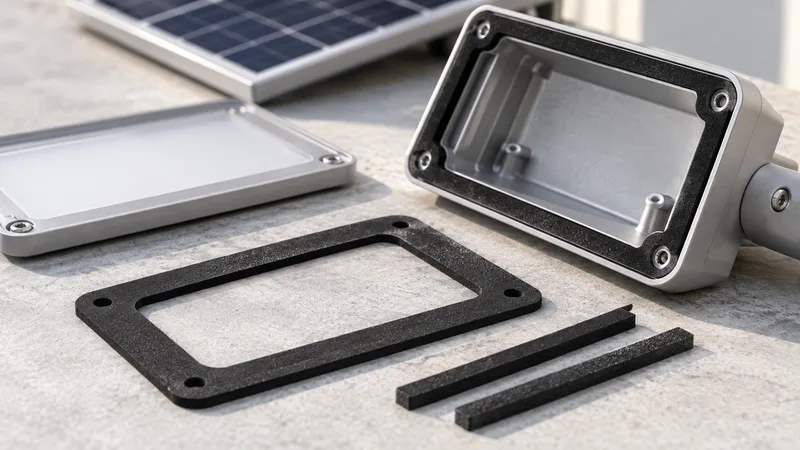
An EPDM Foam gasket brief for outdoor lighting and solar is a procurement record for a specific assembly. The client knowledge base identifies both application directions, along with door/window sealing, but does not provide a named project, IP rating, electrical-safety result or solar lifetime. The brief should define what evidence is requested rather than imply those outcomes already exist.
Start with the EPDM Foam product hub and a controlled component reference. This article focuses on ownership, application inputs and handoff. The format guide remains responsible for sheet, strip and custom-outline conversion choices, while the brief describes the actual lighting or solar request that those choices must support.
Give the project and joint a clear identity
Record the assembly name, component number, drawing revision and request owner. Identify whether the work is a new design, replacement part or revision to an existing joint. A sample from another project can illustrate a reference, but it must not become evidence of this construction without its controlled identity and permission to use it.
Name the components on both sides of the EPDM material. Include their drawings or references and mark which parts are fixed for the next sample. The broad words luminaire and solar do not define the mating surfaces, local section or assembly location where the material is being discussed.
- Name the assembly and its responsible owners.
- Assign each requirement to a specific record.
- Preserve the sample configuration and approval scope.
Show the exact joint on a plan view and section. Mark the contact path, available gap, local steps and the surfaces that must remain clear. Identify which dimensions need confirmation before quotation and which may be refined after an early sample. The request should not leave the joint location to interpretation.
Assign the technical and procurement owners at the start. Engineering can define the joint intent, application or compliance can identify required evidence, quality can define inspection and purchasing can preserve proposal scope. A named owner makes an unresolved field actionable instead of leaving a broad note that everything is pending.
Prepare the outdoor-lighting record
For a lighting request, identify the actual enclosure or component reference and the location of the joint. State which counterpart closes or fastens into place and which surfaces are exposed. Do not assume a standard luminaire construction or infer the presence of hardware, glass or a particular cover from an unrelated product image.
Record the assembly sequence and inspection access. The reviewer should know when the gasket position can be seen and when the interface becomes concealed. If a pre-assembly check is required, identify its method and owner so that external appearance is not used as a substitute for an unseen placement condition.
Ask the responsible owner to define any required ingress or application evaluation. An IP requirement belongs to the relevant assembled system, not to the EPDM material name. The brief should identify the evidence plan without publishing an unverified rating or declaring an informal fit sample to be a completed enclosure test.
Keep electrical-safety and other application requirements separate from material selection. The current knowledge base supplies no proof for those outcomes. Naming an intended lighting use can guide the inquiry, but it cannot establish compliance for the whole product or every proposed seal.
| Decision field | Request input | Review purpose |
|---|---|---|
| Lighting record | Luminaire counterparts and joint location | Application owner defines system evidence |
| Solar record | Actual assembly and component references | Do not assume a generic photovoltaic joint |
| Drawing | Revision, sections and exposed boundary | Control the request |
| Evidence | Material, installation and application owners | Separate approval responsibilities |
| Handoff | Sample identity and included scope | Quote the reviewed assembly |
Prepare the solar-assembly record independently
For a solar request, name the actual components and drawing-defined joint. Identify its location within the assembly and the relevant counterpart references. Do not invent a generic photovoltaic seal design or assume that every solar-related foam part uses the same interface as an outdoor-lighting enclosure.
Show local sections, supports and installation constraints specific to that joint. State where the material is exposed and where other components define the boundary. A project-specific section is needed before a converter can discuss an outline or a technical owner can identify the appropriate evidence question.
Record handling, assembly and any planned access for inspection or replacement. The purpose is to make the reviewed construction understandable, not to claim a particular solar maintenance interval. Actual use and environmental requirements belong to the project owner and remain [需确认] where records are missing.
Ask which material and assembled evaluations are required for the actual application. The source does not establish photovoltaic lifetime, universal weathering resistance, water-exposure results or system certification. Keep those questions with their owner instead of converting an application direction into a performance promise.
Organize exposure requirements by evidence owner
List the conditions the project needs reviewed, such as temperature, exposed surfaces, cleaning or other relevant environmental questions. The owner should identify the actual condition and required evidence. This resource does not supply a universal EPDM range or a service-life threshold to fill an incomplete brief.
Separate material records from system records. A proposed grade may have technical information relevant to one exposure, while the complete joint still requires evaluation with its counterparts. Record what each document covers so a buyer does not assign an individual material result to the whole lighting or solar assembly.
- Name the assembly and its responsible owners.
- Assign each requirement to a specific record.
- Preserve the sample configuration and approval scope.
Use ASTM International and the ISO standards catalogue with the responsible owner for method terminology. Directory links are reference points, not proof of a Green Foams grade result or system approval.
If evidence is missing, identify the required record and next action. A technical report, counterpart drawing, installed observation and application test are different deliverables. A precise pending item makes the inquiry useful while preventing a generic brochure from being mistaken for the evidence needed to release the project.
Attach material and supply fields without duplicating design work
Keep 70–250 kg/m³ and Shore C 10–35 marked [需确认]. Request the proposed grade, methods, specimen thickness, conditioning and tolerances. The density and hardness guide handles interpretation; the brief should preserve its approved fields and unresolved questions rather than repeat the entire technical discussion.
State the proposed outline and section by drawing reference. Use the sheets, strips and custom-gasket guide for conversion details. The application brief identifies which drawing and form proposal are being quoted without retelling the geometry-to-format comparison.
Backing, carrier, liner or lamination require separate confirmation. Name the intended surface and installation purpose and ask who owns compatibility evidence. The current source does not establish universal adhesive supply or a bond result for every lighting and solar counterpart.
Record expected volume, packing, version identification and revision timing as request inputs. Actual stock, minimum order, capacity and lead time remain commercial confirmations. Keep quoted inclusions and exclusions visible so a custom-gasket proposal is not assumed to include every development and testing task.
Define what the next sample will approve
Give the sample an identity linked to the joint, counterpart revisions and grade proposal. State whether its purpose is dimensional fit, placement, handling or a separately defined application evaluation. A single physical sample can support several questions only if each setup and acceptance scope is documented.
Inspect critical geometry and placement before the interface becomes concealed. Then observe the reviewed assembly under the intended sequence. Record deviations and their locations. These findings can resolve a development question without being presented as proof of water-ingress performance or service life.
Separate the approval fields. Engineering may accept the outline, assembly may confirm a placement sequence, quality may accept inspection records and the application owner may define formal evidence. Purchasing should retain what is still pending instead of calling an installed sample fully approved for every requirement.
Use the outdoor sealing selection guide when the sample exposes a new joint or material question. Identify the changed variable and next owner. A revised counterpart, gap or backing scope should have a controlled reference before another trial is compared with the first.
Hand off one controlled request to procurement
Ask each proposal to identify the grade, drawing, conversion scope, sample work and evidence assumptions. A supplier can recommend an alternative, but it should describe deviations from the baseline. Procurement cannot fairly compare two offers when one includes another outline, backing or approval scope without saying so.
Preserve the accepted revision list and sample identity with the quotation. Record evidence received, unresolved fields and the next action. A clarification that remains only in a message can conflict with an older drawing; update the controlled brief when the responsible owner accepts the answer.
If the project moves from lighting to a solar assembly, create the appropriate component record rather than relabeling the old approval. Shared field headings simplify coordination, while the actual counterpart geometry, exposure and application evidence remain tied to the construction that was reviewed.
A useful brief makes responsibility and scope visible. It tells the next buyer what is being quoted, which sample was reviewed and what evidence is still required. That handoff supports project progress without assigning an unsupported ingress, safety, weathering or lifetime guarantee to EPDM foam.
At the procurement transfer, list excluded work alongside the unresolved evidence. Name who supplies the actual counterparts, who controls their revisions and who provides any required application test record. If a quotation covers converted foam only, retain that boundary with the order review. Procurement can then obtain the missing development or evaluation work from its assigned owner without treating the delivery of a gasket as completion of the whole assembly approval.
- Confirm the reviewed drawing and material proposal.
- Identify the required observations and evidence owners.
- Record the sample, deviations and accepted scope.
- Revisit affected fields when the construction changes.