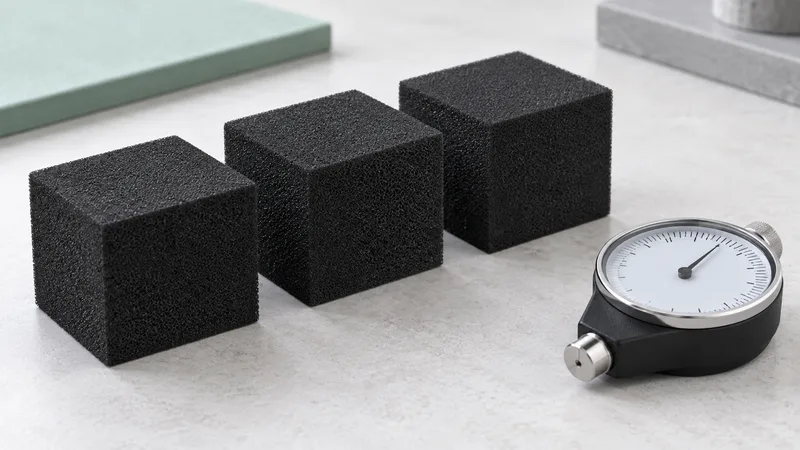
EPDM Foam density and hardness specifications need enough context to identify what was measured. The client knowledge base retains 70–250 kg/m³ and Shore C 10–35 as [需确认]. A buyer can use those fields to request a grade record, but the ranges do not establish stocked grades, tolerances or assembled sealing outcomes.
The EPDM Foam product hub is the starting point for a proposed material identity. Keep the sample and joint drawing references with the data request. This guide concentrates on reading technical records; it does not choose a universal thickness or certify an outdoor application from a pair of numbers.
Read density as a specimen property
Density describes mass relative to measured volume. Request the method, specimen identity and state associated with the value. A rectangular material sample, a cut outline and a finished part can have different geometry records, so the technical owner should identify what the report describes.
Keep total part mass separate from density. A gasket outline includes holes and local features that change volume, while a backing or another layer can add mass. An envelope dimension and shipping weight cannot establish the material density without the applicable specimen and method information.
- Record scale, method and specimen identity.
- Preserve thickness and conditioning with the value.
- Ask the owner to resolve incomplete technical fields.
The source range is not a grade-by-grade table. Do not invent sub-grades, label the low end a universally soft seal or assign the upper end a guaranteed force response. The record does not provide those relationships. Ask for the proposed grade and actual technical data instead.
If a report differs from a sample label, preserve both references and issue a clarification. Identify which record applies to the material being offered. Choosing the value that looks more convenient for the design would conceal the missing evidence rather than answer the density question.
Retain the Shore C scale and method
Shore C hardness describes an indentation reading under an identified procedure. The scale belongs beside the number. A label such as hardness 20 is incomplete when the scale, specimen thickness and conditions are omitted. Keep the original notation until the technical owner supplies a complete record.
Do not convert Shore scales from an undocumented relationship. The current knowledge base does not provide a Shore C to Shore A conversion or a link to a specific installed compression force. A familiar alternative notation is not a reason to discard the source scale.
Ask for specimen thickness, support, preparation, conditioning and the relevant procedure reference. These inputs help identify the observation that produced the result. The planning range Shore C 10–35 does not establish that every value was obtained under one method or refers to every available material construction.
A hardness record is one material description. It does not define an enclosure rating, service life or environmental limit. It also does not approve the contact path, gap or installation sequence of the joint. Those are assembly and evidence questions that must remain visible beside the technical sheet.
| Decision field | Request input | Review purpose |
|---|---|---|
| Density | 70–250 kg/m³ [需确认] | Mass relative to specimen volume |
| Hardness | Shore C 10–35 [需确认] | Retain scale and indentation method |
| Context | Thickness, preparation and conditioning | Compare compatible observations |
| Assembly | Gap, contact band and fastening | Separate installed response |
| Evidence | Grade report and sample revision | Do not infer a system rating |
Compare like questions before comparing numbers
Build a comparison record with grade, density method, hardness scale and method, specimen thickness, conditioning, tolerance and report revision. Two samples may show similar numbers while having different measurement contexts. The reviewer should understand those differences before ranking candidate materials.
Use ASTM International and the ISO standards catalogue with the responsible test owner for terminology and method selection. Directory references cannot prove that Green Foams measured a particular grade or validate a report that has not been supplied.
When a necessary field is missing, ask a focused question. State the sample and the comparison affected. Mark unresolved inputs [需确认] instead of assuming thickness, preparation or a test condition. A partially complete record can support inquiry without becoming a guaranteed specification.
Retain original units and scale alongside purchasing shorthand. A shortened grade label may be useful for coordination, but it should point to the complete approved sheet. That connection protects the method context when another buyer later reviews a substitution or compares a new proposal.
Separate hardness from installed compression response
The installed joint has a defined contact band, local gap, counterpart surfaces and fastening sequence. A Shore C reading does not directly measure that joint response. The outdoor sealing selection guide identifies those assembly inputs before material records are used in the decision.
Record local thickness and the available gap at critical locations. A new section, step or contact width can change the construction being reviewed even if the nominal hardness stays the same. Keep geometry changes separate from grade changes so the sample comparison remains understandable.
- Record scale, method and specimen identity.
- Preserve thickness and conditioning with the value.
- Ask the owner to resolve incomplete technical fields.
If the project needs closure-force or compression-response evidence, define the setup and acceptance requirement with the engineering owner. Do not derive a universal pressure from density or hardness. The current source does not supply the curve or test record needed to establish that result.
Compression-set behavior is another evidence field. A hardness observation or an informal compressed sample does not establish a verified retained-deformation result or lifetime. Ask for the relevant method, grade, conditions and acceptance scope if the application requires this information.
Keep exposure and system requirements in their own fields
Outdoor-lighting, door/window and photovoltaic sealing are client application directions. They do not supply validated temperature, UV, ozone, water-ingress or service-life results for every EPDM grade. A density/hardness record should not be used to fill those gaps.
Ask the project owner which environmental conditions require evidence and which records are relevant to the proposed material. Keep grade-specific results distinct from assembled-system results. An enclosure requirement includes the counterparts and interfaces that the material technical sheet does not describe.
A sample can show fit or placement under one setup while a formal requirement remains pending. State that boundary in the acceptance record. Calling every field approved because a sample was installed would erase the difference between geometry review and application validation.
Use the lighting and solar project brief to assign evidence ownership. It keeps the actual assembly, conditions and approval scope with procurement so an unverified material value does not become a blanket outdoor promise.
Map the report to the supplied form
A sheet, strip and custom-gasket proposal should identify the grade and section it represents. The format guide handles outline, corners, ends and conversion questions. Keep its geometry record separate from the specimen record used to describe density and hardness.
Backing, lamination or another layer should be identified as additional scope. The current source does not establish universal adhesive availability or compatibility. Ask which material the density and hardness report describes rather than assigning those values automatically to a complete multilayer part.
If conversion changes the sample identity or section, record it in the proposal. A different thickness or counterpart can require another installed review even if the material label is unchanged. The technical owner should decide how existing evidence relates to the revised construction.
Inspection should identify dimensions and material traceability separately. A measured strip width does not verify Shore C, while a material sheet does not establish cutting tolerance. Both can support the request when their methods and acceptance scopes are preserved.
Release an auditable requirement
Keep 70–250 kg/m³ and Shore C 10–35 marked [需确认] until the proposed grade, methods and tolerances are confirmed. Do not copy the planning ranges into a purchase specification as guaranteed limits or add unverified availability claims to make the record appear complete.
Assign owners to unresolved fields. Material identity, measurement clarification, joint geometry and application evidence are different responsibilities. Name the required record for each question so the next reviewer can obtain a useful answer rather than another broad description of sealing foam.
During substitution review, request the same evidence fields and identify changed variables. A new grade, thickness, backing or counterpart revision may affect the sample and evidence plan. Similar numbers alone do not establish equivalence of the supplied construction.
Preserve approved fields and pending questions in one controlled record. A development sample may be accepted for fit while quantitative or environmental requirements remain open. The purpose of specification reading is a traceable decision around the proposed material, not a confident looking table assembled from missing methods or inferred results.
Where purchasing uses an abbreviated specification line, include a reference to the complete technical record and its revision. State whether each number is a nominal target, a reported specimen observation or an agreed acceptance field. Those categories should come from the responsible technical owner. This prevents an isolated density or Shore C entry from gaining a tolerance or contractual meaning that the supporting record never supplied.
- Confirm the reviewed drawing and material proposal.
- Identify the required observations and evidence owners.
- Record the sample, deviations and accepted scope.
- Revisit affected fields when the construction changes.