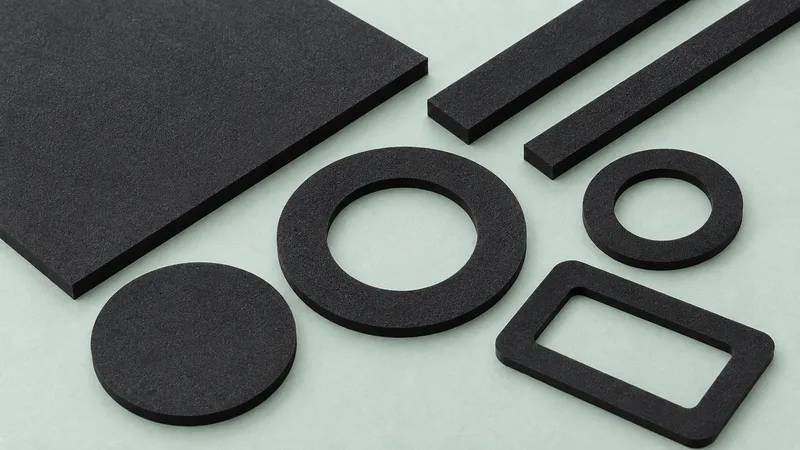
EPDM Foam sheets, strips and custom gaskets describe different ways to organize a sealing-part request. This guide concentrates on the part form and conversion record. The client knowledge base covers closed-cell EPDM sealing directions, while actual stock dimensions, cutting scope, backing and tolerances remain [需确认] for the proposed grade.
Begin with the EPDM Foam product hub and provide the outline plus relevant local sections. A format preference becomes useful when the converter can see what must be made and how it reaches assembly. It cannot establish supply capability or sealing performance simply through its name.
Distinguish flat stock from the finished part
A sheet concept frames flat material that will be supplied or converted for a particular outline. State whether the request concerns stock for another process or a finished part from the proposed supplier. These are different scopes, and the quotation should identify which dimensions and inspection responsibilities belong to each.
Record nominal thickness and the dimensions needed for the project. The current knowledge base does not give a confirmed sheet catalogue. Do not infer a stocked width, a standard length or a conversion tolerance from a sample image or from another material family.
- Show outline, local sections and datum features.
- Identify end, corner and backing scope.
- Confirm inspection before accepting conversion.
If the final outline includes holes, notches or reliefs, show them with a datum reference. A photograph can help orient a reviewer, but its perspective cannot establish the dimensions. Mark the edges that control contact or clearance separately from edges whose size is mainly informational.
Clarify how the stock or finished pieces are identified and handled. A workstation may need individual parts, separated versions or a supplied sheet. Ask about packing and labeling as project inputs rather than assuming that a flat format includes the same presentation in every proposal.
Define strip section and end conditions
A strip concept needs width, thickness, length and a defined path in the assembly. State whether it is supplied as a requested length or intended for another cutting step. Actual supply route and dimensional capability require confirmation. The word strip does not define where the part starts, terminates or changes direction.
Show the start and end locations with a mating-part reference. Describe the proposed join and any local change of section. A butt, overlap or another end concept can change local geometry; the responsible drawing owner should define the intended construction instead of leaving it for an operator to improvise.
Identify orientation and access during placement. A long piece can have a repeatable path while still requiring a clear reference point. Record which edges or marks assembly uses and what can be inspected before the counterpart is installed. These are handling questions specific to the chosen strip concept.
Review the end condition in the actual sample path. An acceptable straight section does not automatically demonstrate a proposed termination or corner. Capture the location and setup of the observation so another reviewer can understand the form decision without treating it as a completed ingress test.
| Decision field | Request input | Review purpose |
|---|---|---|
| Sheet | Flat stock and cut-outline concept | Confirm dimensions and conversion scope |
| Strip | Width, thickness, length and ends | Define the placement and join |
| Custom gasket | Datums, holes and local reliefs | Control the drawing outline |
| Backing | Carrier, adhesive and liner proposal | Confirm scope and interface evidence |
| Inspection | Critical edges and sections | Review before and after placement |
Put custom outlines under drawing control
A custom gasket outline should identify drawing number, revision, datums, contact edges, holes, slots and local reliefs. Show sections where thickness or counterpart clearance matters. A complete drawing makes the geometry review specific without asserting that every detail can be produced by an unconfirmed process.
Mark the dimension priorities. A hole that aligns with hardware, a narrow contact band and an outer trim edge can have different roles. Ask the process owner to confirm achievable tolerances and the inspection method for the proposed material and route rather than assigning a universal cutting value.
Show corners as geometry rather than leaving the converter to infer them. Identify radii, transitions, separate pieces or another proposed construction. The sample record should say which version was reviewed. A corner that differs from the drawing is a revision question, not an automatically accepted manufacturing alternative.
Keep a multi-piece set traceable. Identify each part, its orientation and its relationship to neighboring pieces. A set can reduce one conversion difficulty while adding placement or version-control questions. Those tradeoffs should be visible before the project chooses a route for quotation.
Confirm backing and conversion as additional scope
Adhesive backing, carrier, liner or lamination should appear as separate requested items. Identify the relevant surface and installation purpose. The source does not confirm universal self-adhesive EPDM supply or compatibility with every counterpart, so those fields remain [需确认] until the proposal and evidence are reviewed.
Ask who performs each proposed conversion step and what it includes. A format label cannot establish in-house cutting, a particular tool, edge finish or repeatable dimensional capability. Request the actual route and scope associated with the drawing rather than substituting a broad custom-manufacturing statement.
- Show outline, local sections and datum features.
- Identify end, corner and backing scope.
- Confirm inspection before accepting conversion.
The source retains 70–250 kg/m³ and Shore C 10–35 as [需确认]. Use the density and hardness guide to request the material record for the form. The record describes the grade; it does not establish the tolerance of a finished cut feature.
Consult ASTM International and the ISO standards catalogue with the technical owner for method terms. Directory references cannot certify a conversion process, adhesive interface or gasket assembly.
Inspect the part before it becomes concealed
Choose dimensions and features for inspection before sampling. Check the outline, local section, hole references, end details and identification that matter to the drawing. Record the method and sample identity. A broad visual pass does not explain whether a critical feature was measured or only observed.
Review liner removal, orientation and placement where backing is proposed. Record how the part is handled and what can be seen at the workstation. If installation exposes an unclear start point or a concealed notch, identify the geometry or identification change needed for the next sample.
Place the part on the intended counterpart and review corners, ends and local clearances. A dimensional sample and a placement observation can support the form decision while leaving formal sealing evidence open. The acceptance record should preserve that boundary.
When a feature changes, update the drawing and sample identity together. A new end detail, backing or local section can alter inspection or assembly even if the overall size stays the same. Keep the altered variable visible instead of describing the revision only as another equivalent gasket.
Compare proposals on equivalent geometry
Ask each proposal to identify format, grade, conversion assumptions, backing scope, dimensions and inspection method. A strip alternative to a custom outline can be useful, but the reviewer must explain changes to corners, ends or placement. Procurement needs those differences before it can compare the offered constructions fairly.
Use the outdoor selection guide if the route change affects the joint rather than only the supplied form. It defines mating geometry, exposure and approval questions that remain outside the conversion drawing itself.
State expected volume, packing and revision timing as requests. Actual stock, minimum order, price, capacity and lead time require commercial confirmation. A form guide must not invent such terms or imply that the preferred route is an established supply promise.
For application-specific procurement inputs, use the lighting and solar project brief. It assigns component references and evidence owners so the proposed format remains connected to the actual joint during quotation.
Preserve the accepted conversion record
Keep the approved outline, local sections, backing decision, sample identity and inspection method together. Identify which fields remain unresolved. This lets another buyer understand the proposed supply form without inheriting a photograph whose grade, dimensions and approval scope are unknown.
If the material, thickness, cutting route or backing changes, ask the responsible owners which checks to repeat. Similar outer dimensions do not establish equivalence where contact edges, corners or interface details differ. A substitution needs a clear comparison with the accepted drawing and sample.
Separate conversion acceptance from system approval. A correctly cut part does not prove an enclosure rating, environmental limit or lifetime. Those application requirements need their own evaluation under the actual assembled conditions, even when the format sample is dimensionally accepted.
A useful format decision says what is supplied, how it is identified, which geometry is controlled and which process scope was confirmed. It provides a practical route from drawing to inspection while keeping unverified supply and performance claims out of the procurement record.
Retain the disposition of rejected conversion samples as well as the accepted outline. Record the affected feature, the inspection reference and whether the next proposal changes geometry, process scope or handling. A converter can then address the actual defect or drawing ambiguity without revising unrelated material requirements. When a multi-piece set changes, identify which pieces share the revision and which earlier pieces are no longer part of the reviewed assembly.
- Confirm the reviewed drawing and material proposal.
- Identify the required observations and evidence owners.
- Record the sample, deviations and accepted scope.
- Revisit affected fields when the construction changes.