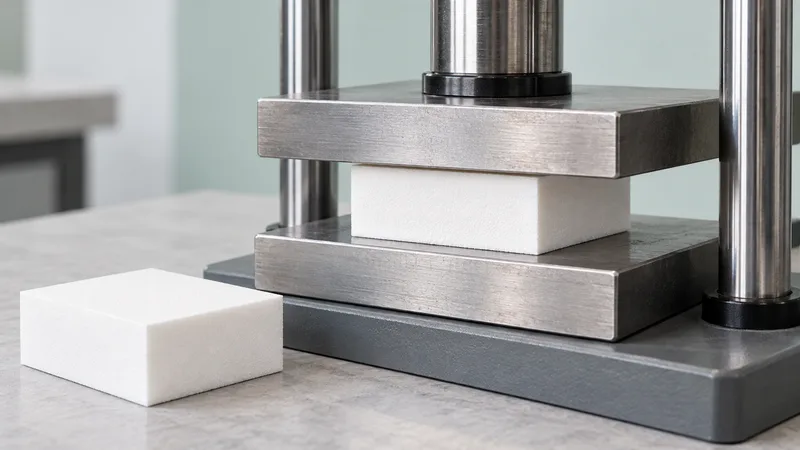
Read the source ranges without inventing grades
PET Foam density and compressive strength appear in the client knowledge base as 60–250 kg/m³ and 0.5–3 MPa, both [需确认]. The record does not establish stocked grades, measurement tolerances or a paired relationship between range endpoints. A buyer should request a grade-specific technical sheet rather than create a correlation table.
Density describes specimen mass relative to volume. Ask for the sample identity, method and specimen state associated with the number. Keep panel mass and core material density separate: a finished sandwich also includes facings, interfaces, local features and any attached components.
- Record the controlled component and counterpart revisions.
- Identify thickness, orientation and critical interfaces.
- Keep unverified material and process fields [需确认].
- Assign the next evidence question to its owner.
Compressive strength is a stress result under an identified compression method and criterion. MPa is a stress unit. The field is not Shore hardness, an indentation-force scale or a direct reading of finished-panel capacity. Retain the method context so another engineer can understand what was reported.
Start with the PET Foam product hub to identify the proposed grade and component. The material record should point to a sample or proposal, rather than sit alongside a drawing without a clear relationship to the actual core being discussed.
Identify method, criterion and specimen direction
Ask which compression procedure was used and what criterion the report represents. A stress result can be associated with an endpoint defined by its method; the number alone cannot tell the reader that definition. Keep the report wording and ask the technical owner to explain any missing field.
Loading direction belongs beside the value. Record how it relates to the proposed core orientation in the panel. If the direction is unspecified, mark it unresolved. Do not assume a specimen result applies equally to every local attachment or assembly load path.
Retain specimen dimensions, preparation, state and conditioning. These inputs identify the configuration that produced the reported stress. A specimen differs from an entire sandwich panel, and the report should describe what was actually tested rather than imply the facings and interfaces were part of the method.
Keep force and stress distinct in procurement language. The material value in MPa cannot be treated as an allowable assembly force without a defined geometry and engineering basis. The current client data does not supply a panel calculation, design load or safety factor.
| Decision field | Input or record | Review purpose |
|---|---|---|
| Density | 60–250 kg/m³ [需确认] | Mass-to-volume specimen description |
| Strength | 0.5–3 MPa [需确认] | Compression stress under criterion |
| Method | Procedure and result definition | Compare like questions |
| Specimen | Direction, dimensions and condition | Retain identity |
| Panel | Geometry, facings and interfaces | Separate assembly evidence |
For the reported compression direction, ask for a reference that connects the specimen axes to the stock and then to the panel drawing. A simple annotated sketch can clarify the intended correspondence when text such as longitudinal or transverse is ambiguous. Preserve the report's own terminology and have the technical owner resolve any mismatch. This is a traceability request, not evidence that the grade has a particular directional response or that a result in one direction approves every panel orientation.
Compare records before ranking values
Create fields for grade, density method, compression procedure, reported criterion, direction, dimensions and conditioning. Two stress values may differ because their methods or specimens differ. A larger number is not a useful selection conclusion until the responsible engineer understands whether the comparison answers the same question.
Use ASTM International and the ISO standards catalogue with the test owner for method terminology. These references do not prove a Green Foams report exists, certify a grade or establish an application result.
If a report lacks a relevant field, issue a focused clarification request. State the sample and decision involved. Do not fill the gap with a guessed specimen thickness or assumed orientation merely to make the table look complete.
Preserve original notation with any purchasing shorthand. A shortened label should point to the full approved record, not replace it. This keeps the method and reported criterion available when another buyer evaluates a substitution or a new panel proposal.
Understand the boundary between core data and panel data
A sandwich panel includes facings, interfaces, supports and local load introduction. Its stiffness, capacity and failure behavior cannot be established by one core compression field alone. The design owner should identify the relevant analyses or assembled tests for the proposed floor, side panel or other component.
Show local thicknesses, recesses and attachment regions on the drawing. Those features can change the construction being evaluated even when the material grade is unchanged. A specimen report remains a material input while the assembly question needs its own controlled geometry and evidence.
The knowledge base supplies no validated PET panel fatigue life, fire classification, universal temperature range or application certification. Density and compression stress do not provide those missing results. Keep them as separate questions with owners rather than assigning them to a material family.
Use the sandwich selection guide to connect the report to the panel function. It helps identify which requirement is being addressed before a provisional number becomes an unsupported finished-system claim.
Retain processing and sample traceability
A planar sheet, machined core and multi-piece panel set should each identify the proposed grade and orientation. A process change can require another dimensional or specimen review. Keep the material record mapped to the sample that was actually inspected or tested.
The PET format guide identifies datums, local sections and hidden-feature checks. Actual dimensions, tolerance and conversion capability remain [需确认]. They cannot be inferred from a density or stress range.
Record counterpart references when assembly evidence is involved. A new facing, bond route or support can change the question without changing the core family. Distinguish a material substitution from a construction revision and ask the responsible engineer which records remain relevant.
Keep observed fit and measured stress in different fields. A core that aligns with a facing supports a geometry finding. It does not demonstrate an interface-strength result, a panel load limit or an application approval. Clear scope makes both the sample and the technical report more useful.
If the evidence includes both a bare-core specimen and an assembled panel result, keep them as separate records with their respective configurations. The panel record needs its facings, interfaces and supports identified; the core record needs its specimen and method. Ask the engineer which requirement each one supports. A shared PET grade label should not cause procurement to transfer the assembly result to a different panel or to rename the bare-core compression value as a complete system capacity.
Release the specification field by field
Keep 60–250 kg/m³ and 0.5–3 MPa [需确认] until applicable grade data is received and approved. Request actual records and tolerances for the proposed material rather than assigning the entire source range as a guaranteed purchase specification.
The wind, rail and marine panel brief carries the technical fields into procurement. It identifies the component, facings, load direction, process proposal and evidence owners. That record prevents approval of one number from being interpreted as approval of every panel requirement.
If a sample label and report disagree, preserve both identities and ask for resolution. Update the grade map and quotation request when the technical owner clarifies the record. Do not silently choose the value that seems most favorable to the desired design.
During substitution review, request the same evidence fields and identify changed variables. A different method, specimen direction, core thickness or facing construction can require further evaluation. The goal is an understandable technical decision, not a ranking that conceals incompatible records.
Avoid extrapolation beyond the supplied record
The source does not provide a density-to-strength equation or a design curve. Interpolating between its range endpoints would create unsupported grade data. If a project needs a relationship for engineering work, request the applicable tested data set and have the responsible owner assess its relevance.
Do not use a material result to promise a maximum panel load. The geometry, interface and engineering basis for such a calculation are not supplied in the knowledge base. A stress report can be part of that work, but it cannot complete the construction analysis by itself.
Keep external method references separate from client measurements. A standard describes how a method is used; it does not mean Green Foams obtained a particular result. Source traceability should identify the actual report that supports any approved numerical field.
If evidence remains incomplete, preserve a pending requirement and a next action. This allows the project to continue dimensional development without inventing a structural or application claim. A transparent specification is more useful than a confident table built from an undefined method or unsupported extrapolation.
Do not use a report date alone as evidence of relevance. Confirm that the grade, specimen and procedure describe the proposed material construction. An older applicable record and a recent unrelated record answer different questions; the responsible technical owner should establish which evidence supports the current requirement.
- Define the component function and load or thermal question.
- Request the proposed grade and relevant methods.
- Review geometry, interfaces and processing scope.
- Preserve the sample identity, evidence and approval boundaries.