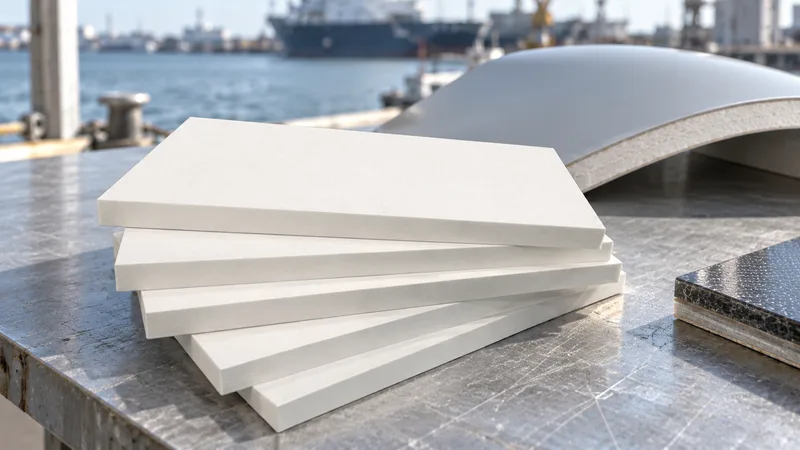
Give the panel request a controlled identity
A PET Foam core brief for wind, rail and marine panels starts with the component reference and drawing. The client knowledge base describes sandwich structures, floors and side panels in wind, marine, rail and building directions. These directions do not identify a proven customer project or establish sector approval for the proposed panel.
State whether the next step is material review, machining development, panel assembly or required testing. Identify the owner and revision of the requested construction. A controlled purpose helps the supplier provide the relevant proposal instead of another generic core material description.
- Record the controlled component and counterpart revisions.
- Identify thickness, orientation and critical interfaces.
- Keep unverified material and process fields [需确认].
- Assign the next evidence question to its owner.
Attach plan and section drawings with core thickness and facing references. Add supports, local attachments and counterpart surfaces. Mark fixed dimensions and exploratory fields so procurement can distinguish a released requirement from a development question.
Start at the PET Foam product hub and share the same brief with each reviewer. The quotation comparison should describe one identified construction and its evidence scope, not assume that every component carrying a PET label is equivalent.
Keep sector requirements specific to the component
For a wind application, identify the actual component, panel geometry and evidence owner. Do not infer fatigue performance or a structural qualification from the sector label. The project engineer must define the relevant loading and acceptance requirements for the proposed assembly.
For rail floors or side panels, retain counterpart references, supports and application requirements as specific fields. A core grade does not establish fire behavior, compliance or service-life evidence for the complete panel. Ask the responsible program owner to identify the required evaluation path.
For marine use, describe the component and expected environment questions. A material direction does not prove a water-exposure result or marine approval. Keep environmental evidence and assembled geometry separate, with the methods and conditions identified by the owner.
If a building panel uses the same inquiry format, give it its own component record. Reusing headings can simplify coordination while the actual facings, supports, requirements and approvals remain distinct. A previous sector sample acceptance cannot be extended by changing the title of the brief.
| Decision field | Input or record | Review purpose |
|---|---|---|
| Identity | Component, drawing and development purpose | Define the quotation baseline |
| Sector | Specific application requirements | No implied approvals |
| Construction | Facings, local sections and load inputs | Preserve panel context |
| Material | Grade, methods and specimen records | Separate from panel performance |
| Handoff | Sample scope, exclusions and open questions | Assign next evidence action |
For a wind component, name the actual part and its controlled panel section instead of using the sector name as a specification. For a rail floor or side-panel request, identify the component location, support references and the person who defines the relevant application criteria. For a marine panel, identify the actual construction and the exposure questions that its owner requires reviewed. These are separate request records; no sector label establishes an approved structure, fatigue result or classification for the proposed PET grade.
Capture local sections and facing interfaces
Show total panel thickness and the core at local recesses, transitions and attachment regions. Name why each feature exists and which dimensions control the functional construction. An outside envelope cannot explain the material remaining near a local support or interface.
List facing materials and the proposed joining or retention route. Identify who supplies each counterpart and who owns compatibility evidence. The knowledge base does not provide a universal adhesive, bond strength or facing qualification for PET core constructions.
Describe load introduction and orientation. Distributed surfaces, supports and local attachments are different inputs for engineering review. Preserve how the specimen direction in any material report relates to the core installation, and mark missing direction information as unresolved.
Use the PET sandwich selection guide if the function is still being developed. It separates core data from the complete panel question and helps the owner identify what evidence the next sample needs to support.
Request grade and process records precisely
The source retains density 60–250 kg/m³ and compressive strength 0.5–3 MPa as [需确认]. Request the proposed grade, density method, compression procedure, reported criterion, specimen state, dimensions, conditioning and loading direction. The compression field is stress, not a hardness or indentation scale.
Use the density and compressive-strength guide to preserve those fields. The ranges are not a grade correlation and do not establish panel capacity, fatigue life or an application approval.
For conversion, use the sheets, blocks and machined panel guide. Record datum faces, local features, orientation, stock assumptions and inspection needs. Actual supply dimensions, tolerance and processing scope require confirmation for the proposed route.
Consult ASTM International and the ISO standards catalogue with the technical owner for method terminology. Directory links do not certify the grade or establish the finished-system evidence.
Before the panel trial, agree who supplies each facing, support or attachment counterpart and which revision will be used. Record whether the converter provides the core alone or also performs a proposed joining step. If the project team assembles the panel elsewhere, identify the handoff condition and the records required before the core is concealed. This makes the sample scope practical for quotation and prevents core delivery, panel assembly and application evaluation from being treated as one automatically included supplier service.
Design the sample review around its purpose
Give each trial an identity linked to the core drawing, proposed grade and counterpart references. State whether it is a material specimen, a machined feature sample or an assembled panel. Each can support useful questions, but their evidence scopes should not be combined without identifying the setup.
Inspect local thickness, datums, edges, recesses and interface features before they are hidden by facings. Record the method and deviations. A dimensional acceptance explains the geometry; it does not establish compression performance, bond strength or a sector qualification.
Assemble the reviewed counterparts for the intended fit and alignment question. Record supports, handling and any installation adjustment. If the sample is used for a defined test, the evidence owner should identify its procedure and acceptance criterion separately from the fit observations.
Keep approvals by owner and scope. Design can approve geometry; quality can accept inspection records; the application owner can identify formal evidence. Purchasing should preserve what remains pending so a development panel is not ordered as a fully qualified system without the required records.
Compare proposals against a clear scope
Ask quotations to state their included work and assumptions. Stock preparation, machining, facing attachment, packing and tests may be separate items. A custom core request should not assume that all these services are included or that every proposed route is performed in-house.
Record expected volume, version identification and revision timing as inputs. Actual stock, minimum order, capacity, tooling costs and delivery terms require confirmation. Keep commercial answers separate from the grade and construction evidence that engineering needs.
If a proposal changes local thickness, grade, processing or interfaces, identify the deviation and affected approval. A similar outside shape or lower price does not establish equivalence. Ask the responsible owners which specimen and assembly checks must be repeated.
Preserve the accepted revision list, sample identity, evidence received and open questions at handoff. This gives the next buyer a usable record of the actual panel request. It prevents application descriptions or provisional numerical ranges from becoming unsupported supply and performance promises.
Make evidence gaps actionable
Assign each unresolved item to an owner and a required record. Grade methods, counterpart drawings, process tolerances, interface evaluation and application criteria are different deliverables. Naming them clearly helps a supplier or project team answer the right question instead of filling the brief with general marketing material.
When a clarification arrives, update the controlled document and preserve its reference. A correction left only in correspondence can conflict with a drawing or an older quotation. The project record should identify the accepted answer and the component, grade or interface it covers.
A sample may be accepted for dimensional development while structural or sector evidence remains pending. State that boundary explicitly. It allows useful progress without pretending the assembly has every required approval or that informal observations demonstrate fatigue, water or fire behavior.
Revisit evidence scope when the panel changes. A new facing, support, local feature or grade can make old records less relevant. A clear brief keeps the engineer, quality reviewer and buyer working from the same construction and makes the next decision traceable.
At transfer to another buyer, include the accepted proposal assumptions as well as the technical drawing. The next person should know whether facing attachment, formal testing or special identification was part of the reviewed scope. If an item was excluded, retain that exclusion and its responsible owner. A complete handoff reduces the chance that a pending evidence task is lost or that a commercial omission is treated as a supplied capability.
- Define the component function and load or thermal question.
- Request the proposed grade and relevant methods.
- Review geometry, interfaces and processing scope.
- Preserve the sample identity, evidence and approval boundaries.