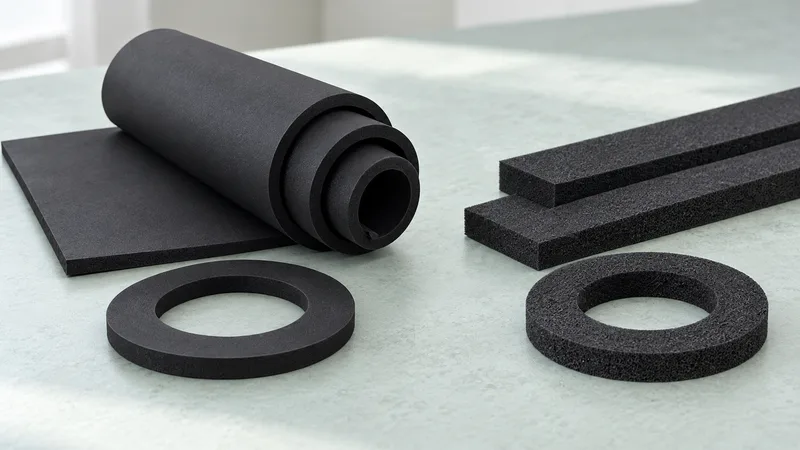
A Neoprene foam vs EPDM foam comparison for sealing applications should begin with the sealing interface in the enclosure. The customer record describes Neoprene for sealing inner liners and sealing pads, and EPDM for outdoor, lighting, window and photovoltaic sealing discussions, including closed-cell routes that require project confirmation. Those boundaries support a material discussion. They do not prove that one family is better for every product, enclosure or installation route.
Start with the Neoprene Foam product page and the EPDM Foam product page as separate family references. Then provide the product drawing or sample, enclosure envelope, critical surfaces and expected volume. This Neoprene foam vs EPDM foam comparison keeps the same decision inputs on both sides so a material preference does not hide a geometry or handling difference.
Make the comparison fair from the first brief
Describe the product revision and the surfaces that can accept contact. Mark finished faces, projections, openings and keep-out areas. Include accessories or neighboring items that share the enclosure or installation. A product may need a broad liner, a local pad or a shaped pocket; the comparison should test the task rather than an abstract material label.
Show the enclosure envelope, closure and adjacent layers. Include the orientation used during loading, movement and removal. If a component is retained by a wall, friction, adhesive or another part, state that arrangement. A loose pad and a shaped gasket may use different material amounts and cannot answer the same question without a complete assembly.
Define the sealing objective in observable terms. It might be separation, locating, surface cushioning or control of a gap. If the buyer needs weather exposure or impact evidence, define the configuration, method and acceptance condition separately. A successful fit review is valuable, but it is not a universal performance claim.
- Use the same product drawing, enclosure, sample and installed orientation for both concepts.
- Identify contact, support, clearance, retention and removal interfaces.
- State the sealing objective and the evidence expected for acceptance.
- Keep format, grade, hardness, thickness and commercial questions tied to each route.
Keep volume and revision timing equivalent when comparing quotations. One proposal may assume a flat converted piece while another assumes a shaped assembly. Ask what conversion, tooling or fixture work is included. Do not treat unconfirmed MOQ, lead time or tooling terms as inherent to Neoprene or EPDM.
Read the Neoprene selection guide when the brief needs more detail. The same product and enclosure description should be copied into the EPDM side of the review so both proposals respond to one controlled revision.
Separate material family from format and geometry
A Neoprene direction may use a door or cabinet liner, dustproof pad or custom gasket. Discuss density and hardness with the product interface and available space. A shaped feature can aid location, but it can also restrict access or introduce a pressure point. Review the complete piece and its surrounding enclosure.
An EPDM direction may use sheet, strip or custom-cut weather sealing for an outdoor, lighting, window or photovoltaic interface. Discuss how the component is retained, folded, wrapped or replaced. A flat separator may be appropriate when the surrounding enclosure already locates the seal. A custom-cut profile may be needed when the enclosure requires a defined clearance. The material name alone does not select the format.
The planning record lists Neoprene density 80–250 kg/m³ and hardness 10–40 Shore C as [需确认]. EPDM construction, closed-cell route and grade parameters require confirmation. Keep these values as questions for the proposed grade, method and specimen. A broad range cannot establish equivalent cushioning behavior or dimensional fit across two materials.
| Review point | Neoprene direction | EPDM direction |
|---|---|---|
| Source application | Door, cabinet or dustproof-pad sealing liner | Outdoor, lighting, window or photovoltaic sealing route; closed-cell option [需确认] |
| Geometry question | Which door, cabinet or pad surfaces need controlled contact? | Which weather-facing interfaces need a sheet, strip or custom-cut seal? |
| Handling question | How is the Neoprene part placed, retained and removed? | How is the EPDM component placed, retained and replaced? |
| Specification question | CR density 80–250 kg/m³ [需确认], Shore C 10–40 [需确认], thickness and fit | Closed-cell route, format, thickness and grade evidence [需确认] |
| Release boundary | Project-specific sample and acceptance record | Project-specific sample and acceptance record |
Consider assembly and replacement as design dimensions. Neoprene may be specified as one shaped component or a set of pads. EPDM may be supplied in a profile that an installer cuts or installs. The practical choice depends on repeatability, access, inspection and the installation workflow. Record who performs each step and what they must see to confirm orientation.
Color is not a proxy for hardness or performance. If colors differ between proposals, agree whether the comparison remains valid and document any grade change. Likewise, nominal thickness does not show the same contact behavior in every geometry. Measure critical sections on the sample and keep the method visible in the record.
Use equivalent sample checks and evidence
Build the Neoprene and EPDM samples around the same product and enclosure. Check loading, closure, movement and removal. Look for unexpected contact, slipping, snagging or difficulty replacing the component. A sample that fits on a bench may still be awkward in the installer sequence, so observe the intended handling.
Evaluate protection using the agreed question. If the concern is surface contact, inspect the interface and finish. If the concern is separation, check the gap in the complete assembly. If weather exposure evaluation is required, define the enclosure configuration and method before comparing results. Keep material observations separate from enclosure-level conclusions.
| Evidence stage | Keep equivalent | Document separately |
|---|---|---|
| Product brief | Same product revision, accessories and sensitive surfaces | Material proposal and format assumptions |
| Enclosure fit | Same enclosure, closure and orientation | Critical dimensions and interface observations |
| Handling | Same loading, removal and movement sequence | Retention, replacement and installer notes |
| Protection | Same defined objective and evaluation condition | Method, specimen, configuration and result |
| Commercial | Same quantity and delivery assumptions | Conversion, tooling and quotation scope |
The ASTM International standards catalogue and ISO standards catalogue can help the team identify terminology and possible methods. Select the applicable method for the project. These references do not show that either material, gasket or enclosure has passed a test or holds a Green Foams certification.
- Keep product, enclosure, orientation, quantity and revision equivalent.
- Record each proposed grade, format, density and hardness separately.
- Observe fit, handling, retention, replacement and the defined protection question.
- Attach methods, conditions, sample limits and approval scope to the review record.
Environmental or end-of-use questions also need a defined route. Do not infer recyclability or a universal sustainability outcome from the material name. Describe collection, inspection and disposal expectations if they matter to the buyer. Request evidence for the proposed grade and enclosure rather than extending a general claim to every construction.
Commercial comparison should use the same assumptions. Expected quantity, destination and revision frequency affect a quotation. Conversion, assembly, tooling and inspection may differ by route. Ask each proposal to state those boundaries so a lower apparent material cost does not hide additional handling or unfinished geometry.
Release the route with a traceable decision
After sample review, record why the preferred route answers the sealing task. Include product revision, critical interfaces, material proposal, format, thickness and observed handling. Describe limitations and open questions next to accepted results. This gives engineering, purchasing and installers the same reference when the enclosure installation is repeated.
When a product changes, revisit the affected checks. A new projection can change a Neoprene pocket or an EPDM cut profile. A new closure can change thickness and retention. Keep earlier evidence attached to the configuration it represents instead of assuming it transfers to every revision.
Review the seal at the point where it changes hands. Receiving, installation, maintenance and replacement may each expose a different interface. Note whether the component stays with the enclosure, is removed for inspection or is replaced before the next exposure. These workflow details help the team compare labor and control questions without turning either material into a universal reuse claim.
Keep appearance and cleanliness requirements explicit. A visible mark on an outer liner may be treated differently from a mark on a product-contact surface. State whether dust, fibers, adhesive residue or color variation are inspection concerns for the intended application. Request evidence for the actual grade and conversion route when a requirement is critical.
Ask both proposals to identify what the first sample can and cannot demonstrate. An early cut piece may show profile and fit but not represent a later assembly. A different conversion step can change an edge or tolerance. A transparent evidence boundary lets the buyer plan the next review instead of treating an exploratory sample as a final release.
Document how a material change would be managed after approval. A substitution request should identify the affected grade, format, color, thickness and interfaces. Repeat the checks that depend on those fields and retain the earlier record for comparison. This is useful when sealing is purchased repeatedly or when the product revision changes.
Finally, state who owns the decision. Engineering may approve geometry, sealing may approve handling, and purchasing may approve commercial scope. The project record should name those owners and list open items. That simple step prevents a material comparison from being closed by a single observation that did not cover the complete enclosure.
Keep a short decision summary with the samples. State which route was selected, which interfaces were checked and which requirements remain open. If neither route is ready, record the next input needed rather than forcing a preference. This makes the comparison useful for a later revision and keeps the enquiry focused on evidence.
For format details, read Neoprene sheets, strips and custom gaskets. For specification questions, use the density and hardness guide. Then share the product brief through the Neoprene customization route. The result of a Neoprene foam vs EPDM foam comparison should be a documented construction and evidence boundary, not a material preference detached from the enclosure.
For a fair commercial review, ask both proposals to use the same product revision, enclosure envelope and quantity assumption. Separate material cost from conversion, assembly, inspection and any tooling or fixture discussion. This helps the team understand whether a route is attractive because it solves the interface more clearly or because an unfinished step has been left outside the quotation. Keep every open item visible until the sample and quotation describe the same deliverable.
Document the decision in language that can be reused by purchasing and operations. State the selected material family, format, critical dimensions, orientation, inspection points and the evidence still required. If the route remains undecided, record the next sample question rather than forcing a ranking. A traceable comparison can then be revisited when the product, enclosure or expected volume changes.
Where a proposal uses a planning range, preserve the [需确认] marker in the review record and request the supplier’s proposed grade and method. Do not treat equal nominal thickness or a shared color as proof that Neoprene and EPDM will behave the same. The useful comparison is the complete construction in its enclosure, with the observations and limits attached to that exact revision.