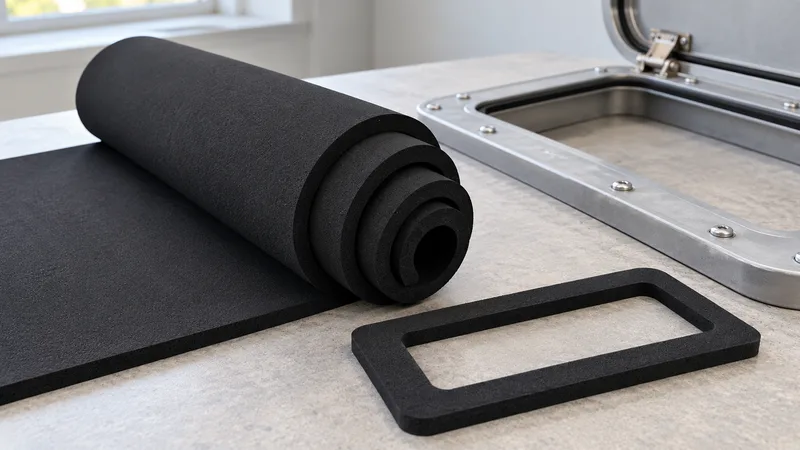
How to choose Neoprene foam for sealing applications starts with the item being protected, not a color swatch or a broad material label. The customer record describes Neoprene foam for sealing inner liners and sealing pads, for door, cabinet and dustproof-pad sealing applications. These are useful application boundaries for a project brief. They do not establish one universal density, hardness, thickness or performance result for every gasket.
The Neoprene Foam product page gives the family-level route for sealing liners and cushioning components. Before comparing options, send a drawing or representative sample, identify sensitive surfaces and describe how an installer loads and removes the item. This Neoprene foam selection guide turns those inputs into a practical review sequence for engineering, sealing and purchasing.
Start with the product and the protective task
Describe the product envelope in a way that another reviewer can understand without guessing. Include length, width, height, protrusions, openings and surfaces that can accept contact. Mark faces that need a gap or a controlled support. If the product has a finish that must remain free of marks, state how that finish will be protected and inspected.
Explain what the foam must do inside the package. A liner may close a door or cabinet interface, keep dust from a joint, or hold a component against movement. A pad may cushion a local interface or prevent a surface from touching another component. A custom gasket may combine locating and separation. Write the objective as an observable question, such as whether the product stays located during the defined handling route.
Include the surrounding door, cabinet, window or equipment enclosure. Give the opening envelope, closure arrangement, adjacent layers and available assembly space. A component that fits the product can still prevent a lid from closing or make removal awkward. The complete enclosure also determines whether a flat sheet, a shaped liner or a multi-piece gasket is a sensible direction.
- Send a drawing or sample with critical dimensions, projections and keep-out surfaces.
- Describe the sealing objective, installed orientation and installer loading sequence.
- Show the enclosure, case, tray or adjacent layer that will support the foam.
- List the checks that will decide fit, handling and protection acceptance.
State expected volume and revision timing without turning them into a promise about minimum order or lead time. Commercial conditions require a project quotation. A useful brief simply explains whether the team is exploring a prototype, a recurring sealing component or a revision to an existing liner. That context helps the manufacturing discussion stay attached to the intended use.
Separate a protection hypothesis from proven performance. A drawing can define a cavity and a sample can show fit. Transport or impact behavior needs an agreed configuration, method and acceptance condition. Keep those questions visible in the project record rather than treating an attractive gasket as evidence of an untested result.
Choose a format that matches the assembly
Sheets are useful when a door, cabinet or equipment enclosure needs a flat separator, layer or pad that can be cut and installed. Rolls can support a repeated strip, wrap or conversion route when the installation design allows continuous material handling. A custom gasket is appropriate when the product needs controlled locating, pockets or a shaped interface. The final route depends on drawing details and available conversion steps.
Review the access path before choosing a shape. A deep pocket may locate a product but restrict a hand or tool used during removal. A thin separator may be easy to replace but may not maintain the required spacing. If the component is assembled from several pieces, identify which seams or interfaces could affect registration.
Use a qualitative comparison first, then request a project proposal. Do not infer a production method from an image or from a file number in the media library. The product page can start the conversation while the drawing, sample and expected volume determine the relevant construction questions.
| Brief area | What to provide | Why it matters |
|---|---|---|
| Product geometry | Drawing, sample, envelope and projections | Defines contact, clearance and locating questions |
| Protection task | Door, cabinet or dustproof sealing objective | Connects the material route to an observable acceptance check |
| Format | Sheet, roll, liner or custom gasket concept | Sets the conversion and assembly discussion |
| Specification | Hardness, color, thickness and tolerance questions | Keeps unconfirmed choices visible for review |
| Commercial context | Expected volume, destination and revision timing | Creates a clear quotation scope without assuming terms |
The table keeps the brief balanced between design and commercial information. Product geometry explains what must fit. The protection task explains why the component exists. Format connects that task to a conversion discussion, while specification questions identify what needs a grade-specific answer. Commercial context defines the quotation boundary without implying an unverified term.
When reviewing a door, cabinet or dustproof pad, check how it is retained. Friction, an adhesive, a surrounding wall or a separate closure can produce very different handling outcomes. Record the intended retention approach and whether the foam can be removed for inspection. If an adhesive or coating is under consideration, request compatibility evidence for the proposed materials.
Review hardness, thickness and color as linked choices
The planning record lists Neoprene density of 80–250 kg/m³ and hardness of 10–40 Shore C as [需确认]. Treat these as planning ranges, not as a published grade table. Ask which value is proposed for the specific construction, what test method applies and whether the value belongs to a representative specimen. A range alone cannot predict how a gasket will behave at every wall thickness.
Hardness should be discussed with contact area and geometry. A broad support surface can distribute a load differently from a narrow rib. A small locating feature may need a different balance between retention and easy removal. A cushion pad may be judged by compression and recovery under a defined condition. Keep the requirement tied to the actual interface instead of choosing a number by habit.
Thickness affects both protection and sealing efficiency. More material can increase separation, yet it also consumes internal volume and may change closure force. Multiple thin layers can create assembly questions that a single thicker part avoids. Record nominal thickness, permitted variation and critical areas on the drawing once the route is understood.
Color is often a visual control for orientation, part identification or brand coordination. It should not be treated as evidence of hardness, cleanliness or performance. Confirm the requested color, acceptable variation and any marking requirement. If color changes between samples, document whether the material grade also changed so the review remains traceable.
| Sample review | Observe | Record |
|---|---|---|
| Fit | Contact, clearance, locating and closure interfaces | Drawing revision and dimensional observations |
| Handling | Loading, removal, orientation and installer access | Sequence used and any restrictions |
| Protection | Specified contact, dust-control or gap condition | Agreed method, configuration and result |
| Finish | Edges, surfaces, color and assembly details | Appearance criteria and open questions |
| Release | Production requirements and remaining assumptions | Approval owner, scope and next action |
For terminology and test-method discussions, use the ASTM International standards catalogue and the ISO standards catalogue as reference starting points. Select the applicable method with the project team. These links do not prove a Green Foams grade has passed a test or carries a certification.
- Record proposed hardness with its method, specimen and project purpose.
- Relate thickness to clearance, closure, contact area and required separation.
- Specify color as an identification or appearance requirement, not a performance proxy.
- Keep density, tolerance, adhesive and compliance questions marked [需确认] until evidenced.
Ask for the information needed to compare samples fairly. If hardness changes, identify whether the geometry or thickness also changed. If color changes, confirm whether the grade and process remain comparable. A clean comparison records one variable at a time when possible and notes the limitations when several variables move together.
Use a sample review to close the sealing decision
Prepare the sample review before the part arrives. Attach the drawing revision, product sample, proposed format and open specification questions. Define the intended installer sequence and identify who will approve fit, appearance and protection. This prevents a convenient demonstration from becoming an approval for a different enclosure configuration.
Check loading and removal with the actual hand position and orientation. Look for snagging, unwanted contact, movement and interference with closures. Review whether the foam stays in place when the enclosure is moved as intended. If the gasket has pockets or locating features, confirm that the product can be placed consistently without forcing a sensitive surface.
- Send the product brief, drawing or sample, surrounding enclosure and sealing objective.
- Review format, proposed grade, hardness, color, thickness and conversion assumptions.
- Check fit, handling, appearance and the agreed protective condition in the sample.
- Record approval scope, restrictions and production questions against the controlled revision.
Keep fit and performance decisions separate. Fit confirms the interface under the reviewed conditions. A weather exposure or cushioning evaluation addresses a defined protection question. Neither resolves every possible change in product, installer, enclosure or route. If a feature changes, identify which checks must be repeated.
Include inspection and replacement in the final conversation. A sealing component may be removed between exposures, cleaned by an installer or replaced after a visible mark. Define what counts as acceptable wear for the reviewed use and who makes that decision. The source record does not provide a universal service-life value, so the project should set its own inspection scope and evidence.
Also record how the part will be identified at receiving and during packing. A drawing number, orientation mark or color reference can prevent the right product from being paired with the wrong liner. These controls support the material decision without claiming that color or marking changes the foam's physical behavior.
When the sample is accepted, preserve the information that made the decision possible. Note the proposed material route, relevant dimensions, specification values, visual criteria and remaining assumptions. Purchasing can then request a quotation against a defined configuration. Engineering can identify the effect of a revision without relying on a generic phrase such as “same foam.”
For a format-focused follow-up, read Neoprene foam sheets, strips and custom gaskets. For a material comparison, use Neoprene vs EPDM foam for sealing applications. The density and hardness guide helps prepare a specification conversation. Together these resources support the Neoprene drawing-to-sample workflow.
Before releasing a request, check that the brief can be read by someone who did not attend the original sealing discussion. Put the product revision, enclosure revision and orientation on the first page. Add a marked-up image for sensitive surfaces and a short note explaining how the installer loads and removes the item. These references reduce interpretation differences when several formats are quoted.
Keep open questions visible in the same record as the proposed construction. Density, hardness, color, thickness, conversion route, adhesive compatibility and inspection tolerances may all need confirmation. A clear “to confirm” field is more useful than filling a blank with a guessed value, because it tells the sample reviewer exactly what evidence to request and prevents an unverified assumption from becoming a purchasing requirement.