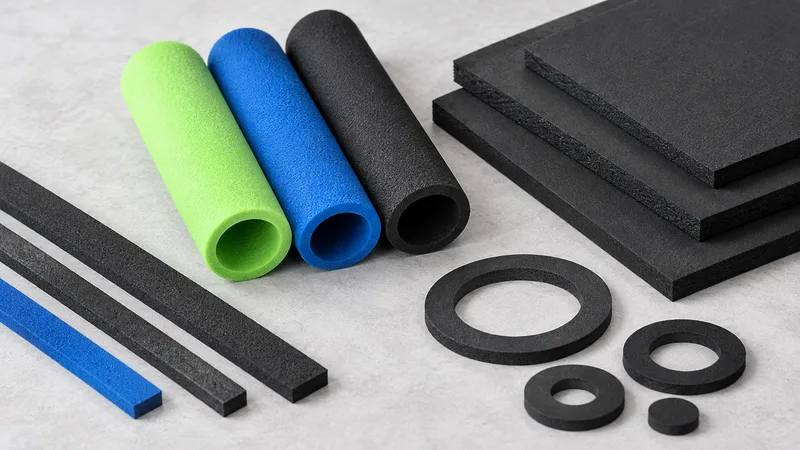
A format decision begins with a drawing problem: how to represent the contact path as a part that can be made, handled and installed. The terms sheet, strip and custom gasket are useful, but they do not describe the same geometry. Comparing them through one flat product photograph hides the ends, corners and locating features that often determine the practical route.
This guide concerns NBR Foam for oil-environment equipment interfaces. The NBR Foam family page remains the starting point for the material discussion. Here, the aim is choosing a conversion concept to review with the supplier. Material supply, dimensions, backing and cutting methods require confirmation for the proposed grade; the format names alone establish none of those details.
Draw the contact path before choosing a format name
Trace the surface where the foam is intended to sit. Mark interruptions, changes in width and spaces that must remain clear. Include locating features or nearby fasteners if they affect positioning. A clearly defined path allows the reviewer to see whether the component can be represented as a flat outline, a continuous strip route or a more detailed custom shape.
Use the equipment datum system where one exists. A converted part should relate to the mating assembly rather than an arbitrary image edge. If the current drawing lacks datums, ask the design owner how position will be controlled and inspected. That question should be settled before a supplier chooses convenient measurement points that the assembly team cannot reproduce.
Specify whether the outline is final or exploratory. A supplier may identify a conversion concern and suggest a geometric adjustment, but the equipment designer should review its effect on the contact path. Keep proposed changes marked separately. A practical manufacturing suggestion is useful input without automatically becoming permission to alter the component duty.
- Overall outline and internal openings.
- Contact path and prohibited contact zones.
- Equipment datums and locating features.
- Ends, joins and corner locations.
- Installation direction and accessible inspection points.
Use a sheet-cut concept for a genuinely flat part
A sheet-cut concept is worth reviewing when the drawing represents a flat boundary with any required openings. The supplier needs the grade proposal, thickness requirement and controlled outline rather than a photograph with an estimated scale. Confirm the material-specific cutting scope and dimensional expectations before treating the concept as a producible component.
Ask how edges and small features will be reviewed. A broad external dimension does not describe the local opening around a locating feature or fastener. Mark the dimensions that affect installation and distinguish them from reference dimensions. The design owner should determine the required acceptance, while the supplier identifies what it can propose and inspect.
A sheet-cut part also needs an orientation rule when the outline is easily reversed or confused with another component. Show which face and direction matter. If a marking or identification method would help, request it explicitly and confirm its scope. Do not assume that a production file name will be visible to the operator holding the delivered part.
Explain how the flat component will be lifted, placed and held before the assembly closes. These actions can reveal a handling issue even when the drawing appears straightforward. Ask for a representative sample observation rather than inventing a universal minimum feature width or handling guarantee for the entire NBR family.
| Format concept | Drawing focus | Practical question |
|---|---|---|
| Sheet-cut outline | Flat boundary and internal openings | How are shape and orientation identified? |
| Strip route | Width, path, starts and ends | Where do joins and corners occur? |
| Custom gasket | Datums, holes, features and tolerances | How is the part located and inspected? |
| Added backing or join | Complete construction and material identity | Who confirms scope and relevant oil exposure evidence? |
Evaluate strips as a path with controlled ends
A strip concept shifts attention from one cut outline to a route. Show its width, path and total length requirement, together with the point where installation begins and ends. If the assembly contains a corner or interruption, locate it on the drawing. The route cannot be assessed reliably from length and width alone.
Ask how the path is formed at corners. A bend, a cut corner and a joined construction are different proposals that require their own scope discussion. The project should identify the intended contact outcome before the supplier recommends a route. No generic statement about NBR establishes that every corner construction will satisfy that outcome.
Where a join is proposed, record its location and construction. Ask who is responsible for making it and what observation or evidence will assess it. A join in a convenient installation location may still be relevant to the sealing duty. Keep the question visible instead of letting the overall strip route imply continuity that has not been reviewed.
Document start and end placement so the operator can reproduce the sample configuration. If length is adjusted during installation, clarify whether that is an approved process or an exploratory prototype action. A manually fitted sample does not automatically describe the intended production assembly method, and the handoff should identify any difference.
Treat a custom gasket as a controlled geometry package
A custom-gasket proposal may bring holes, cut-outs, locating features and several dimensional relationships into one part. Provide the drawing revision and the mating component references. Ask the supplier to identify any geometry that needs clarification. The word custom does not itself confirm a particular cutting method, tolerance or finished construction.
Establish how the part is located during inspection and assembly. A measurement plan based on one datum can produce a different interpretation from an informal check against the outside edge. The design owner and supplier should agree which features matter and how they will be reported, without applying an unsourced tolerance to every cut feature.
If a corner, narrow region or internal opening raises a conversion concern, record the affected feature. A revised geometry can then be assessed against the original equipment requirement. This keeps the discussion specific and avoids a broad conclusion that either all custom shapes are easy or none are suitable.
Make additions to the construction explicit
A request for foam with backing or a joined configuration contains more than one material and process question. Identify the added layer or connection, its purpose and where it sits in the assembly. Availability and construction details need a supplier response. The NBR family description should not be used to imply an adhesive or laminate offer.
The oil exposure review must follow the complete proposal. A technical record for the foam alone may not answer a question involving an added backing or joining material. Use the oil compatibility and hardness guide to retain exact medium, temperature, duration and grade context. Geometry approval and exposure evidence remain separate decisions.
Where backing is intended only to aid placement, state that purpose rather than assigning it an unreviewed structural or sealing duty. The equipment owner should determine what the installed construction must do. A convenient assembly aid still needs the relevant scope confirmation and should appear on the reviewed sample record.
Assign inspection and installation responsibilities
Decide which dimensions the supplier will report, which the receiving team will check and which observations belong to an assembly review. These activities serve different purposes. A converted-part dimension can be correct while the installation sequence still needs revision, so record each finding in the appropriate place.
Ask how parts will remain identifiable during handling. Similar outlines, revised drawings or different constructions can be mixed if the delivery reference does not connect to the sample record. Request the identification needed by the project, while leaving actual packaging and marking arrangements for confirmation rather than assuming a standard offer.
The ASTM standards catalogue is a place to identify possible measurement references. NIST measurement guidance helps reviewers discuss measurement conditions and traceability. Those references are methodological context, not certification of a converted NBR part or evidence for every equipment interface.
- Review the contact path and assembly datums.
- Compare sheet, strip and custom-outline concepts.
- Identify corners, joins and added construction.
- Confirm supplier scope and inspection responsibilities.
- Record the sample configuration and open questions.
Release a route that the next team can reproduce
At sample review, keep the drawing, grade proposal and construction together. Record where the part was placed and any adjustment made during installation. If a trial required an unplanned trim, join or repositioning, send that observation back to the design owner. The delivered format should reflect an approved route rather than an operator's undocumented workaround.
Use the industrial equipment gasket brief guide when handing the proposal into procurement. Include the final outline, installation rule, inspection plan and remaining evidence requests. Expected volume is an inquiry input; confirmed quantities, supply and timing come from the supplier's response.
The result is a geometry decision that can be reproduced across drawing, converted sample and equipment assembly. If the path, backing, join or orientation changes, identify the change and ask which observations repeat. That preserves the value of the earlier review while keeping the new construction's questions visible.
Where the same outline is required in several equipment variants, verify the relevant mating references before reusing the conversion file. A shared external shape can conceal a changed fastener, contact path or installation direction. Keep the variant relationship in the drawing package so the supplier can identify which parts share a route and which require separate review.
The confirmed file should also distinguish reference geometry from controlled cutting geometry. Ask the drawing owner to resolve conflicting layers or annotations before conversion, rather than allowing an unreviewed file interpretation to determine the component.