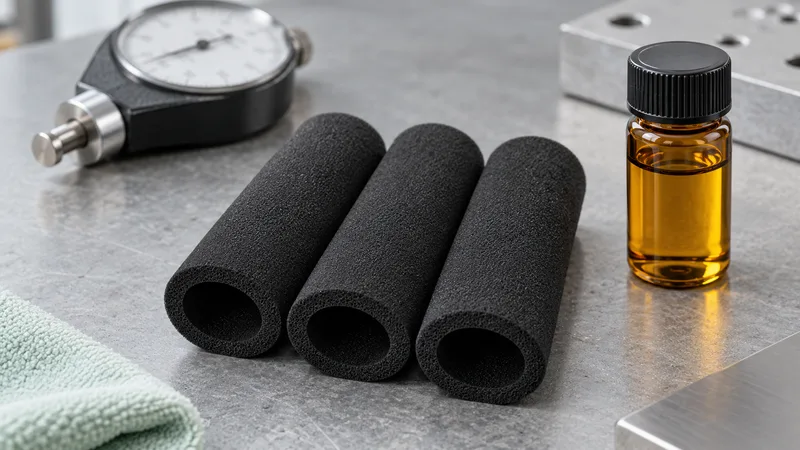
The phrase oil-resistant NBR foam is an application starting point, not a complete compatibility specification. A defensible review must connect an identifiable material grade to an identifiable medium under defined conditions. Without that connection, a supplier and equipment owner can agree on a material name while answering different questions about the actual exposure.
The NBR Foam material entry covers oil-environment gaskets and equipment sealing. Its provisional density of 80–250 kg/m³ and Shore C 10–40 remain [需确认]. Those ranges do not identify a particular grade or establish compatibility. This guide keeps the fluid evidence and specification fields separate so that one does not accidentally stand in for the other.
Name the substance instead of relying on an oil category
Record the actual oil or fluid identification used by the equipment. Include the product or formulation reference that allows the project team to distinguish it from an alternative. If the identity is not final, mark it as provisional. A broad description such as lubricating oil may explain the application without giving enough information to assess the proposed grade.
State whether the material can contact a mixture, a changed fluid condition or relevant contamination. The project owner should supply those facts rather than expecting a foam supplier to infer them from the machine type. A compatibility record for a clearly specified medium is more useful than a general statement whose substance cannot be reconstructed.
Identify other contact events separately. A cleaning or maintenance substance may create a different question from the oil present during operation. Do not hide it in a miscellaneous environment line. List the actual events the component must address, and ask which ones require evidence before the construction can be approved.
- Exact oil or fluid identity and source reference.
- Relevant mixture, contamination or changed fluid condition.
- Temperature at the component's exposure location.
- Contact duration, frequency and mode.
- Separate operating, cleaning and maintenance events.
Describe exposure where the foam actually sits
Specify the temperature relevant to the component rather than an unrelated machine label. If the project has different operating states, identify them in the request. The equipment engineer determines which states matter. The current material information supplies no universal temperature rating that can be assigned to every NBR foam proposal.
Record contact duration and frequency in a way that a reviewer can compare with a test record. A brief handling event and a sustained operating contact are different exposure descriptions. Where the duty is uncertain, request the missing application facts. Do not convert an incomplete description into an assumed continuous or intermittent condition.
Explain how contact occurs, for example through the project's stated surface contact, splash or other defined mode. These are descriptions to supply, not guaranteed suitable conditions. The reviewer needs to know what is being evaluated and whether the proposed test represents it. A test heading that simply says oil can conceal a materially different setup.
Also preserve the construction surrounding the foam. Added backing, a joined region or another material in the contact path may introduce its own evidence requirement. A record for a plain foam specimen does not automatically establish the behaviour of that complete construction. Ask the engineer which configuration must be evaluated.
| Record | Required context | Cannot establish alone |
|---|---|---|
| Medium identity | Exact oil/fluid, relevant mixture and contamination | Suitability for every oil |
| Exposure condition | Temperature, duration and contact mode | Long-term suitability from a brief fit check |
| Grade evidence | Identifiable grade, TDS and applicable test conditions | Assembly sealing from a family description |
| Density / Shore C | 80–250 kg/m³ / 10–40, provisional [需确认], methods | Oil compatibility or life |
Read the grade record before accepting its conclusion
Ask for the proposed grade identity and technical data sheet, including the revision or date where available. Check that the record concerns the material being quoted or sampled. A collection of favourable statements drawn from unrelated grades cannot represent one coherent proposal. Preserve the original record so later reviewers can reconstruct the comparison.
When a compatibility result is supplied, look for the medium, temperature, duration, specimen and evaluation method. Compare these conditions with the application record. If one field is missing, ask for clarification instead of interpreting silence as a match. The question is applicability to this project, rather than whether the document looks technically detailed.
Distinguish a family description from a grade-specific result. Marketing language may explain why NBR is considered for oil environments, but it is not equivalent to a controlled exposure evaluation. Likewise, a grade-specific result for one fluid does not authorize a claim about every oil, every temperature or an unspecified contact lifetime.
The acceptance criteria must come from the project's responsible technical owner. This guide does not invent a universal permitted change or pass threshold. The owner should decide which observations address the component duty and how the result will be interpreted. The supplier can then respond to a defined question rather than guessing the intended approval.
Plan testing around the unresolved compatibility question
If existing evidence does not address the actual exposure, record the gap precisely. It may involve a different medium, missing duration information or an unreviewed construction. That gap should guide the testing request. Repeating a general oil-resistance claim does not resolve the mismatch between the application and the available record.
Identify who will provide the medium, prepare the specimen and approve the evaluation plan. Where representative material or equipment is not yet available, document the substitute and what the result can support. A preliminary test can inform a next step without releasing every operating condition. Its limits should travel with the result.
Retain observations and conclusions separately. The record should show what was assessed, the configuration used and the reasoning for acceptance or further work. This makes later changes reviewable: a different oil or construction can be compared with the original scope instead of inheriting a vague statement that NBR passed testing.
Interpret density as a material field with method context
The provisional 80–250 kg/m³ range is a broad material record requiring confirmation. It is not a guaranteed range for every offered grade and should not be inserted into a purchase specification without a supplier response. Ask which proposed grade, method, specimen conditions and tolerance apply to the value under discussion.
A density comparison should use records that the reviewer can meaningfully compare. If measurement contexts differ or are unknown, identify the uncertainty before ranking proposals. Do not infer an oil compatibility class from density, and do not treat a more complete density record as proof that the medium evidence is complete.
Separate the material number from the component drawing. The required thickness, outline and installed condition remain design questions. A nominal density value does not establish those dimensions or the assembly's sealing outcome. The NBR selection guide explains how to keep the interface decision connected to the evidence review.
Preserve the stated Shore C scale
Shore C 10–40 is also provisional and requires grade-specific confirmation. Retain the named scale when discussing it. Do not casually substitute Shore A or Shore D, and do not assume an informal conversion produces a valid specification. Ask for the applicable hardness method and specimen details alongside the reported number.
A tactile impression of a sample does not establish the test value. It can describe a handling observation, but the reviewer needs a measurement record for a hardness specification. Likewise, hardness does not prove oil compatibility, installed sealing or service life. These separate requirements must have their own applicable evidence.
If procurement needs an acceptance value, the engineer and supplier should agree the record and tolerance that support it. A broad provisional range is insufficient to identify the intended grade. Keep any unresolved field visible in the request rather than choosing a convenient midpoint and presenting it as confirmed product data.
- Define medium, temperature, duration and contact mode.
- Identify the proposed grade and construction.
- Compare applicable TDS and test conditions with the requirement.
- Request testing or clarification for unresolved gaps.
- Confirm density and Shore C independently of compatibility.
Keep method references separate from product proof
The ASTM International catalogue helps identify method references for technical discussion. The NIST public measurement resources offer context for consistent measurement. Neither source certifies this NBR grade, supplies a project test result or establishes an equipment sealing requirement.
When the review closes, retain a concise evidence statement naming the grade, medium, exposure conditions and accepted scope. Link it to the relevant drawing and construction. The industrial equipment gasket brief can carry those records into the supplier request without mixing material approval and geometry approval.
A later change in fluid identity, temperature, duration, grade or added construction should trigger a review of applicability. Keep the earlier evidence intact and describe what changed. This protects the usefulness of the original evaluation while preventing a bounded result from becoming an unsupported promise of universal oil compatibility.
Review an alternate oil as a changed requirement
Equipment maintenance may introduce an alternate fluid after a component has been reviewed. Obtain its exact identity and the proposed use conditions before deciding whether the original evidence remains relevant. Similar commercial descriptions do not establish that the media are equivalent for the evaluated NBR grade.
Keep the original exposure record and add the changed requirement as a new review item. Ask the technical owner whether an existing grade-specific record addresses it or whether testing is needed. Procurement should know that a fluid substitution remains open while this review proceeds, even when the component drawing and material name have not changed.