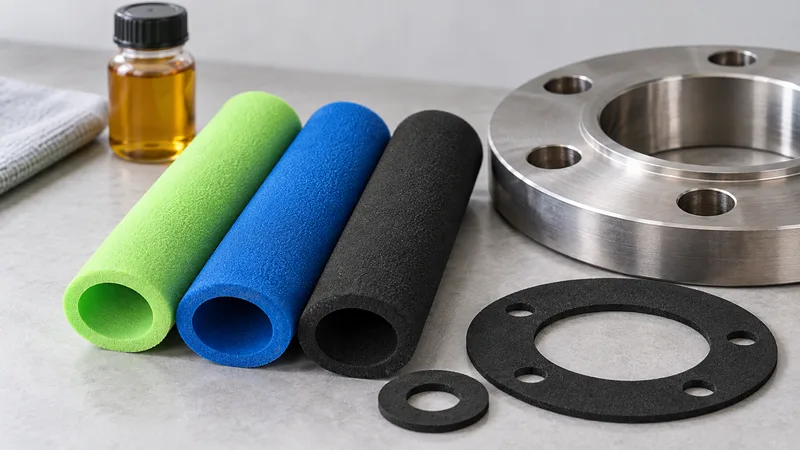
An oil-resistant sealing inquiry often begins with a material name and a photograph. That gives a supplier a useful starting point, but it leaves the engineer's main decision unfinished: whether a particular foam construction can perform a defined job at a defined equipment interface. NBR belongs on the discussion list for oil-environment gaskets and equipment sealing; it does not automatically settle every oil-related requirement.
The NBR Foam material page provides the family entry. This guide turns that entry into a selection sequence for industrial equipment or automotive components. The sequence begins with the assembly, moves through the exposure evidence, and ends with a sample decision whose limits are visible. It avoids selecting a grade from a hardness number before anyone has established what the component must actually do.
Describe the job at one identifiable interface
Name the component location and show the two surfaces around it. Explain whether the requested function is a gasket contact, a sealing-related equipment interface or another duty that needs discussion. If several locations use similar-looking parts, identify them separately. A successful decision at one location should not be copied to another solely because both are described as oily.
Translate the desired outcome into something the responsible engineer can assess. The project may have a contact requirement, a fit requirement or a defined sealing evaluation. Those are distinct questions. A drawing can establish an outline without proving installed sealing, while a sealing observation may say little about whether the part can be assembled repeatedly without damage.
Show the contact path, clearances and fastener locations that influence the component. Mark what is fixed and what the supplier may propose changing. If the thickness envelope is still exploratory, label it accordingly. That lets the supplier explain an alternative without accidentally converting an informal suggestion into a released engineering dimension.
- Equipment or vehicle-related component location.
- Mating surfaces and required contact path.
- Clearance, orientation and installation restrictions.
- Defined duty and how the project will assess it.
- Drawing revision and person responsible for acceptance.
Use the exposure question as an early decision gate
Before comparing shapes or prices, identify the substance that can reach the foam. An oil-environment label is useful context, but the compatibility question depends on the exact medium. Include the oil or fluid identification, temperature and duration of contact. Ask whether contact is continuous, intermittent or associated with a maintenance event, rather than letting the supplier infer the condition.
The first selection gate is whether the proposed grade has relevant information for that condition. Ask for its technical data sheet and applicable evaluation records. If the evidence is unavailable or concerns a different medium or condition, retain an open compatibility question. A familiar family name should not turn an evidence gap into an assumed approval.
The NBR oil compatibility and hardness guide explains how to examine those records. At this stage, the objective is deciding what evidence must exist before the material proposal advances. Do not substitute a general oil-resistance statement, a density range or another customer's unspecified application for the specific question in this assembly.
If compatibility testing is needed, make the owner and intended decision explicit. A supplier may help define a candidate material or specimen, while the equipment engineer decides whether the conditions represent the application. The test scope and the sample scope should be recorded independently so that neither silently replaces the other.
| Decision gate | Question to resolve | Result to retain |
|---|---|---|
| Function | What must this interface do? | Defined component duty and acceptance owner |
| Exposure | Does the grade evidence address the actual oil, temperature and duration? | Applicable evidence or an open evaluation request |
| Assembly | Can the proposed shape and construction be installed? | Drawing-linked installation observations |
| Release | Which requirements have adequate evidence? | Bounded approval and unresolved actions |
Assess the interface without inventing a compression rule
The drawing should identify the available space and how the assembly closes around the foam. Ask the engineer which features control that position. A nominal sheet thickness alone cannot describe the installed condition if mating surfaces, fasteners or local geometry are still undefined. Record the actual assembly assumptions before treating a proposed thickness as suitable.
Do not apply an unsourced universal compression percentage. The current material information does not establish one for every NBR foam grade, construction or equipment interface. If the project needs a compression-related design value, request the relevant grade-specific record and engineering review. Qualitative handling impressions can be useful, but they do not create a design limit.
Consider how variation will be reviewed. A local opening, step or edge may deserve its own drawing note rather than being hidden inside an overall dimension. The supplier needs to know where the component may move and where it must remain controlled. The assembly owner can then choose representative locations for the sample check.
Compare proposals against the same requirements
Prepare a short comparison record with one row for each actual proposal. Include grade identity, proposed construction, drawing revision, relevant exposure evidence and remaining questions. Separate known fields from requested fields. That prevents a complete-looking quotation from appearing stronger than a proposal that honestly identifies missing test information.
Ask why each proposal remains on the shortlist. One may need a medium-specific evaluation; another may require a revised corner or installation method. These are different next steps. A simple overall preference does not show which action will make the proposal reviewable, so connect the reason to the specific interface requirement.
Where a supplier suggests changing the construction, record the change before comparing results. A foam part with a new backing or joining detail is a different proposal even if the family name stays the same. Request confirmation of availability and evidence for the complete construction instead of assuming that the original material record covers everything added later.
Choose the format after the essential constraints are visible
Once the function and evidence boundary are understood, review the possible sheet, strip or custom-gasket route. The useful question is which route represents the geometry and can be installed in the stated sequence. These are conversion concepts to confirm with the supplier, not a list of guaranteed stocked NBR products.
The NBR sheets, strips and custom gaskets guide focuses on that geometry decision. Bring the contact path, ends, corners, holes and locating features to the discussion. A format that appears simple on a flat drawing may introduce installation or joining questions when placed into the actual equipment.
Keep commercial inputs in the comparison without allowing them to answer technical questions. Expected volume helps scope the inquiry, while actual supply, quantities and timing require a supplier response. No MOQ, production capacity or delivery interval is confirmed by the material family. An attractive route still needs evidence for its stated duty.
- Define one interface and its required outcome.
- Identify exact oil exposure and the evidence gate.
- Compare identifiable grades and constructions.
- Review shape, installation and unresolved scope questions.
- Approve the requirements supported by the actual records.
Give the sample a specific decision to answer
A sample request should say what the next review will decide. It might check whether the outline locates correctly, whether the installation sequence works or whether a controlled assembly observation supports a requirement. Naming that decision is more useful than asking for a sample merely to see the material.
Record the drawing, mating parts, proposed grade and construction used. If substitute equipment parts are necessary, explain their differences and limit the conclusion accordingly. A sample evaluated in a convenient fixture can still provide useful geometry information, but that does not make it representative of every operating condition.
Keep the compatibility decision visible after the fit check. The medium, temperature and duration may need separate grade-specific testing. A successful fit does not establish oil compatibility, installed life or universal sealing capability. The record should say which questions were answered and which remain open before procurement treats the part as released.
Use the industrial equipment gasket brief to carry the decision into a controlled request. Attach observations to the exact configuration rather than to NBR Foam in general. A marked image, measurement location and installation note make a geometry finding easier to reproduce than a broad comment such as looks acceptable.
Keep evidence references proportionate to their role
The ASTM International method catalogue can help reviewers identify measurement or evaluation references. The NIST measurement resources support discussion of measurement context. Neither website supplies evidence that a particular Green Foams NBR grade meets this project's requirement.
The current density and Shore C fields are provisional material information, with confirmation still required. Treat them as questions for the supplier rather than a substitute for an applicable technical data sheet. Grade identity, method and specimen context matter when interpreting a number, and exposure compatibility remains a separate evaluation.
A useful final selection note therefore names the chosen proposal, the interface it addresses, the records reviewed and the unresolved actions. If the oil, temperature, duration or construction changes later, route the change back to the responsible engineer. The earlier decision stays traceable, while the changed condition receives the review it needs.
Define the next decision when evidence is incomplete
A proposal can remain under consideration without being approved. Record what would move it forward: a clarified interface, an applicable exposure record or a representative assembly observation. Assign that action to the person able to provide it. This gives the team a practical next step instead of repeatedly comparing unresolved proposals on the same incomplete basis.
If the project chooses to pause one route, retain the reason and the evidence already reviewed. A later design change may make it relevant again, but the old assumptions should remain visible. Restart the review from the changed requirement rather than treating the earlier shortlist position as a permanent material judgement.