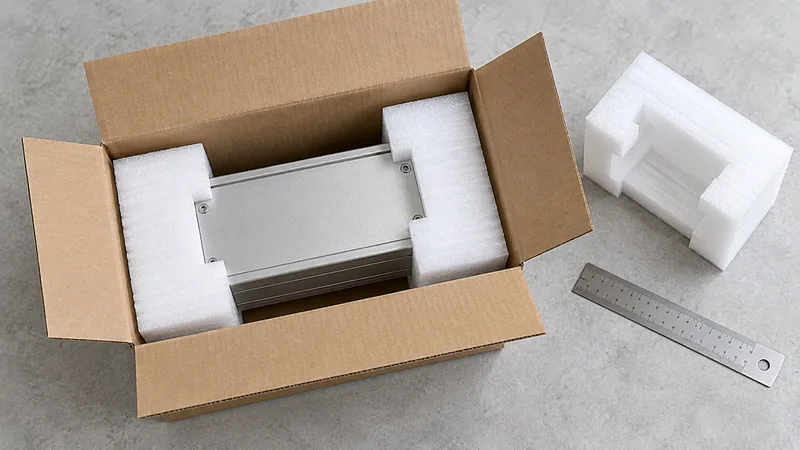
To validate a foam packaging sample, identify the complete configuration before deciding whether it is acceptable. The product, insert or carrier, enclosure and loading method all contribute to the reviewed system. A loose foam sample can answer a limited material or geometry question. It cannot represent every contact and handling condition in a finished package.
The packaging and logistics hub links the application routes. An EPE transport liner, an EVA packaging insert and an EPP returnable unit need records tied to their actual job. This guide focuses on the sample setup and release decision after the route has been shortlisted.
Identify every part in the packed configuration
Name the product version, packaging enclosure and foam drawing revision. Record any accessories, layers or inserts that are part of the proposed pack. A configuration list prevents a photograph from becoming the only record of the sample. It should be possible to identify the same parts when another reviewer repeats the loading sequence.
State whether the enclosure is final or provisional. A prototype carton or substitute case can help answer a fit question, but its limits must be visible. Mark any known difference in walls, closure or available space. A later enclosure change should return to the packaging owner rather than silently inheriting the previous sample approval.
Identify the proposed material family and grade, or keep the grade field open where it is not yet supplied. An image number is not a grade or SKU. Record thickness and converted-form questions without inventing tolerances. The supplier should explain which material record and processing route apply to the sample.
- Product, accessory and enclosure identity.
- Foam drawing and revision.
- Material, grade and conversion questions.
- Known prototype departures.
- Review owner and intended decision.
Check contacts against the approved support map
Before loading, compare the foam geometry with the intended product contacts. Locate the support surfaces and prohibited contact zones on the drawing. If the pack designer has not defined them, resolve that question before describing the sample as suitable. The reviewer should not create support rules informally while pushing the product into the insert.
Place the product using the planned orientation and sequence. Observe interference at protrusions, connectors, finished faces or other sensitive features identified by the project. Record the location rather than using a broad pass comment. A precise observation can guide a revision to a cut-out or support surface without condemning the entire material route.
Include the accessories in the same setup. Their position can affect the enclosure clearance or unloading path. Record whether a separate layer, divider or pocket is part of the sample. If the accessory arrangement is provisional, keep it marked. The complete configuration must describe what was actually reviewed.
For a carrier, inspect the locating relationship to the handled part. State which features prevent incorrect orientation and how the operator checks seating. Do not infer a holding force or protective result from visual contact alone. If the project requires a measurable outcome, identify its method and owner separately.
| Review stage | Keep fixed | Record |
|---|---|---|
| Identity | Product, insert/carrier and enclosure | Drawing and proposed grade references |
| Packing | Loading and closure sequence | Contact, clearance and access observations |
| Evaluation | Agreed setup and method | Conditions, evidence owner and scope |
| Release | Approved configuration | Open actions and change-triggered review |
Review packing, closure and removal as one sequence
Show how the operator prepares the enclosure, places the foam and loads the product. Note extra supports or handling aids used during the review. A prototype that needs an unrecorded fixture may not represent the intended packing process. The record should explain that difference before purchasing treats the shape as final.
Close the packaging with the actual lid or closure method where possible. Observe movement and unintended contacts. If closure changes the position of a product or insert, identify the feature involved. Record whether the enclosure is constrained by another layer, an accessory or a fastening step. These details help the designer distinguish a shape issue from a system issue.
Then remove the product through the intended path. Check finger access, lift direction and sensitive surfaces during extraction. A sample that is easy to load can be difficult to unload without altering the support arrangement. Include both observations if the product is expected to be unpacked and packed again.
The sequence also matters for returnable handling units. Describe inspection between uses and the decision to retain or replace a unit under the agreed workflow. The application scope does not establish a universal reuse count. Ask the logistics owner to define the condition that needs evaluation rather than adding a cycle-life number to the record.
Separate dimensional approval from transport evaluation
A fit review can confirm observations in an identified enclosure under a stated sequence. Transportation evaluation asks about the complete packed system under defined conditions. Those decisions can be linked, but they should not be merged into one unsupported claim. State the intended scope before using terms such as validated or released.
The International Safe Transit Association offers packaging-test information. The ASTM International catalogue provides test-method references. The project owner should select the relevant protocol and complete configuration. Public catalogue links are not evidence that the sample has passed a test or that Green Foams holds an approval.
If evaluation is required, record who owns it, which parts it uses and which observations allow acceptance. Do not add test severity or pass thresholds from an unrelated example. The actual product and shipping conditions must guide that decision. A planned test is an open action until its applicable result and approval are recorded.
- Confirm the packed-system identity.
- Complete the geometry and loading observations.
- Define any separate transport evaluation requirement.
- Identify its method, owner and evidence scope.
- Release only the decisions supported by the record.
Keep comparison samples under the same conditions
If EPE and EVA proposals are compared, use the same product and enclosure where the project allows. Record changes to material, thickness, shape and construction. An observation cannot be assigned to a material family alone when the geometry changed as well. A concise comparison sheet should name the variables rather than hide them behind an overall preference.
A revised EPP carrier concept may change both the handling unit and the workflow. Treat that as a separate configuration. Show the new loading and inspection sequence and decide which prior observations remain relevant. Keeping the earlier record makes the reason for the change visible and allows the operations owner to review it.
Photographs are useful when they identify the sample and location. Pair an image with the drawing feature and a short observation. A close-up of a corner without its orientation can be ambiguous. The evidence should help another person reconstruct the check, rather than serve only as a visual proof that a prototype exists.
Release the configuration and preserve open actions
The release record should name the drawing revision and the observations approved. Geometry can be accepted while transport evidence remains open if the scope is stated. A quality or packaging owner should decide which requirements are mandatory before the next step. Do not let a partial decision become a general protection claim in the purchasing description.
Identify changes that require review. A new product version, enclosure, material grade, thickness, contact pattern or packing sequence can affect the sample. The owner should state which checks repeat. Commercial substitutions should be visible to engineering before the approved configuration is altered.
Use the packaging and carrier route-selection guide if the revised proposal changes the job itself. An insert and a returnable carrier have different workflows and evidence questions. The validation record should follow the selected route rather than stretch an old fixture to answer a new application.
At quotation handoff, include expected volume, the identified configuration, proposed format and open specification questions. Ask the supplier to flag assumptions and departures. Keep unsupported MOQ, delivery, environmental or protection claims out of the request. The useful outcome is a traceable packaging decision with the product, enclosure and sample evidence kept together.
Close the loop with the packing team
The packing operator and logistics owner should be able to understand the approved sequence from the record. Include the practical observations that affected placement or removal. A drawing can show a cut-out while the sample reveals an access problem. Both belong in the handoff so a later revision addresses the actual workflow.
If another packing location uses the same concept, confirm that its product, enclosure and sequence are equivalent before reusing the record. A similar appearance does not establish the same configuration. Preserve differences and route them to the packaging owner. This keeps a validated sample useful as evidence for its stated job without turning it into a promise for every shipment.
Store the approved drawing and configuration list where the packing team can find them. If an operator reports a repeated obstruction or a damaged contact feature, identify the sample and location before changing the pack. The record can help distinguish a revised product, an altered enclosure and a handling-method issue.
Route the proposed correction to the approval owner and repeat the relevant observation. A practical feedback loop improves the next review while keeping the release scope intact. It avoids treating an informal workstation adjustment as an approved new packaging configuration.