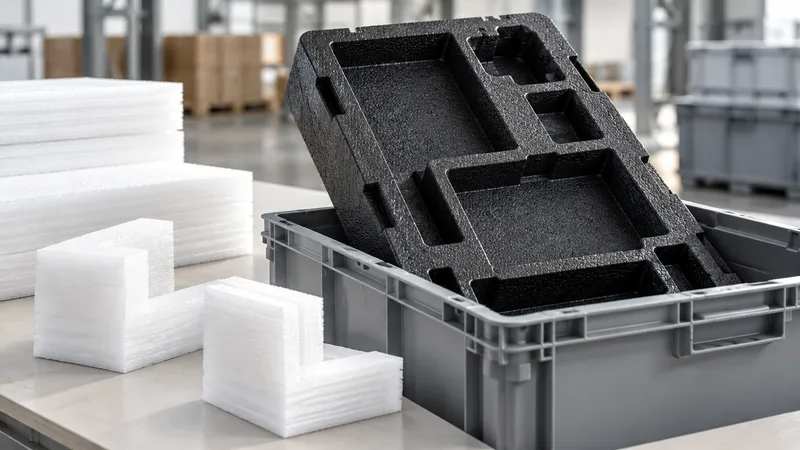
Choosing foam for packaging and returnable carriers begins with the packed product, not with a generic cushioning label. The foam has to occupy a specific enclosure and contact approved regions of the product. A carrier must also support a defined handling sequence. Material discussions become useful when those relationships are visible in the same request.
The packaging and logistics hub separates insert and returnable-unit jobs. The customer material scope describes EPE Foam for electronic-product and precision-instrument transport liners, EVA Foam for packaging inserts and EPP Foam for returnable boxes, pallets and protective parts. These directions do not supply a complete-package performance result.
Begin with the product envelope and support rules
Provide the product drawing or a controlled sample. Mark the faces that can carry contact and those that must remain clear. Sensitive areas may include finished surfaces, protrusions, connectors or controls, depending on the product. The packaging owner should identify them rather than asking the converter to infer support rules from an image.
Show the product in its packed orientation. A product can be loaded from one direction and travel in another position. Record the accessories that share the enclosure and whether they affect clearance. The foam outline should be reviewed against the complete envelope, including features that are easy to overlook in a simple width-and-length request.
- Controlled product geometry and orientation.
- Approved support zones and prohibited contacts.
- Accessories and protruding features.
- Enclosure and closure context.
- Loading, removal and inspection sequence.
Support geometry is a design input, not a protection claim. A sample can show where the product contacts the insert under a defined setup. It does not prove a shipping outcome on every route. Keep required performance conditions in a separate field so the project can plan the appropriate complete-package evaluation.
Review EPE and EVA as insert routes
EPE and EVA enter a packaging-insert discussion from their customer-stated applications. Use the same product envelope when reviewing proposals. Ask each proposal to identify its form, thickness question and grade reference. A fair comparison explains what changed between samples instead of presenting two unrelated shapes as a material ranking.
The insert must fit the enclosure as well as the product. Show the carton, case or box dimensions and closure sequence. Explain whether a lid, wall or separate layer constrains the foam. If the enclosure is still under development, mark the open dimensions. A revised case can change the insert even when the product itself stays unchanged.
Ask about cut geometry, corners and edge treatment in the proposed format. An inset, notch or finger opening can improve access, but it also changes contact. If the proposed construction uses layers, joins or backing, show them in the request and ask for capability confirmation. Do not treat every process as available across every material family.
EVA adds hardness, colour and thickness questions in its customer material scope. EPE includes sheet/roll and shaped-cut discussions. These are useful fields for a route review, but the supplied grade and conversion details still need confirmation. Avoid replacing those records with a broad statement that one material offers better protection in all inserts.
| Packaging job | Material discussion | Control in the brief |
|---|---|---|
| Electronic/precision-product insert | EPE / EVA | Product envelope, support faces, cut geometry and enclosure |
| Packaging insert form | EPE / EVA based on proposed construction | Thickness, extraction access, edge/colour/format questions |
| Returnable handling unit | EPP | Loading access, carrier interfaces and defined inspection workflow |
Review EPP through the returnable workflow
EPP is described for returnable boxes, pallets and protective parts. Start with the handling unit and the components it carries. Show locating surfaces, loading access and the features that control orientation. A molded concept should be discussed around this geometry, with any tooling or insert requirements visible as questions.
Explain the movement through the workflow. Who loads the part, who removes it and which operations inspect the unit? The review can include handling access and disposition rules without claiming a reuse count. A carrier that is intended to return needs a clear record of the conditions under which it is accepted, repaired or replaced.
Keep the carrier interfaces separate from the product contacts. Handles, bases, stacking features or fixtures may belong to the wider handling system. Identify which of these the proposed foam component must accommodate. Do not infer a load rating or transport result from the appearance of a pallet or box in a reference photograph.
If a returnable route is compared with a shipping insert, explain the different job rather than forcing a direct substitution. Their handling, enclosure and commercial questions may differ. The project owner should decide which workflow is required before procurement evaluates route proposals. A shared material shortlist cannot resolve an undefined logistics process.
Include packing and removal in the geometry review
A product that fits when placed carefully on a bench may be difficult to pack at a workstation. Describe the operator's sequence and access. Show whether the insert is placed before the product, assembled around it or combined with another layer. Identify any temporary support used in the prototype review so it does not become an invisible production assumption.
Removal deserves its own observation. A finger opening, lift feature or product orientation can affect access to a sensitive surface. Record the intended unloading direction and whether the product must remain protected during that step. A useful sample checks both placement and extraction against the same support rules.
Observe accessories and labels as part of the packing sequence. A cable or small part stored beside the main product may alter clearance or operator access. Include only the actual project items; do not invent an accessory arrangement to make the layout look complete. The final insert record should describe the reviewed pack, not an imagined typical shipment.
- Place the insert in the intended enclosure.
- Load the identified product and accessories.
- Close the enclosure using the agreed sequence.
- Remove the product with the intended access.
- Record contacts, interference and unresolved questions.
Separate fit checks from transportation evidence
A dimensional review can establish that the sample matches the agreed geometry. A transportation evaluation asks another question about the complete packaged system under defined conditions. Keep these decisions distinct. Do not summarize a successful fit as proof of impact protection, drop performance or a universal shipping result.
The International Safe Transit Association provides packaging-test information, and the ASTM International catalogue provides test-method references. Consult the relevant project owner about the required protocol and configuration. These links do not imply that a Green Foams package has been tested, certified or approved by either organization.
Record the product, enclosure, insert and method behind any planned evaluation. If one of those changes, ask which observations need repeating. A result attached to an old configuration cannot automatically transfer to a revised pack. The approval record should make the tested or observed scope easy to identify.
Finish the route comparison with a bounded decision
Request the grade, form and conversion assumptions for each proposal. Keep density or hardness values attached to their method and specimen. Compare quotations against the same controlled drawing and packaging job. If a supplier proposes a different enclosure or contact pattern, treat it as a design alternative rather than an equivalent material replacement.
The packaging foam sample-validation guide explains how to record the next review. Use it to connect the shortlist to a repeatable packed-system setup. Approval can cover geometry while a transport requirement remains open, provided both scopes are stated clearly.
Before purchasing handoff, confirm that the support zones, enclosure and handling sequence still match the approved configuration. Include expected volume and commercial questions without adding an unsupported MOQ or delivery promise. Ask the supplier to flag departures from the brief. A clear packaging route follows the product through its actual workflow rather than relying on a general claim about foam performance.
Record the reason for each shortlisted route
A shortlist should explain whether the proposal addresses an insert shape, a handling unit or a changed logistics workflow. Keep that reason next to the proposed material and form. A route can remain under review because the enclosure is unfinished, because a grade record is needed or because the loading sequence needs another sample. These gaps require different next actions.
Preserve rejected options with a short explanation where they affect the design decision. An insert may interfere at a connector; a carrier may not provide the required removal access. Recording the location and setup is more useful than assigning a universal score to the material family. The next proposal can then address the actual packaging issue instead of repeating a broad cushioning claim.
Also explain who receives the package and what they must do after opening it. A service technician, assembler and end user may need different access to the product. The package review should use the actual unloading task that the project defines. That information can change a finger opening, support face or accessory pocket without changing the family shortlist.
Keep these changes on the controlled drawing and include them in the next sample review. The packaging material recommendation then remains connected to the product journey, from loading through removal, with evidence limited to the observed or evaluated configuration.