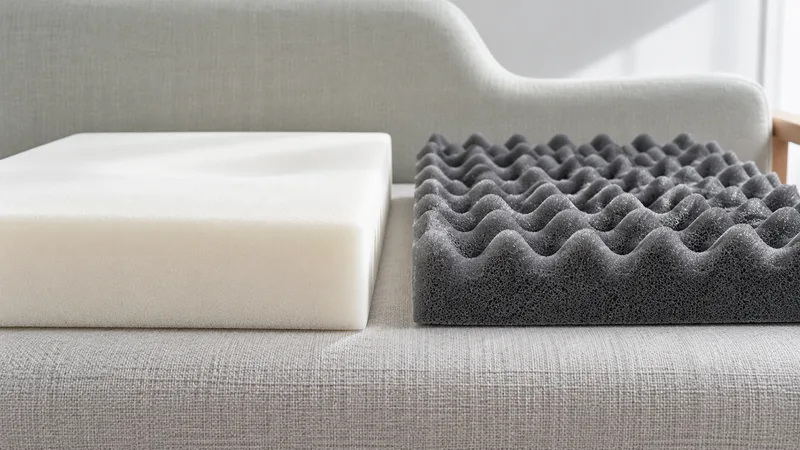
To compare PU and Memory Foam cushions, start with the seat assembly and the decision the sample needs to support. The names describe material routes, not an automatic comfort ranking. A buyer can compare proposals more clearly when the base, cover, thickness envelope and contact zones are identified before the material conversation begins.
The furniture and seating hub organizes these questions. The customer material information describes PU Foam Cushions for density/ILD selection and molded seating forms. It describes Memory Foam Cushions for slow-response and composite structures. These application directions guide a review; they do not establish ergonomic, medical or lifetime performance.
Define the seat before comparing the foam
Provide the seat base and intended cushion envelope. Mark the regions where the user or surrounding parts contact the cushion. Show locating features, attachments and clearances that constrain the geometry. A loose material sample can help discuss a grade, but it cannot represent the whole assembled cushion without these surrounding parts.
Describe the cover and the installation order. The cover can change the assembled geometry and the way a cushion is placed on the base. If a prototype cover differs from the proposed design, state that difference. A sample observation made under one cover should not automatically transfer to a revised cover.
- Seat/base drawing and cushion envelope.
- Contact zones and locating features.
- Cover geometry and attachment method.
- Installation and review conditions.
- Acceptance question and responsible owner.
Decide which task the comparison answers. It may be a geometry review, cover-fit observation or a material specification discussion. A useful test or review plan can include several tasks, provided each one is named. Avoid compressing every observation into a single description such as more comfortable when the project has not defined that evaluation.
Read the PU route through density and ILD
The PU cushion route includes density and ILD selection in the customer material scope. Keep these fields separate. Density is a mass-to-volume record, while ILD needs its stated method and specimen context. A higher or lower density does not by itself establish a comfort outcome, a cushion life or the behaviour of every seat geometry.
Ask for the proposed grade and the applicable technical record. Include the specimen thickness, area, conditioning and method where they affect comparison. The material-information numerical ranges are pending confirmation and should not be turned into a guaranteed stocked grade. Request the record that applies to the actual proposal.
Compare samples while preserving their geometry. If grade and thickness change together, note both changes before describing the observation. The assembled response can reflect more than one variable. A comparison that hides those variables can lead procurement to choose a material for an outcome that belonged to a different configuration.
Molded geometry is another PU route question. Confirm the proposed form, mold scope and dimensional priorities. Inserts, covers and other construction details need their own capability discussion. The material application description does not prove that every mold, insert or process is available for every cushion design.
| Comparison input | PU cushion route | Memory Foam route |
|---|---|---|
| Material record | Density and ILD with method | Response and structure with method |
| Geometry | Molded or shaped form to confirm | Proposed cushion/layer form to confirm |
| Shared fixture | Seat base, cover and contact zones | Same identified seat base, cover and contact zones |
| Evidence | Grade and assembled sample observations | Grade and assembled sample observations |
Read the Memory Foam route through response and structure
Memory Foam Cushion is described for slow-response and composite-structure selection. Ask the supplier to explain the proposed construction and the conditions attached to any response record. The family name does not describe every layer, thickness or cover. Treat the response question as a controlled project input rather than a broad guarantee.
If a composite construction is proposed, identify its layers and interfaces. State which material belongs at each location and what the project expects that layer to do. Ask which joining or conversion details are confirmed. Do not assume a complete layered cushion from a photograph that shows only one material surface.
Keep the review condition visible. A sample observed in one setup may not represent another setup with a different thickness, cover or temperature context. The responsible designer should define which variables matter to the project. The material record and the assembled observation should describe those conditions clearly.
Do not turn slow-response terminology into a medical or ergonomic claim. The current material information does not provide that evidence. If a buyer needs a specific requirement, record it and request the applicable grade or system evidence. A useful material discussion can proceed without making a result that the record does not support.
Compare each route in the same seat context
Use the same base and cover where the project permits. Identify departures when a proposed route requires another geometry or layer structure. A design alternative can be valuable, but it should be named as an alternative. It is not equivalent to swapping only the material while preserving every other input.
Record what the reviewer observes and how. Placement, edge alignment, cover fit and assembly access can be described directly. If the project asks for a response or load-related result, agree the method and conditions first. The record should distinguish a practical assembly observation from a measured performance outcome.
Ask reviewers to report the locations that matter. A broad preference can start a design conversation, but it is difficult to reproduce without context. Note the sample, seat, cover and observation conditions. This helps another engineer understand whether the proposal answered the original question or raised a new one.
- Identify the shared seat and cover.
- Record material, geometry and structure changes.
- Use the agreed observation or measurement method.
- Describe results with locations and conditions.
- Preserve open questions and the next review.
Use methods as evidence context rather than labels
The ASTM International catalogue provides material-method references. The NIST measurement resources support measurement terminology. These authority references can help a project team identify a method; they do not establish that a proposed cushion has passed a test or holds a certification.
Keep the material record linked to the grade and specimen. A record for raw foam is not automatically a result for a converted cushion or complete upholstered seat. The drawing, layer structure and cover add variables. Ask which level the evidence addresses and which requirements need another review.
If proposals use different methods, do not compare their values as though they were equivalent. Ask the material owner to explain the difference or provide a consistent basis for the project. This protects the decision from an apparent numerical comparison that ignores how the values were obtained.
Keep furniture requirements explicit
Furniture buyers may have fire, chemical, durability or other product requirements. The present material information does not establish those approvals for these cushion families. State the actual requirement and the evidence the buyer expects. Do not infer compliance from the use of office or home seating in an application description.
Separate mandatory requirements from exploratory questions. The design team may still compare shape while another evidence item remains open. That can be a useful bounded review if its limits are stated. The purchasing description must retain those limits rather than describing an early sample as approved for every intended market.
The seating foam sample-review guide explains the next step after route selection. Use it to define a representative base, cover and acceptance record. The sample should answer the project question that brought the material into the shortlist.
Finish the comparison with a traceable handoff
Provide procurement with the drawing revision, proposed material route, grade question, form and evidence scope. Include expected volume as an input without assuming universal tooling or delivery conditions. Ask suppliers to flag departures. A response should identify the configuration behind the proposed grade rather than only give a material-family description.
Keep the reason for each decision in the comparison record. One route may need a geometry change, another may need a method record and another may require a separate assembled evaluation. Those are different open actions. Distinguishing them helps the team move forward without converting missing evidence into a comfort or durability claim.
When the seat, cover or cushion drawing changes, review whether the previous comparison still applies. Retain the old configuration and identify the reason for the revision. The useful result is a material route chosen for one defined seating task, with its method context, assembly observations and unresolved requirements preserved.
A receiving or upholstery team should be able to recognize the approved form from the handoff. Include the edge profile, orientation and cover relationship where they affect assembly. If a supplier proposes a different shape to simplify production, route that suggestion back to the designer. A useful manufacturing alternative still needs review against the same seat task.
Record whether the revision affects only a local feature or the wider cushion structure. Repeat the observations that depend on the changed feature and keep the rest of the evidence identifiable. This makes a comparison between PU and Memory Foam cushions practical for the project rather than a general ranking of material names.
Keep a shared comparison form with the reviewed drawing and its approval scope. A consistent record helps the next reviewer separate a changed cushion feature from an unchanged material question.