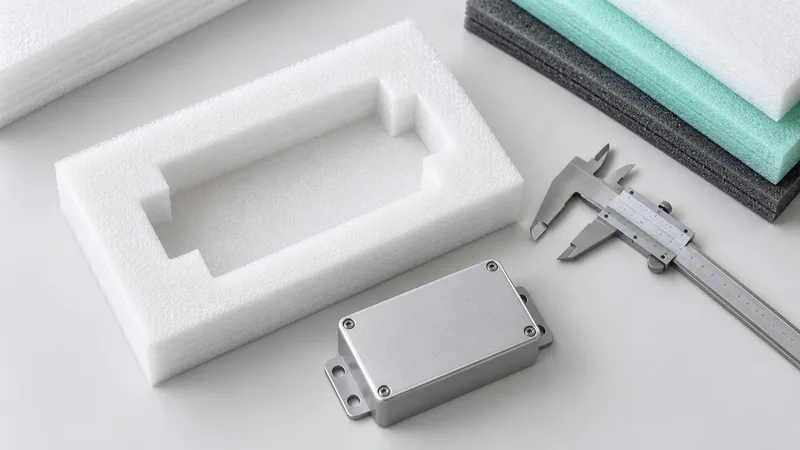
An electronics foam sample brief should let another reviewer reconstruct what was checked. A photograph of a foam part cannot do that alone. The record needs the product or mating assembly, the drawing revision, the installation sequence and the acceptance method. Separate transportation packaging from an installed equipment interface even when they belong to the same product programme.
Use the electronics application hub to identify the relevant route. A brief for an EPE shipping insert or an EVA packaging insert focuses on support and enclosure geometry. A Silicone Foam equipment interface adds temperature and medium questions. This guide controls the sample record after that initial routing decision.
Give the sample a traceable identity
Name the part, programme and drawing revision used for review. Record who issued the drawing and whether the sample follows it completely or includes agreed departures. An early prototype can be useful, but the review must describe what it represents. If a cut-out, thickness or backing is provisional, keep that fact beside the sample identity.
Identify the other parts in the fixture. For an insert, this means the product and packaging enclosure. For an equipment interface, it means the mating surfaces and any parts that control placement. A sample reviewed against a substitute enclosure should say so. The substitute may help answer a geometry question while leaving the final configuration open.
Attach a simple configuration list to the record. It can identify the sample, drawing, product version, proposed material family and format. Do not substitute an image filename for a real material grade. The project material information does not treat photograph numbers as SKUs. Ask the supplier to name the proposed grade when that information becomes available.
- Part or programme name and drawing revision.
- Proposed material, format and open grade fields.
- Product, enclosure or mating-part identification.
- Known departures from the intended configuration.
- Review date, responsible person and record location.
Prepare the transport fixture around the packed product
A transport sample should show the relationship between the insert, product and enclosure. Mark the approved contact zones before the product is loaded. Keep sensitive features visible in the drawing or accompanying images. The reviewer should know where contact is intended and where clearance is required, rather than discovering those rules after the sample is installed.
Record how the product enters and leaves the insert. State its orientation and the access needed by the operator. If cables, connectors or accessories travel with it, show their location. A successful placement observation does not automatically settle removal. Review both directions if they form part of the intended packing workflow.
Close the enclosure using the planned sequence. Note whether the insert moves, whether an accessory changes the clearance or whether a lid contacts a prohibited surface. Describe observations with locations and photographs rather than with a single word such as good. The record should allow the designer to revise a specific feature and review it again.
Keep transportation performance separate from this dimensional exercise. A sample can demonstrate fit in a defined enclosure. It does not establish a shipping outcome under every route or handling condition. If the project needs a transportation evaluation, identify the protocol and owner and preserve the complete packaging configuration used for that test.
| Record field | Transport insert | Installed equipment part |
|---|---|---|
| Fixture | Product plus packaging enclosure | Mating surfaces and assembly parts |
| Geometry | Support zones and removal access | Contact band, clearance and keep-outs |
| Exposure | Defined shipping/handling conditions | Temperature, medium and service context |
| Release | Approved packaging configuration | Approved installed configuration |
Prepare the installed fixture around mating surfaces
An installed electronics part needs the surfaces that locate and constrain it. Include a section view if a step, recess or fastener affects the available space. Mark the regions where the foam must contact and where it must stay clear. A loose part on a table cannot show how a cover, clip or bracket sets the final interface.
Record the installation order. Describe whether the foam is placed before a cable, after a connector or during cover assembly. Note access restrictions and any temporary support used by the operator. An installation method used only for the prototype should not silently become the production method. Put that difference in the observation record.
If the interface includes temperature or medium requirements, attach them as controlled inputs. State the location and condition the engineer wants reviewed. Silicone Foam is a material family discussed for electronic-equipment insulation and sealing; the name alone does not supply the missing grade or test evidence. Ask which record applies to the proposed material and assembly.
Separate a visual contact check from a performance test. An observation of continuous contact may support one assembly decision. A thermal, electrical, flame or ingress question can require another method and specimen. Give each requirement its own evidence owner so that one successful observation does not close unrelated items.
Write observations that a second person can repeat
A repeatable record names the feature, method and setup. Instead of saying the fit is tight, identify where contact occurs and how it was observed. Instead of saying a part is easy to handle, describe the placement sequence and any extra support used. The reviewer does not need a complicated form; precise descriptions are often more useful than a broad score.
Use measurement fields only where the project needs them and where a method is agreed. A critical cut-out can be checked against the drawing, while another surface may need a visual inspection. Record the instrument or method context when it affects interpretation. Avoid adding invented tolerance numbers merely to make the brief look complete.
The NIST measurement resources and the ASTM International catalogue can help the project team discuss measurement and test terminology. They are authority references, not a statement that this sample has been tested or certified by either institution. Identify the actual record required for the project.
- Locate the feature on the controlled drawing.
- State the reviewed configuration and observation method.
- Record the result and any departure from the setup.
- Assign the open action and its owner.
- Repeat the relevant check after a controlled change.
Separate the material record from the converted part
A grade record describes a material under its stated method and specimen conditions. The converted part adds geometry, edges, joins and any proposed backing. The installed assembly adds mating parts and access constraints. Keep those levels separate in the brief. This prevents a material value from being presented as proof of every feature in the finished product.
For EPE or EVA inserts, ask which grade and thickness relate to the proposed cut geometry. For a Silicone Foam interface, ask how the grade evidence relates to the stated temperature and medium conditions. Supply routes such as cutting, backing or lamination remain subject to material-specific confirmation. Do not assume that one family uses the same route as another.
If a supplier offers an alternative, record the change in a comparison column. Identify whether it changes only the material or also the thickness, edge or assembly step. A revised sample can answer a new question, but the original observation should remain available. Procurement can then compare proposals without losing the conditions that made each sample useful.
Make release a bounded decision
Approval should say what is released and what remains open. A buyer can approve the insert geometry while waiting for a transport test plan. An equipment designer can accept installation access while awaiting a grade-specific exposure record. These are meaningful partial decisions when their scope is explicit. They should not be summarized as full product compliance.
Assign an owner to every unresolved item. The engineer may own geometry, the quality team may own measurement and procurement may own the commercial request. If the final configuration changes, specify which observations need repeating. A new enclosure, cover, connector or drawing revision can change the reviewed interface even when the material family remains the same.
The electronics foam route-selection guide is useful when an alternative changes the functional job itself. Return to that decision rather than stretching the sample record to cover an unrelated application. Keep transport support, equipment sealing and electrical requirements visible as separate tasks with separate evidence.
Before sending the brief, check that a colleague could identify the exact sample and reproduce the intended review. Confirm that photographs match the configuration list and that drawing departures are marked. Close only the observations the setup supports. That produces a practical electronics foam sample brief without turning a well-fitted prototype into an unsupported performance promise.
Hand the same record to purchasing
When the sample moves from engineering to procurement, preserve its configuration list and approval scope. A purchasing description should name the controlled drawing and the proposed grade or open grade question. Attach the acceptance observations that justified the next step. Do not replace them with a broad statement that the foam is electronics approved.
Ask the supplier to identify any proposal that departs from the reviewed sample. A different format, backing or dimensional method can affect how the part is assembled. Route that change to the appropriate owner before it becomes a purchase assumption. This handoff keeps the technical decision visible and allows an unresolved requirement to remain open without losing the useful sample evidence.