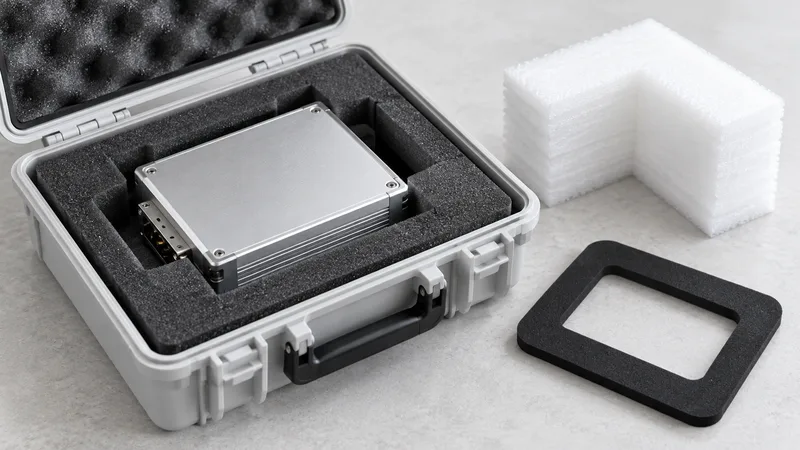
Choosing foam for electronics packaging and interfaces starts by asking whether the part travels with the product or stays inside the equipment. These locations can look similar in a photograph, but they serve different jobs. A shipping liner supports a product inside its package. An installed part occupies a defined interface and needs its own assembly review.
The electronics material hub separates those routes. The customer material information describes EPE Foam for electronic-product and precision-instrument shipping liners. It also describes EVA Foam for packaging inserts and Silicone Foam for electronic-equipment insulation and sealing. These are application directions, not a certificate or proof of an approved component.
Identify the job before comparing material names
Draw a boundary around the foam part in the product system. Is it inside a carton, case or shipping fixture? Does it remain on the product when the package is removed? Is it placed between equipment surfaces during assembly? Record the answer on the drawing rather than leaving it to the buyer or converter to infer.
A single electronics programme may have both jobs. An instrument can require a protective transport insert and a separate internal sealing part. The package reviewer and the equipment designer may own different acceptance conditions. Splitting the requests makes their decisions visible and avoids asking a packaging sample to prove an equipment requirement.
- Name the transportation or installed location.
- Show the product envelope and the foam contact surfaces.
- Identify who owns the drawing and acceptance decision.
- Keep electrical, thermal and shipping requirements in separate fields.
Do not start with the most impressive material description. A grade that belongs in a temperature discussion may be irrelevant to an insert whose main problem is removal access. Likewise, a well-fitted packaging insert does not settle an equipment interface. The task map should explain why a family enters the review, before any specification range is considered.
Map support and clearance in the transport insert
For transportation, mark the surfaces that can carry contact and the surfaces that must remain clear. Electronics products can have connectors, displays, controls or other features that the project owner considers sensitive. Do not assume that the largest flat face is the correct support surface. Use a controlled drawing or an approved physical sample to show the distinction.
Record the packed orientation. A product may enter the insert vertically but travel on another face. Show how the operator places it, where the enclosure closes and how it is removed. Finger access, cable position and the direction of removal can change a cut-out without changing the product envelope. Those details belong in the brief for both EPE and EVA routes.
The packaging enclosure is another part of the system. A loose insert on a bench does not show its relationship to a carton wall, lid or case. Review the insert with the intended enclosure where possible. State which parts of that enclosure are fixed and which remain under development. A change to the closure can invalidate a clearance observation.
EPE and EVA can therefore enter a packaging discussion from the same geometry, but the comparison still requires agreed grade and format questions. Ask what thickness, edge construction and supply form are proposed. Keep density or hardness records attached to their method and grade. Do not turn a family-level planning range into a finished-package performance claim.
| Task | Candidate discussion | Evidence boundary |
|---|---|---|
| Electronic-product shipping insert | EPE / EVA | Product envelope, support zones, packaging route and sample checks |
| Precision-instrument transport | EPE; other routes only after review | Sensitive surfaces, clearances and unloading sequence |
| Equipment insulation/sealing interface | Silicone Foam | Temperature/medium, mating surfaces and assembly-specific evidence |
Keep the installed equipment interface separate
For an installed part, begin with the mating surfaces and installation order. Show where the foam contacts the equipment and where it must leave room for fasteners, connectors or service access. A plan view can hide a step or a local change in clearance. Include a section through the relevant interface when that explains the fit more clearly.
Silicone Foam enters this route because the material information describes electronic-equipment insulation and sealing. Its selection remains tied to temperature and medium needs. Identify the source of those requirements and the exact location at which they apply. Avoid assigning one temperature label to every part inside an enclosure when the project has not defined that condition.
A seal and an insulating interface are not automatically the same acceptance task. A drawing may require continuous contact, while another part may require a defined separation or position. Name the task and the observation the sample should support. If a performance test is needed, record its method, specimen and owner separately from a simple dimensional check.
Material selection should also account for access during assembly. Explain whether an operator places the part before a cover, after a cable or during a service step. If a backing, carrier or laminated construction is proposed, treat its availability as a question. The current application description does not establish that every conversion route is supplied for every grade.
Use comparable specification records
A useful comparison preserves the method behind each value. Density is a material record; hardness and installed response need their own context. Thickness, geometry and contact area can affect how a sample behaves. Keep these variables visible so a change in fit is not mistakenly assigned to one material property while several other inputs changed.
Request the proposed grade reference, applicable technical data and the specimen conditions. Confirm whether the record relates to the material as supplied or to the converted part. Record dimensional tolerances for the drawing features that matter. This helps procurement compare proposals against a common request rather than against descriptions with different scopes.
For method terminology, the ASTM International catalogue is an authority reference. The National Institute of Standards and Technology provides measurement resources. These public institutions support a conversation about methods and measurement; linking to them does not certify a Green Foams material or assembly.
- Define the task and the reviewed geometry.
- Identify the proposed family, grade and format.
- Request the method and specimen context for each value.
- Approve only the observations covered by the agreed sample setup.
Ask directly about electrical and compliance requirements
Electronics buyers may need an ESD, antistatic, flame or electrical requirement. The current material information does not establish these outcomes for the families on this page. Put the requirement in the request, identify the evidence expected and ask whether the proposed grade can be evaluated. Do not infer compliance from the colour or appearance of a sample.
Keep a requirement distinct from a result. A line in the project brief can explain what the buyer needs without claiming the material already achieves it. The proposed evidence path may involve a material record, a converted-part test or an assembled-system check. The responsible engineer should state which of those is relevant before the quotation becomes a purchasing specification.
This distinction also helps when a product is supplied to more than one market. The commercial team should record the actual project destination and the buyer's stated requirements. A general export-market description is not evidence of approval for a particular electronics product. If the evidence is absent, keep that item open rather than resolving it through a broad marketing phrase.
Finish with a controlled comparison sample
Choose the sample setup before discussing approval. For the packaging route, include the product, insert and packaging enclosure. For the installed route, include the relevant mating surfaces and assembly sequence. Name the drawing revision and the parts used. A representative setup gives the reviewer a practical way to report fit without expanding the observation beyond its scope.
Compare alternatives by holding the agreed geometry and inspection method steady. If a thickness, cut-out or backing changes, record that change next to the material choice. An observation such as easier placement can then be connected to the revised feature. Avoid summarizing a multi-variable trial as proof that one foam family is universally better.
The electronics foam sample brief guide explains how to preserve separate transport and equipment records. Use it when the shortlist needs a review plan rather than another catalogue description. The result should be an explicit choice for a defined job, with unresolved specification or compliance questions still visible.
Before sending the request, check that the buyer and engineer agree on the same task. Confirm the contact zones, sensitive areas, operating or shipping context and approval owner. Ask for a route recommendation against those inputs. A clear distinction between transport packaging and installed interfaces is more useful than an unsupported claim that a material can solve every electronics application.
Keep the inquiry usable for procurement
Send a compact shortlist with a reason for each route. A packaging buyer can explain which product surfaces need support and which removal step is difficult. An equipment designer can explain which mating surface and exposure question drives the interface. Those reasons let procurement request comparable proposals without presenting a material family as an already approved specification.
Keep the expected volume, sample quantity question and target assembly in the same request. Ask the supplier to identify assumptions rather than supplying an unexplained price. Any proposed change to the form, grade or drawing should return to the relevant engineering owner. The final comparison then reflects a specific electronics task and a controlled configuration.