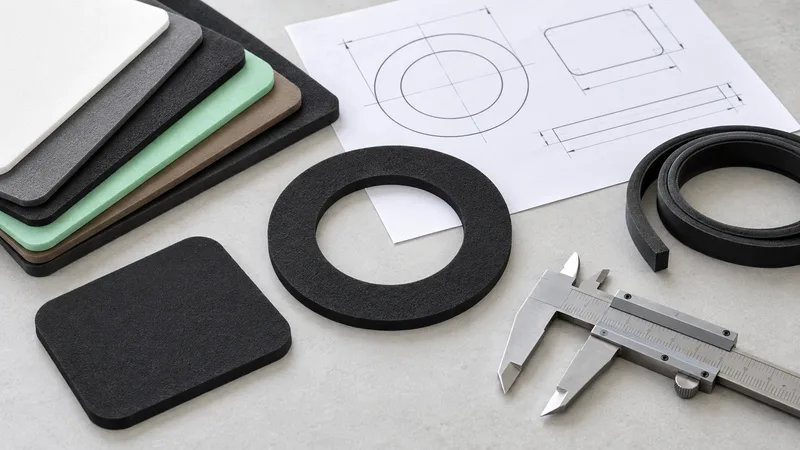
An automotive foam component brief should identify one part, one controlled drawing and the next decision required from the sample. Large programmes can contain many foam applications. A request that merges their functions into a single performance description is difficult to review. Separate carrier, sealing and seating records while keeping a common programme reference for commercial coordination.
The automotive industry hub explains the task routes. A brief for an EPP handling part needs a component-contact fixture. A brief for an NBR sealing interface needs mating surfaces and medium questions. A PU seating cushion needs its seat and cover context. The record should preserve those distinctions.
Identify the controlled component rather than only the programme
Begin with the component name, drawing revision and responsible engineer. State whether the sample matches the drawing or includes agreed changes. A prototype may have provisional dimensions, but those departures must remain visible. Do not let a photograph or quotation title become the only identity for a sample that will guide a purchasing decision.
Record the surrounding parts that determine fit. A handling carrier needs the transported component; a seal needs the mating assembly; a cushion needs the seat structure and cover. Identify any substitute used during evaluation. The substitute may answer a limited question without establishing the final configuration. Preserve that limitation beside the observation.
Use one review record per distinct part or task. A shared programme number can connect the records without merging their acceptance conditions. This helps procurement follow the commercial scope while allowing engineering to revise a specific component. It also prevents an approved carrier shape from being read as approval of a separate installed part.
- Programme and component identity.
- Drawing revision and known departures.
- Proposed family, grade question and format.
- Surrounding parts and sample fixture identity.
- Responsible reviewers and the intended next decision.
Write the carrier record around loading and handling
For a handling part, map the component contacts and required clearance. Show which surfaces locate the part and which must remain untouched. Include the loading direction, removal access and orientation in the handling unit. A brief that lists only the component dimensions cannot show whether the carrier interferes with the operator's sequence.
Describe the intended workflow. State where the part is loaded, how its position is checked and how it leaves the carrier. If the handling unit returns through a reuse workflow, define the inspection and disposition questions the project owner wants answered. Do not assign a reuse count or protective result without a project-specific evaluation.
Record proposed tooling or conversion questions separately. An EPP molded route may require a defined form and insert discussion, while another part may use cut geometry. Ask which operations are available for the proposed grade and which remain open. A tooling concept is useful planning input, not proof of confirmed production capability.
The sample observation should name locations and actions. Report an obstruction at a specific feature or the need for extra support during loading. Photographs can help explain the sequence when they identify the reviewed parts. Avoid treating a handling observation as evidence of an unrelated vehicle impact or safety requirement.
| Brief section | Record | Avoid assuming |
|---|---|---|
| Component identity | Drawing revision and task | One programme means one common approval |
| Sample fixture | Handled part, mating parts or seat system | Loose foam proves assembled performance |
| Requirements | Medium, environment and evidence owner | Automotive scope proves qualification |
| Release | Approved observations and open actions | Fit approval closes every requirement |
Write the seal record around medium and installation
A sealing brief needs the surfaces that position the foam and the installation method that constrains it. Provide the gap, corner and fastening questions on the drawing. Mark any keep-outs or local changes in section. If a nominal value is not yet controlled, present it as an open field rather than inventing a tolerance to complete the request.
Record the medium and exposure location. An oil-environment NBR discussion needs the actual medium and contact conditions, because the material-information boundary calls for compatibility testing. CR or EPDM discussions also need the actual assembly context. The material name is not a substitute for the environment description or an approved grade record.
Show when the seal is placed in the assembly sequence and how its position is inspected. If a backing, lamination or joining method is proposed, list the requirement and ask for material-specific capability confirmation. These additions can change handling and interface behaviour. They should appear in the sample configuration, not only in a commercial note.
Distinguish fit observations from exposure outcomes. A sample may show that the cut shape follows the reviewed interface. It does not prove a service life, universal medium compatibility or complete system rating. Assign those requirements to their appropriate method and evidence owner before the record closes them.
Write the seating record around the seat and cover
A cushion brief should identify the seat base, foam geometry and cover used in the sample. Mark the contact zones and attachment or locating features. Record thickness and dimensional questions alongside density/ILD fields when reviewing a PU route. If Memory Foam is proposed, explain the slow-response or composite-structure question the design owner wants reviewed.
The assembled cushion can answer questions that a loose sample cannot. Cover fit, placement access and interface alignment depend on the surrounding parts. Name any prototype cover or base that differs from the intended configuration. This keeps a useful early observation from being mistaken for final approval of a changed seat system.
Ask the reviewer to describe the condition used for an observation. A subjective comment may support a design conversation, but it is not a universal comfort or ergonomic result. Requirements involving fatigue, fire, safety or regulatory approval need their own evidence. Keep the distinction visible so a seating sample does not inherit claims outside its reviewed scope.
- Identify the seat base, cover and sample.
- Record geometry and specification questions separately.
- Describe the installation and observation condition.
- List results, departures and unresolved requirements.
- Assign the next action and release owner.
Keep measurement and qualification records apart
Ask for the applicable method and specimen context behind material values. A density, hardness or ILD record can help compare proposals, but it does not release the component by itself. The drawing adds geometry; the sample adds conversion details; the assembly adds surrounding parts. Each level should retain its own identity in the project file.
Use the ASTM International catalogue to discuss material-method terminology and the NIST measurement resources for measurement context. These references do not constitute a Green Foams test result or automotive qualification. The buyer must identify the actual record required for the component.
If the programme requires a buyer approval, regulatory record or system test, list its exact scope and owner. The present application descriptions do not supply that evidence. A mandatory requirement can remain in the brief as an open action. Do not convert it into a supplier claim merely because the quotation includes automotive in its title.
Release the configuration and control subsequent changes
Approval should state the configuration and observations covered. A reviewer may accept geometry while another requirement remains open. Preserve both outcomes in the same project file. A bounded decision is useful because it tells the team what can move forward and what still needs evidence. It is more precise than a broad label such as fully approved.
Record which changes require another review. Material grade, thickness, geometry, backing, mating parts and installation order can each affect the sample. The acceptance owner should decide which checks repeat after a change. Keep the previous sample and its record identifiable so the reason for the revision can be understood later.
Return to the automotive foam selection guide when an alternative changes the task or material route. A different family can require different specification questions and sample conditions. Do not keep the previous approval wording unchanged while replacing the configuration underneath it.
At purchasing handoff, include the drawing revision, proposed grade or open grade question, format, expected volume and acceptance record. Ask suppliers to identify any departure from the request. Route that departure to the relevant engineer. This keeps carrier, seal and cushion decisions traceable without claiming that one sample or one material list settles every automotive requirement.
Keep the supplier response aligned with the brief
Ask the supplier to answer the controlled fields in the same order as the request. The response should identify the proposed family and grade, the format, the drawing revision and any open processing questions. A response that only names a material cannot be matched reliably to the reviewed component. Request the missing context before treating it as a comparable proposal.
Place commercial questions beside the component identity but keep them separate from engineering approval. Expected volume can help describe the request, while tooling and delivery conditions still need the appropriate commercial discussion. The material information does not establish a universal MOQ or lead time. Do not add either as a default value to make the form look complete.
When a revised sample arrives, retain the earlier record and add the reason for the change. The next reviewer should be able to follow the decision from drawing through sample and proposal. This preserves useful evidence for the individual automotive component without making an unsupported claim about the whole vehicle programme.