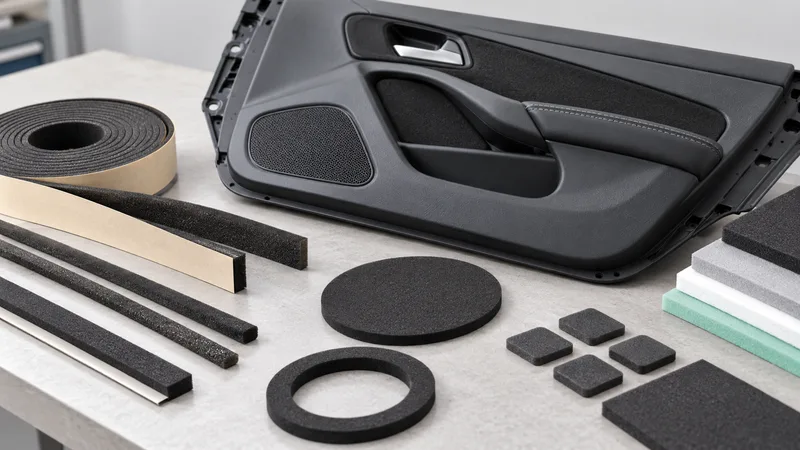
Choosing foam for automotive component tasks begins with the job the part performs. A carrier used to handle components, a sealing interface and a seating cushion can all involve foam. They do not share one acceptance condition. A useful selection request identifies which component is under review and then brings the relevant material families into that specific discussion.
The automotive materials hub organizes these jobs. Customer applications include EPP Foam for returnable boxes, pallets and protective parts, rubber-foam routes for sealing and PU Foam Cushions for automotive seating. Those directions help build a shortlist. They do not establish that a particular part or grade has vehicle approval.
Define whether the part handles, seals or supports seating
Locate the foam on a component drawing or in the handling system. State whether it travels with a part, stays on a component or forms part of a seat assembly. This distinction gives the engineer a functional starting point. It also prevents procurement from comparing materials that solve different problems simply because they appear in one portfolio.
The expected review differs by task. Handling parts need controlled contact and a clear loading path. Sealing parts need mating surfaces, exposure and installation conditions. Seating cushions need geometry, cover fit and agreed specification questions. Name that task in the inquiry subject and preserve it through each proposed alternative.
- Identify the component or handling unit.
- Show where the foam goes and what it touches.
- State the functional job without an unsupported performance promise.
- Name the engineer who owns the acceptance decision.
A programme can contain more than one foam task. Keep separate drawing and sample records even when purchasing combines the commercial request. A common programme name is useful for coordination, but it does not turn a carrier evaluation into a seal validation. Each component needs its own evidence boundary and release owner.
Review the handling route around contact and access
EPP enters a discussion about returnable boxes, pallets and protective parts because these applications appear in the customer material scope. Start by mapping the handled component, its approved support areas and the route through the workstation. A carrier should be reviewed with the part it locates, not as an isolated shape whose purpose is inferred from a photograph.
Mark areas that must stay clear. Include connectors, finished surfaces, access holes and any other features the project owner identifies. Show how an operator lowers the component, checks its position and removes it. If a carrier is reused, explain the intended handling and inspection workflow. Do not assume a cycle life or protective result without an agreed evaluation.
Format questions follow the geometry. A molded route may need a controlled tooling discussion; an insert or pad route may need cutting and edge details. Confirm which operations apply to the proposed material rather than borrowing a capability from another family. Any inserts, joints or backing should be listed explicitly as questions until the relevant scope is confirmed.
EVA is described for damping pads within the automotive application scope. Keep that task distinct from a returnable carrier. Ask where the pad remains, what interface it supports and what the assembly owner wants observed. A broad reference to protection is not enough to establish that EPP and EVA are direct substitutes for the same component.
| Component task | Families to discuss | First review input |
|---|---|---|
| Returnable handling/protective part | EPP; EVA for stated pad tasks | Part contacts, loading access and defined sample conditions |
| Sealing interface | CR / EPDM / NBR as task requires | Mating geometry, medium/exposure and applicable grade evidence |
| Automotive seating cushion | PU / Memory Foam | Seat/cover geometry, specification method and assembled sample record |
Review a sealing route around environment and mating geometry
For a seal, provide the surfaces that establish its position and available space. Show the gap, corners, steps and fastening sequence without inventing tolerance values. Include a section view when the top view hides the interface. The supplier needs to understand where contact is required and which regions must remain clear during assembly.
CR and EPDM are included in the automotive target-industry scope. NBR is described for oil-environment gaskets and equipment sealing. These application directions can guide a discussion, but they do not determine the final grade. Record the actual medium, exposure location and conditions rather than replacing them with a generic label such as automotive resistant.
If oil compatibility matters, name the oil or contamination source and the intended contact condition. The NBR material-information boundary requires testing of medium compatibility. Ask what evidence applies to the proposed grade and converted part. Keep a required result separate from a result already demonstrated by an approved record.
Do not use the material family to assign a complete system rating. A foam seal exists alongside coatings, covers, fasteners and other parts. The project owner should identify which assembled requirement needs evaluation. A dimensional fit check can answer an interface question while leaving exposure, safety or regulatory questions open.
Review seating through the assembled cushion
PU Foam Cushion and Memory Foam Cushion appear in the automotive seating scope. The selection conversation should begin with seat geometry, contact zones, cover and installation. Density/ILD fields belong to the PU route, while slow-response and composite-structure questions belong to the Memory Foam route. Neither route proves comfort or durability from the family name alone.
A cushion is reviewed as part of the seat system. Show the base, cover and features that locate the foam. Record how the sample is placed and which parts constrain it. If the drawing is provisional, identify the features that remain open. A change in cover geometry can alter the assembly even when the foam family remains unchanged.
Ask the design owner what the sample needs to demonstrate. It may support a geometry discussion, cover-fit observation or specification comparison. Record the condition and method for each task. Avoid describing a subjective observation as a general ergonomic, safety or lifetime claim unless the project has the relevant evidence and approval scope.
- Map the seat assembly and contact regions.
- Record thickness, cover and installation questions.
- Request the applicable material method and grade reference.
- Review the representative assembled sample.
- Preserve the approval scope and remaining actions.
Keep the method behind every specification
Specifications become useful when their context is retained. Ask for the method, grade, specimen and conditions rather than comparing numbers in isolation. Density, hardness and ILD describe different things. An automotive buyer should not replace one with another or infer a completed-component outcome from a planning range.
The ASTM International catalogue can help identify the relevant material methods. The NIST measurement resources support discussion of measurement context. These authority links are references for the project team, not proof that Green Foams holds a certificate or has performed a particular test.
Control the variables when reviewing alternatives. If grade, thickness and geometry all change, record each change. A difference in installation cannot be attributed to the material family alone. The same discipline applies to a carrier, seal or cushion: explain the revised configuration before describing the observation.
Treat automotive requirements as explicit evidence requests
An automotive programme may have safety, fire, traceability or buyer-qualification requirements. The present material information does not establish those approvals for these materials. Put the actual requirement in the inquiry and ask for the evidence relevant to the proposed component and grade. Do not infer it from the fact that automotive is listed as a target industry.
Ask the responsible buyer to distinguish mandatory requirements from exploratory questions. The engineer can then define the test or review path that answers each one. A request for a required record does not itself prove the result. Preserve open items so they cannot silently become supplier claims in the quotation or purchasing description.
The automotive component foam brief guide turns this shortlist into controlled drawing and sample records. Use it when the material conversation reaches the point of review. Approval should identify the exact configuration and task rather than summarize the entire programme as approved.
Before seeking a quote, make sure the component function is still visible. Include the drawing revision, environment, format questions, expected volume and evidence owner. Ask the supplier to show departures from those inputs. The resulting proposal can be assessed for one defined automotive task without implying that a broad material portfolio carries universal qualification.
Compare proposals without hiding a task change
Use a short comparison sheet that names the function and the reviewed configuration in every column. A carrier proposal should identify the transported part and contact pattern. A seal proposal should identify the medium and mating surfaces. A cushion proposal should identify the seat base and cover. This keeps commercial alternatives anchored to the same engineering question.
If the proposed route changes the component design, ask the engineer to review that change before comparing prices. Moving a contact zone, adding a join or replacing a cover can affect the sample setup. The difference may be useful, but it must appear as a design decision rather than an invisible supplier substitution.
Preserve the reason for selecting or rejecting each route. A proposal may remain open because its geometry needs revision, because a material record is missing or because an assembled test is still planned. Those are different reasons and they should produce different next actions. A clear record lets the team proceed with an automotive component task while keeping unsupported qualification claims out of the decision.