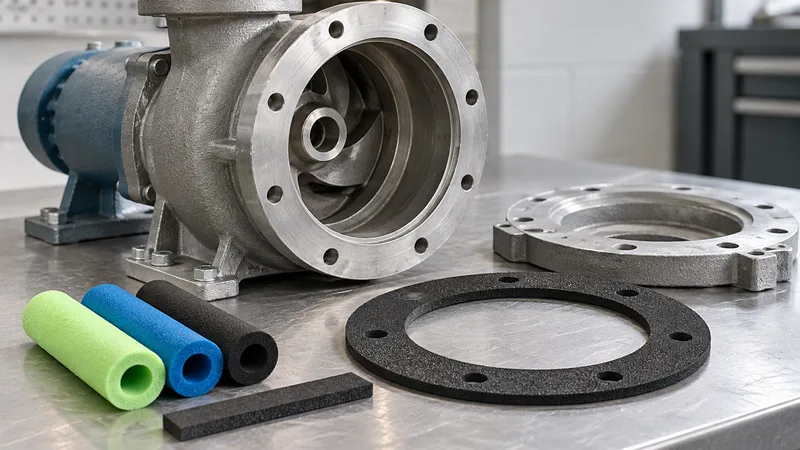
An industrial equipment gasket request needs more than a drawing attachment and the words NBR Foam. The supplier must know which revision is current, where the part sits, what exposure it must address and what the first sample is supposed to decide. The buyer needs the same context to compare responses without treating every assumption as an agreed specification.
Use this guide to assemble a controlled inquiry package for an oil-environment equipment interface. The NBR Foam material page establishes the family discussion, while the brief establishes a particular component request. No existing case, production capacity, MOQ or lead time is implied by the material name. Those commercial details require an actual supplier response.
Assign a single reference to the request
Give the component an identifiable project or drawing reference and state the active revision. Include the date or revision status of the accompanying documents where needed. If the drawing is not released, make that clear in the brief. A prototype request and a production request can use similar files while requiring different decisions from the recipient.
List the documents in the package so the supplier can confirm what was reviewed. A two-dimensional drawing, equipment section and marked installation image may each explain a different feature. Their references should connect to the same component. Avoid allowing an older image or informal sketch to override a controlled dimension without the design owner's review.
Name the person who can answer drawing questions. A buyer may coordinate the inquiry without owning the geometry. Separating those roles allows a proposed manufacturing adjustment to reach the engineer who can assess its equipment effect. It also prevents a quotation comment from becoming an unnoticed design change.
- Component reference and active drawing revision.
- Drawing, section and image list.
- Prototype or production status.
- Design contact and purchasing contact.
- Questions that are explicitly still open.
Show the gasket's location in the equipment
Add an assembly view or section that locates the foam between the actual mating parts. Identify those parts and their relevant revisions. The supplier needs to see how the component is placed, retained and accessed. A detached outline does not reveal the nearby fastener, step or clearance that may control installation.
State the required function at this location. If the task includes a sealing evaluation, identify the project requirement and responsible owner. If the initial task is only geometry or placement, say so. A limited prototype observation can be useful, but it should not be labelled complete equipment sealing approval.
Describe the installation sequence and any practical restriction. Explain which side is accessible, how orientation is recognized and whether an inspection point is visible after assembly. Keep these as application facts to review rather than asserting that the proposed foam or backing already solves the handling problem.
For several related interfaces, use a common programme reference but maintain separate component records. Each needs its own geometry, location and exposure conditions. A sample decision at one equipment location should not be copied across the programme simply because the parts share a material family or similar appearance.
| Brief item | Owner or reference | Supplier response needed |
|---|---|---|
| Controlled geometry | Drawing owner and mating-part revisions | Proposed construction and flagged geometry questions |
| Equipment location | Assembly reference and installation owner | Placement/handling questions |
| Oil exposure | Technical owner, exact medium, temperature and duration | Grade-specific TDS and applicable test evidence |
| Sample decision | Acceptance owner and defined observation scope | Sample identity and open actions |
| Commercial handoff | Buyer and expected volume | Confirmed scope and quotation assumptions |
Attach a concise exposure record with a named owner
The technical owner should identify the exact oil or fluid, temperature and contact duration relevant to the gasket. Include the stated contact mode and any separate cleaning or maintenance event that requires review. If a field is unknown, assign an action to obtain it. An empty exposure field should not become an assumed approval during quotation.
Ask for grade-specific technical data and applicable testing rather than a broad promise of oil resistance. The NBR compatibility and hardness guide explains the evidence context. Compatibility depends on the actual medium and conditions, so the request should enable the reviewer to compare a proposed record with the real equipment requirement.
Keep the proposed grade identifiable through every response. A change in grade, backing or joining construction can change the evidence question even if the part number stays the same. Ask the supplier to flag such changes and name the equipment engineer who decides whether earlier evidence remains applicable.
Density and hardness belong in the material record, with methods and confirmed grade values requested where needed. The current provisional fields do not establish exposure suitability. Procurement should retain them as confirmation requests until the relevant technical owner accepts the supplier's documented response.
Distinguish required geometry from a conversion suggestion
Indicate which dimensions and features are controlled by the equipment design and which are open to supplier input. If a feature is provisional, retain that status in the inquiry. This lets the supplier propose a conversion route without treating every exploratory dimension as either fixed or freely changeable.
The NBR format guide can support a discussion of sheet-cut outlines, strips or custom gaskets. The brief should identify the intended route or request a proposal, together with any corners, joins, holes or backing questions. Actual conversion and supply scope remain for confirmation.
Ask the supplier to mark a proposed deviation by feature and explain the reason. The design owner can then assess the effect on contact, clearance or installation. Keep the original drawing intact and record an approved change through the project's revision process. An email suggestion should not silently replace the controlled geometry.
Give the first sample a bounded acceptance task
Describe what the reviewer will inspect when the sample arrives. It may involve outline dimensions, locating features, installation order or an assembly observation. List the setup and required references. The supplier can then prepare a proposal that addresses the decision instead of sending a generic sample whose relevance is unclear.
Identify the mating parts or fixture used for review. If those differ from the final equipment, document the difference and its limit. A substitute fixture may answer a geometry question while leaving installed sealing or actual exposure open. The acceptance note should preserve that distinction when it travels to the buyer.
Keep exposure testing separate from the fit observation where appropriate. Record who approves the plan, which grade or construction is assessed and how the result connects to the requirement. A good fit alone cannot release oil compatibility, service life or every operating condition. The review should name the evidence behind each conclusion.
Use marked observations instead of an overall comment such as sample approved. A dimension result, image location or installation note tells the next team what was checked. Identify any damage, adjustment or unexpected construction without inventing its cause; ask the responsible owner to decide the next action.
Copy the equipment-location handoff
Complete one record for each interface. The supplier response should answer each line or identify a deviation; a blank is an unresolved task, not an implied agreement.
| Controlled input | Equipment-team entry | Supplier reply / next decision |
|---|---|---|
| Location and geometry | Component/location: ___; active drawing/mating revisions: ___; fixed/provisional features: ___ | Offered outline/construction: ___; deviation by feature: ___ |
| Installation | Accessible side: ___; orientation/retention: ___; concealed inspection stage: ___ | Placement limitation: ___; sample observation needed: ___ |
| Exposure | Exact fluid/event: ___; temperature/duration/mode: ___; owner: ___ | Grade/TDS and applicable exposure record: ___; gap: ___ |
| Next sample | Concept/fit/evaluation task: ___; actual counterparts or substitute fixture: ___ | Sample construction and identity: ___; supported checks / exclusions: ___ |
| Purchase request | Expected volume: ___; included conversion/backing/sample work: ___ | Quoted inclusions/exclusions: ___; confirmed assumptions: ___ |
| Acceptance transfer | Geometry scope: ___; exposure scope: ___; record references: ___ | Pending action / owner: ___; changed-field recheck: ___ |
Teaching handoff example: a substitute fixture can demonstrate a locating feature while the actual oil exposure remains pending. Write “fit observation in identified fixture” in the sample scope and list the applicable fluid record as a separate open action. This is a scope classification, not a passed sample or operating result.
Control the handoff after the sample review
The acceptance owner should issue a decision naming the reviewed configuration and its limits. State which requirements have supporting evidence and which need further work. Procurement can then request the next step with a known scope rather than interpreting an informal sample reaction as complete production release.
Link measurement or test references to the actual record. The ASTM catalogue of methods can inform a method discussion, and NIST measurement information supports measurement context. Public references do not replace a project test or certify the proposed component.
For the next revision, identify whether the changed field is geometry, fluid, grade, backing or installation. Keep earlier evidence attached to its original configuration and ask the relevant owner which part of the handoff must be repeated.