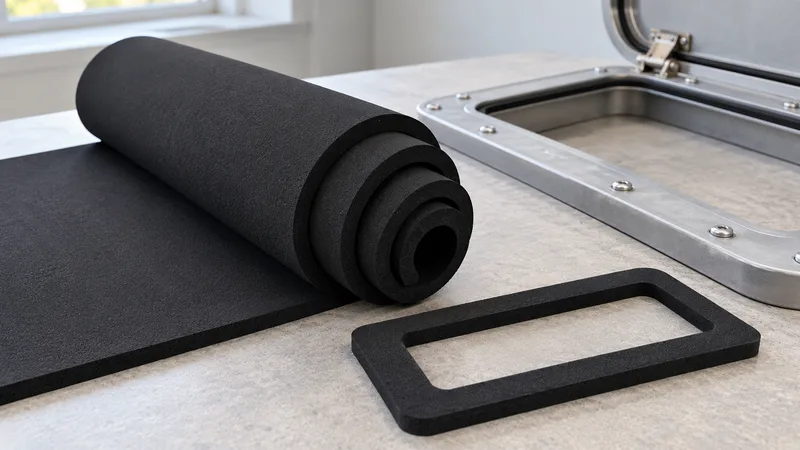
Choosing Neoprene foam for sealing starts with the joint and the entry path to be controlled, not a color swatch or a broad material label. The customer record describes Neoprene foam for sealing inner liners and sealing pads, for door, cabinet and dustproof-pad sealing applications. These are useful application boundaries for a project brief. They do not establish one universal density, hardness, thickness or performance result for every gasket.
The Neoprene Foam product page gives the family-level route for sealing liners and gaskets. Before comparing options, send mating-part drawings or samples and identify contact surfaces, gaps, corners and joints. Describe closure and service access so engineering, installation, testing and purchasing owners can review the same construction.
Start with the mating interface and sealing task
Draw the surfaces the seal should meet and the path that must remain in contact. Include mating-part dimensions, the available gap, corners, openings, fasteners and hinges. Mark intentional openings and keep-out areas separately. Identify how critical sections and contact faces will be inspected.
Define which dust or water entry path the foam is intended to control. Describe the installed orientation and relevant exposure questions, such as water contact, outdoor exposure, temperature changes, cleaning media or repeated opening. Ask the technical owner to define conditions, method and acceptance criteria rather than treating contact or location alone as proof of a seal.
Include the surrounding door, cabinet, window or equipment enclosure. Show the closure arrangement, adjacent parts, retention and installation space. Check whether the proposed thickness interferes with closure, fasteners or service access. The complete joint also determines which sheet-derived profile, strip or shaped gasket concept should be reviewed.
- Send mating-part drawings or samples with critical gaps, contact faces and keep-out areas.
- Describe the sealing objective, exposure conditions, orientation and closure sequence.
- Show the mating surfaces, corners, end joints and proposed retention.
- Separate dimensional and installation checks from the defined sealing evaluation.
State expected volume and revision timing without turning them into a promise about minimum order or lead time. Commercial conditions require a project quotation. A useful brief simply explains whether the team is exploring a prototype, a recurring sealing component or a revision to an existing liner. That context helps the manufacturing discussion stay attached to the intended use.
Separate an intended sealing function from proven performance. A drawing defines geometry and a sample can show installation or closure. Dust, water and weather-exposure conclusions need an agreed configuration, method and criterion. Record what has and has not been evaluated for the proposed grade and assembly.
Choose a format that matches the assembly
Sheet material can be a starting point for a flat sealing profile. Roll-derived strips may follow an enclosure edge or joint, with end joints and corners defined. A custom gasket may follow a perimeter with openings or location features. Confirm the proposed conversion route, grade and dimensions with the process owner; a material name does not establish every format or capability.
Review the full contact path before choosing a shape. At corners, strip ends or changes in section, show the proposed joint and inspection access. If several pieces form the seal, identify registration, butt joints or overlaps. Check retention and replacement without assuming that separate lengths automatically provide continuous contact.
Use a qualitative comparison first, then request a project proposal. Do not infer a production method from an image or from a file number in the media library. The product page can start the conversation while the drawing, sample and expected volume determine the relevant construction questions.
| Brief area | What to provide | Why it matters |
|---|---|---|
| Mating geometry | Drawings, contact path, gaps, corners and joints | Defines sealing contact and closure-clearance questions |
| Sealing task | Dust or water entry path and relevant exposure conditions | Connects the route to a defined method and acceptance criterion |
| Format | Sheet-derived profile, strip or custom gasket concept | Sets the joint, retention and installation discussion |
| Specification | Density, hardness, thickness and tolerance questions | Keeps unconfirmed choices visible for review |
| Commercial context | Expected volume, destination and revision timing | Creates a clear quotation scope without assuming terms |
The table keeps the brief balanced between design and commercial information. Mating geometry defines the contact path and gap. The sealing task identifies which entry path and conditions need evaluation. Format connects that task to a conversion discussion, while specification questions identify what needs a grade-specific answer. Commercial context defines the quotation boundary without implying an unverified term.
When reviewing a door, cabinet or dustproof pad, identify how the seal is positioned and retained. Show the actual concept rather than assuming adhesive backing is included. Check installation, closure and inspection access. If adhesive or coating is proposed, request compatibility and process-scope evidence for the actual materials and environment.
Review grade, density, hardness and thickness together
The source lists Neoprene density of 80–250 kg/m³ and hardness of 10–40 Shore C, pending grade-specific confirmation. Treat these as planning ranges, not as a published grade table. Ask which value is proposed for the specific construction, what test method applies and whether the value belongs to a representative specimen. A range alone cannot establish behavior at every gap or contact geometry.
Review hardness with its scale, method and specimen, then relate it to contact area, gap and closure requirements. Retain density as a separate mass/volume record for the identified specimen. Neither number alone establishes compression force, recovery or ingress resistance. Request any additional evidence needed for the actual seal.
Relate free thickness to the installed gap and intended closure condition. More material does not automatically improve sealing and may interfere with closure or retention. Ask the technical owner to define permitted variation and any compression requirement for the proposed grade. Show critical sections and joints; do not assume that additional layers improve performance.
Color is often a visual control for orientation, part identification or brand coordination. It should not be treated as evidence of hardness, cleanliness or performance. Confirm the requested color, acceptable variation and any marking requirement. If color changes between samples, document whether the material grade also changed so the review remains traceable.
| Sample review | Observe | Record |
|---|---|---|
| Fit | Contact path, gaps, corners, joints and closure clearance | Drawing revision and dimensional observations |
| Installation | Placement, retention, orientation and service access | Sequence used and any restrictions |
| Sealing evaluation | Defined ingress path and exposure conditions | Agreed method, installed configuration and result |
| Finish | Edges, contact faces, color and assembly details | Inspection criteria and open questions |
| Release | Production requirements and remaining assumptions | Approval owner, scope and next action |
For terminology and test-method discussions, use the ASTM International standards catalogue and the ISO standards catalogue as reference starting points. Select the applicable method with the project team. These links do not prove a Green Foams grade has passed a test or carries a certification.
- Record proposed density and hardness with methods, specimen and intended use.
- Relate thickness to the mating gap, closure, contact path and tolerance.
- Specify color as an identification or appearance requirement, not a performance proxy.
- Keep density, tolerance, adhesive and compliance questions pending confirmation by the responsible supplier or project owner until evidence is received.
Ask for the information needed to compare samples fairly. If hardness changes, identify whether the geometry or thickness also changed. If color changes, confirm whether the grade and process remain comparable. A clean comparison records one variable at a time when possible and notes the limitations when several variables move together.
Resolve the contact-path problem before changing the grade
Teaching examples, not seal-test observations: use these branches to separate a drawing or installation problem from missing material evidence.
| Condition to identify | Next action | Decision not established |
|---|---|---|
| Corner or butt joint interrupts the intended contact path | Mark the discontinuity on the installed drawing; revise the join or piece layout | A hardness change alone does not restore an undefined path |
| Gasket obstructs the hinge or service opening | Review section and locating geometry with actual closure/removal | More thickness is not an automatic improvement |
| Retention depends on an unconfirmed adhesive | Keep backing/interface scope open and obtain a defined proposal | Foam-only fit does not approve the bond |
| Cell construction not identified in the offered grade | Request actual open/closed-cell construction and relevant evidence | A CR label, density or color does not supply this identity |
For the actual sample, record the branch, drawing and counterpart revisions, affected location and observation reference. Preserve separate outcomes for placement/closure and the agreed ingress or exposure evaluation. Attach receiving identification and service-removal instructions where they control installation; they are not substitutes for material evidence.
For a format-focused follow-up, read Neoprene foam sheets, strips and custom gaskets. For a material comparison, use Neoprene vs EPDM foam for sealing applications. The density and hardness guide helps prepare a specification conversation. Review the Neoprene Foam formats and custom options alongside your sealing brief.