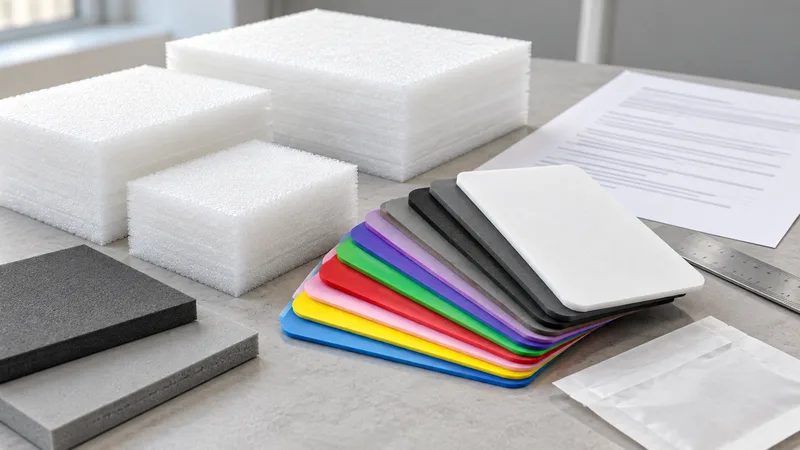
Foam material evidence connects a proposed material or component to the requirement a buyer needs to establish. A material name, catalogue range or sample photograph is not enough on its own. A useful request identifies the grade, construction, property, method and conditions that matter to the project. The response should show what the evidence covers and where its limits are. This makes the review more useful than collecting technical documents without a defined acceptance question.
The Green Foams company profile and material pages explain the supplied business and product scope. The knowledge base retains preliminary parameters with confirmation boundaries. Those records do not establish all values as verified production specifications. This guide helps prepare an evidence request for a specific application. It does not claim certification or assign a test result to an untested foam grade, and it keeps company identity evidence separate from material and component performance.
Begin with the requirement and its owner
Foam material evidence should answer a stated question. Identify what the component must do and who controls the requirement. A drawing dimension, material property, environmental exposure or regulatory condition may need a different document or evaluation. Explain the acceptance criteria if they are already established. If the requirement is provisional, label it and request review. This helps the supplier respond to an actual decision rather than infer a performance target from a broad application name.
Distinguish the material from the finished construction. A property measured on a material specimen may help select a grade, but the assembled component can introduce geometry, adhesive, inserts or contact conditions not covered by that specimen. Identify whether the request concerns raw foam, a converted part or the complete assembly. The evidence should match that scope. If the project needs both material data and component evaluation, keep them as related but separate requirements.
List exposure conditions only where they affect the decision. Temperature, contact media, cleaning or repeated handling may need a defined evaluation. Describe the configuration and conditions rather than requesting a universal statement that the material is suitable. If a requirement comes from a customer or controlled specification, provide the relevant reference. A supplier cannot establish applicability reliably when the governing condition is missing or when the intended use is described only in general terms.
- Name the requirement and the decision it supports.
- Identify whether it applies to the material, part or assembly.
- Provide the controlled method and acceptance criteria where available.
- Mark undecided conditions and assign responsibility for confirmation.
Ask for an identified grade and technical data sheet
A technical data sheet is most useful when it identifies the proposed material and explains the reported properties. Ask for the grade, document revision and scope of supply. Determine whether a value is typical, a specification limit or a project-specific result. These descriptions are not interchangeable. A preliminary range may support discussion but should not become an automatic acceptance limit. Request the method and tolerance needed to interpret the property relevant to your application.
Do not transfer parameters across material families. The EPDM Foam sealing discussion uses density and hardness as selection dimensions within its own scope, while the Rigid PU Foam review concerns insulation or structural tasks and different evidence questions. The fact that both are foams does not make their methods or values interchangeable. Identify the grade and application before asking which parameter should govern the component.
Keep the relationship between the document and the delivered material visible. Ask how the proposed supply will be identified and what records can link it to the approved reference. Do not assume every company uses the same traceability system or invent a batch protocol on its behalf. Describe the information your project needs and request confirmation of the available record. That discussion can clarify a practical evidence requirement without promising an unsupported inspection or reporting process.
| Evidence request | Information to identify | Decision supported |
|---|---|---|
| Data sheet | Grade, revision and value description | Material selection and specification review |
| Test report | Specimen, method and conditions | The property and scope actually evaluated |
| Certificate | Holder, product or activity and validity | The stated certification scope |
| Sample record | Construction, revision and review purpose | Observed fit or agreed functional checks |
| Outstanding work | Requirement, owner and evidence gap | What needs resolution before release |
Read a test report as a defined evaluation
Foam material evidence from a test report needs an identified specimen or part, method and conditions. Read the report for the actual property evaluated and the configuration used. Compare it with the proposed grade and construction. If the report covers another thickness, density, formulation or assembly, ask how it applies rather than silently assuming equivalence. A report can be valid within its own scope while failing to establish a different requirement for your project.
Identify the test method and version, along with any departures or qualifications recorded in the report. The ISO standards directory and ASTM International are references for discussing standards and methods. Their names do not prove that Green Foams has tested the proposed material or holds a certification. Ask for the applicable document and assess its relationship to the requirement your organization controls.
Look for the result and the acceptance basis separately. A reported measurement does not by itself establish pass or fail against an unspecified limit. Compare the result with the criterion relevant to your project and identify who is authorized to accept it. If the criterion is undecided, retain the report as selection information and resolve the requirement before release. This keeps useful data from being overstated as a final performance guarantee.
Match certificates and declarations to their scope
Certification evidence needs an identifiable holder, covered product or activity, scope and relevant validity. Compare those fields with the legal entity and supply route under discussion. A document naming another entity may require a relationship explanation, but it should not be treated as the supplier's own certification without that basis. Similarly, a document covering another product cannot be generalized into an approval for all foam families or all applications listed in a catalogue.
Ask what a declaration establishes and which material or product it covers. Some requirements depend on formulation, grade or intended use. A broad statement about environmental or regulatory status may be insufficient for a particular project. Request the applicable supporting record and scope rather than replacing it with an absolute phrase. If a document cannot be connected to the proposed supply, record the question as unresolved and avoid using it to support a claim.
Separate standards references, test reports and certificates in the review record. They may support different decisions and have different limitations. A standard defines a framework or method; a test report records an evaluation; a certificate covers the identified scope under its own conditions. The foam supplier profile review guide connects this evidence discussion to identity and manufacturing scope. Keeping the roles distinct helps prevent one document from being treated as proof of every requirement.
- Check the holder, product or activity and scope of the document.
- Compare validity and applicability with the proposed supply.
- Request clarification for entity, grade or product mismatches.
- Distinguish declarations, test reports and certificates in the record.
Define the evidence a sample can provide
Foam material evidence may include a sample review, but the sample needs a defined purpose. Identify its material, construction and drawing revision. Agree whether it supports a concept, fit or production-representative decision. A fit check can establish an observed interface in the tested assembly; it does not prove every material property or environmental condition. Record what the sample represents before interpreting its result, especially when the process or grade is still provisional.
If the sample is used for a functional evaluation, describe the configuration, conditions and acceptance criteria. Explain which questions the check can answer and which remain outside its scope. A sample may be useful for choosing between constructions without completing final qualification. Treat that as a valid intermediate outcome rather than forcing a complete approval. The evidence plan can then identify the remaining documents or evaluations needed for the intended production requirement.
Record changes after the evaluation and ask whether the evidence transfers to them. A different outline, material, thickness, adhesive or interface may change the relationship between the sample and the intended component. Do not assume earlier results apply automatically. Keep the sample record and controlled references together so a later reviewer can understand the decision. This makes the evidence useful for development, production discussion and future revisions.
Turn missing evidence into a practical next step
A missing document should lead to a specific question rather than a vague request for all certifications. Identify the requirement, the proposed grade or component and the record needed to establish it. Ask whether applicable evidence exists, whether another evaluation is needed or whether a different route should be considered. Keep the status visible. Uncertainty is part of the project review and should not be concealed by a general claim that the material is suitable.
Prioritize evidence that affects material choice, geometry or the ability to release the component. Other information may support company qualification or commercial review. Explain these roles so the request can be answered coherently. The available sources do not establish universal test capabilities, third-party arrangements or review times. Confirm what can be provided for the specific project and avoid assigning an unsupported schedule or process to the supplier.
- Identify the requirement and applicable material or component.
- Review the scope of existing data, reports and certificates.
- Record the evidence gap and the decision it blocks.
- Agree the next review or evaluation before making a release decision.
Preserve foam material evidence in a controlled project record alongside the drawing, proposed grade and approval decisions. The record should state what each document establishes and what it does not cover. When the part or use conditions change, revisit applicability instead of relying on an earlier conclusion by default. A useful evidence request creates a traceable basis for discussion and acceptance, without turning preliminary parameters or unrelated documents into production claims.